
If you’ve spent more than five minutes in the cryptocurrency space this year, you already know the vibe. The market is moving faster than ever, institutional money is flowing in through ETFs, and AI-driven bots are executing trades in milliseconds. It feels like everyone is getting rich overnight, right? Wrong.
Behind the flashy screenshots of massive gains on social media lies a graveyard of wrecked portfolios. Why? Because human psychology hasn’t evolved as fast as blockchain technology. Despite the wealth of information available in 2026, new investors are falling into the exact same traps they did in 2021 and 2017.
Making a single trading mistake won’t necessarily end your career, but repeating them will drain your account down to zero. In this guide, we are pulling back the curtain on the crypto trading mistakes that are destroying beginner portfolios right now, and exactly how you can dodge them.
Key Takeaways:
- Chasing the Pump (FOMO): Buying an asset after it has already surged 200%.
- Trading Without a Stop-Loss: Letting a tiny, manageable loss turn into a total portfolio liquidation.
- Over-Leveraging: Using 50x to 100x margin without understanding the mathematical risk of a tiny price swing.
- Revenge Trading: Trying to instantly win back lost money while emotional.
- Blind Trust in AI Bots: Letting unregulated automated software manage your money without oversight.
1. The Trap of FOMO in a 24/7 Market
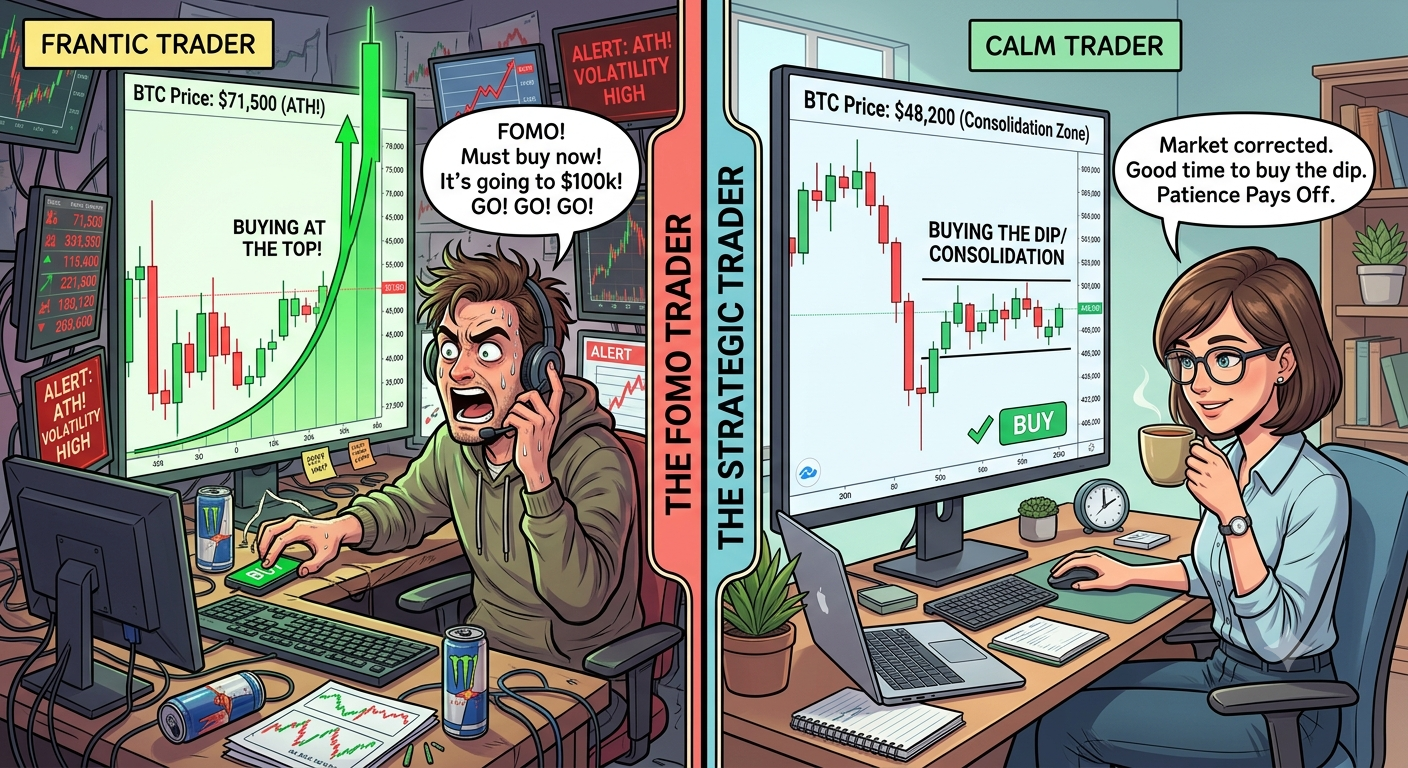
Fear Of Missing Out (FOMO) is easily the king of common trading mistakes. It’s that knot in your stomach when you open X (formerly Twitter) and see a random meme coin or Layer-2 token rocketing up 400% in a few hours. Your brain screams, “If I just put in $1,000 right now, I can double it by dinner!”
So, you buy in. And almost immediately, the price plummets.
You didn’t buy the breakout; you bought the exit liquidity of the smart money that got in weeks ago. By the time a massive pump makes it to mainstream crypto feeds, the move is usually over. Here is a guide on How to Spot Memecoin Gems Early.
How to Fix It
Stop looking at the 1-minute and 5-minute charts when a coin is pumping. Zoom out to the 4-hour or daily chart. Has it already gone parabolic? If yes, walk away. The market will always offer another setup tomorrow. Patience is a skill you have to actively practice, and failing to wait for the trade to come to you is a massive mistake in trading.
2. Ignoring Risk Management
If there is one section of this article you take to heart, make it this one. You can have a win rate of 30% and still be a highly profitable trader, provided your risk management is tight. Conversely, you can have an 80% win rate and lose everything in a single afternoon.
The most catastrophic of all trading mistakes is trading without a defined stop-loss.
Beginners often say, “I don’t want to use a stop-loss because the market always dips, triggers my stop, and then goes back up.” Yes, that happens. But the alternative is waking up to find that a “small dip” was actually the start of a 60% market crash, and your capital is trapped for the next three years.
The 1% Rule
Professional traders rarely risk more than 1% to 2% of their total trading capital on a single trade. If you have a $10,000 portfolio, your maximum accepted loss on a trade should be $100. This doesn’t mean you only buy $100 worth of crypto; it means you set your stop-loss at a price where, if hit, your portfolio only shrinks by $100.
Table: Beginner vs. Professional Risk Mindset
| Metric | The Beginner’s Approach (Guaranteed to Lose) | The Professional’s Approach (Sustainable) |
| Position Sizing | Bets 50% of portfolio on a “sure thing.” | Bets based on a strict 1% risk model. |
| Stop-Loss | “Mental stop loss” (never actually executes it). | Hard-coded stop-loss placed upon entry. |
| Take Profit | Holds forever hoping for a 100x return. | Takes partial profits at logical resistance zones. |
| Leverage | 50x on a whim to get rich quick. | 2x-5x, only used to optimize capital efficiency. |
3. Over-Relying on “Black Box” AI Trading Bots
Welcome to 2026, where every crypto influencer is peddling an “unbeatable AI trading algorithm.”
Artificial intelligence has genuinely revolutionized market analysis. However, a modern trading mistake is blindly plugging your API keys into a random Telegram bot or third-party web app and letting it trade your funds on autopilot.
Markets change regimes. A bot trained to crush a trending bull market will get absolutely demolished in a choppy, sideways bear market. If you don’t know the parameters of how the AI is making decisions, you aren’t trading—you’re gambling in the dark.
The Fix: Use AI for analysis, not blind execution. Let algorithms scan for volume anomalies, RSI divergences, or on-chain data spikes, but keep the actual buy/sell decision in your own human hands.
4. The Venom of Revenge Trading
We’ve all been there. You take a perfectly logical trade. It looks great. Suddenly, Elon Musk tweets something, the Federal Reserve changes an interest rate, or a whale dumps a massive bag. Your stop-loss gets smashed. You lost $500.
Your blood boils. You feel like the market specifically targeted you. So, to “get it back,” you immediately open a new trade with double the size and double the leverage, completely ignoring your strategy.
This is revenge trading, and it is the fastest way to liquidate your account. When you trade out of anger, your logic shuts down. You are no longer reading the chart; you are letting your ego drive the car.
How to Break the Cycle
When you take a meaningful loss, stand up and walk away from your desk. Close the app on your phone. Implement a strict “cool down” rule: after a loss, you are not allowed to place another trade for at least 24 hours. The market will still be there tomorrow. Eliminating emotional reactions is one of the most vital trading mistakes to avoid.
5. Poor Portfolio Diversification
Diversification doesn’t mean owning Bitcoin, Ethereum, and 15 different dog-themed meme coins. Because when Bitcoin sneezes, the altcoin market catches a severe cold. If all your capital is tied up in highly volatile micro-cap tokens, your portfolio’s value will swing violently, making it impossible to sleep at night.
One of the most common trading mistakes is failing to understand correlation.
In 2026, a well-structured crypto trading portfolio should look like a pyramid:
- The Base (50-60%): Large caps like Bitcoin (BTC) and Ethereum (ETH). These are your anchors.
- The Middle (30-40%): Mid-cap tokens with actual utility, strong developer activity, and revenue generation (e.g., strong Layer 1s and Layer 2s, established DeFi protocols, solid AI-infrastructure tokens).
- The Tip (5-10%): The “moonbag.” This is your purely speculative capital for meme coins, brand new launches, and high-risk/high-reward plays.
If your pyramid is inverted—where 60% of your money is in a coin that was launched last Tuesday—you are a ticking time bomb.
6. Over-Trading and Boredom Sickness
Crypto exchanges run 24 hours a day, 7 days a week, 365 days a year. There is always a chart blinking. There is always a token pumping somewhere.
Because of this constant availability, beginners feel like they must be in a trade at all times to make money. This leads to forcing trades in dead markets. Sometimes, the market is just moving sideways, chopping up both buyers and sellers.
As a trader, “cash” (or stablecoins) is a perfectly valid position. Sitting on your hands and protecting your capital while waiting for a high-probability A+ setup is a skill. Trading out of boredom is a massive trading mistake. If you find yourself opening 10-15 trades a day just to feel the thrill of the market, you aren’t trading; you have a dopamine addiction.
7. Neglecting Basic Security: Not Your Keys, Not Your Coins
It blows my mind that in 2026, after the catastrophic exchange collapses we’ve witnessed over the last few years, people still leave their entire life savings on centralized exchanges.
Exchanges are for trading. They are not banks. If you need a quick swap of BTC to XMR, just use Swapgate. We never hold your funds hostage.
If you leave $50,000 on an exchange because it’s “convenient,” you are risking 100% of that capital to hacks, regulatory crackdowns, or company insolvency.
The Golden Rule: Keep your active trading capital (the money you need liquid to execute trades) on the exchange. Move your long-term hold investments to a cold storage hardware wallet. Ignoring basic digital hygiene is arguably the saddest mistake in trading, because losing money to a bad trade is a learning experience; losing money to a hack is just a tragedy.
Actionable Steps: How to Recover From a Major Mistake
Let’s be real. If you are reading this, there is a good chance you just made a massive error and you are looking for answers. First, take a deep breath. Every single profitable trader you follow on YouTube or X has blown up an account at some point. It is the tuition fee for learning the market.
Here is your recovery plan:
- Stop Trading Immediately: Do not try to win it back today.
- Analyze the Failure: Open a trading journal (or a simple text document). Write down exactly what went wrong. Did you ignore your stop-loss? Did you use 50x leverage? Be brutally honest with yourself.
- Refine Your Strategy: Paper trade (trade with fake money) for two weeks. Rebuild your confidence without risking capital.
- Scale Down: When you return to live trading, cut your usual position size in half until you put together a winning streak.
Final Thoughts
The cryptocurrency market is an incredible wealth-building machine, but it is also brutally unforgiving to the undisciplined. By recognizing these crypto trading mistakes and actively working to eliminate them from your routine, you automatically put yourself ahead of 90% of retail investors.
Remember: The goal of your first year in crypto trading isn’t to buy a Lamborghini. The goal is simply to survive, protect your capital, and learn the mechanics of the market. Ditch the FOMO, respect the stop-loss, and trade smart.
Frequently Asked Questions
What are the biggest crypto trading mistakes to avoid?
The biggest mistakes include trading without a stop-loss, succumbing to FOMO (Fear Of Missing Out) by buying at the top of a rally, over-leveraging your positions, and revenge trading out of emotion. Mastering risk management is the key to surviving the crypto market.
Is it a trading mistake to hold crypto on an exchange?
Yes, leaving long-term investments on a centralized exchange is highly risky. While you need funds on an exchange for active daily trading, your long-term holdings should be stored in a cold hardware wallet to protect against hacks and company bankruptcies.
Can I recover my portfolio after making a massive trading mistake?
Absolutely. The best course of action is to stop trading immediately to prevent emotional “revenge trading.” Take time to analyze what went wrong, adjust your risk parameters, and slowly scale back into the market using much smaller position sizes until your confidence and strategy align.
Why do I keep losing money in crypto trading?
Most beginners lose money because they lack a documented trading plan. If you are entering trades based on social media hype, gut feelings, or boredom, rather than waiting for technical or fundamental setups, you are gambling. Consistency requires a strict, rules-based approach.