
If you are asking which meme coin will reach $1, or searching for the next crypto to hit $1 or the next crypto to hit $1 dollar, the most important thing to understand is this: price targets are not about vibes alone. They are about supply. In March 2026, Dogecoin is trading around $0.10 with about 150 billion coins in circulation, while Shiba Inu is still priced in tiny fractions of a cent with a supply near 590 trillion. That means a $1 DOGE would imply roughly a $150 billion market cap, while $1 SHIB would imply something closer to $590 trillion. Those are not remotely the same bet.
That is why traders still chase meme coins that will explode, the next meme coin to explode, the best new meme coins, and every new crypto under $1 or crypto under $1 that will explode. March 2026 sentiment has clearly improved from the lows: WIF is up about 10.5% over the past week, POPCAT about 8.1%, PNUT about 10.0%, SHIB about 9.0%, and Base meme coin BRETT about 12.2%, which shows that risk appetite has returned even if it is selective.
But low price does not automatically reveal the best meme coin, the best meme coin to buy, or the best meme coins to buy. To answer that, you need to look at market cap, liquidity, community strength, and whether the token’s supply makes a $1 target plausible at all.
The $1 Milestone: Why This Psychological Barrier Matters
The “Unit Bias” Effect: Why Investors Love Sub-Dollar Tokens
Sub-dollar coins feel cheap, even when they are not. That is the emotional engine behind many meme rallies. A trader can buy thousands or millions of units and imagine that “just” getting to $1 will change everything. This is why top meme coins and even many names outside the top 10 meme coins attract outsized attention when they trade below one dollar.
The problem is that unit bias hides the real question. A token with a 1 billion supply and a token with a 590 trillion supply can both trade under a penny, but the path to $1 is completely different. Serious investors should think in market cap first and token price second.
Market Cap vs. Token Price: The “Reality Check” Calculator
Here is the simple formula that cuts through hype:
Token Price = Market Cap / Circulating Supply
So if you want to know whether a meme coin can hit $1, calculate the market cap it would need at that price. That is where most moon-boy narratives collapse.
| Meme Coin | Current Price | Required Gain to Reach $1 | Required Market Cap at $1 |
| Dogecoin (DOGE) | $0.1007 | 893% | $150 billion |
| dogwifhat (WIF) | $0.1882 | 431% | $1 billion |
| FLOKI | $0.00003155 | 3,169,472% | $9.7 trillion |
| Shiba Inu (SHIB) | $0.00000588 | 17,015,384% | $590 trillion |
| Pepe (PEPE) | $0.00000380 | 26,315,689% | $420 trillion |
This table uses March 2026 circulating-supply snapshots from CoinGecko and the standard price-to-market-cap formula. The exact percentages will move with price, but the bigger message will not: WIF is mathematically difficult but possible, DOGE is hard but still within the realm of a monster cycle, while SHIB, PEPE, and FLOKI are nowhere near realistic $1 candidates under their current supply structures.
Lessons from the Past: How Dogecoin Changed the Meme Economy
Dogecoin changed the whole meme economy because it proved that a joke coin could become a large-cap asset with real liquidity, exchange depth, and cultural staying power. Today it still carries a multibillion-dollar market cap and daily trading activity that dwarfs most smaller meme projects, which is why every new meme token is compared with DOGE sooner or later.
Top Contenders for the $1 Mark in 2026
Dogecoin (DOGE): The Path Back to the All-Time High and Beyond
Source: Coingecko
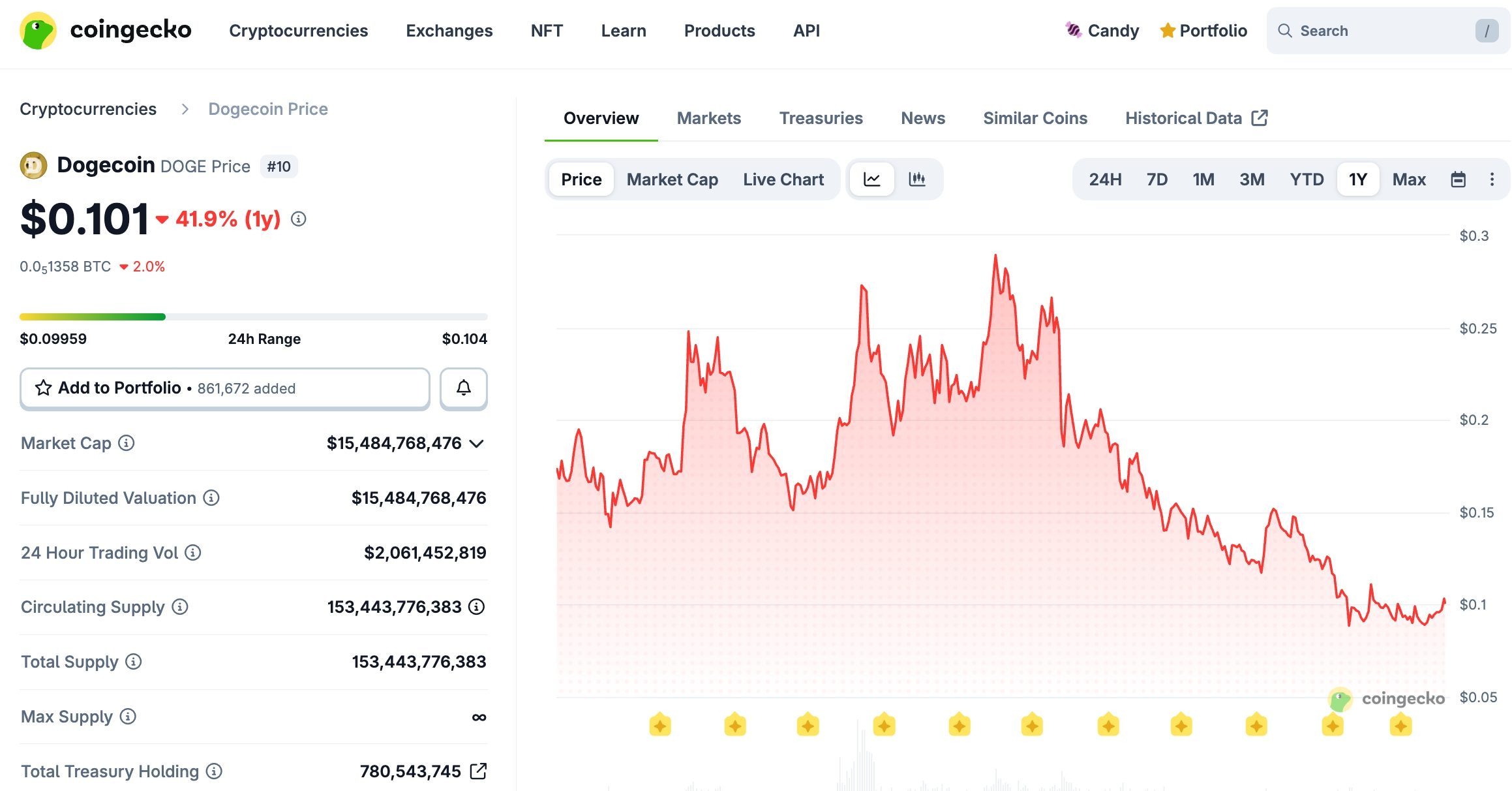
When people ask will Dogecoin hit $1, they are asking the most reasonable $1 question in the meme sector. DOGE is trading around $0.10, so it “only” needs about a 9x move from here, and its brand recognition is still unmatched in meme coin land. The catch is that $1 DOGE would mean roughly a $150 billion market cap, so this is not a casual move; it would require a broad crypto bull market, strong retail participation, and likely another wave of social-media-fueled mainstream attention.
Dogwifhat (WIF): Analyzing the Momentum of the Solana “Hat” Community
Source: Coingecko
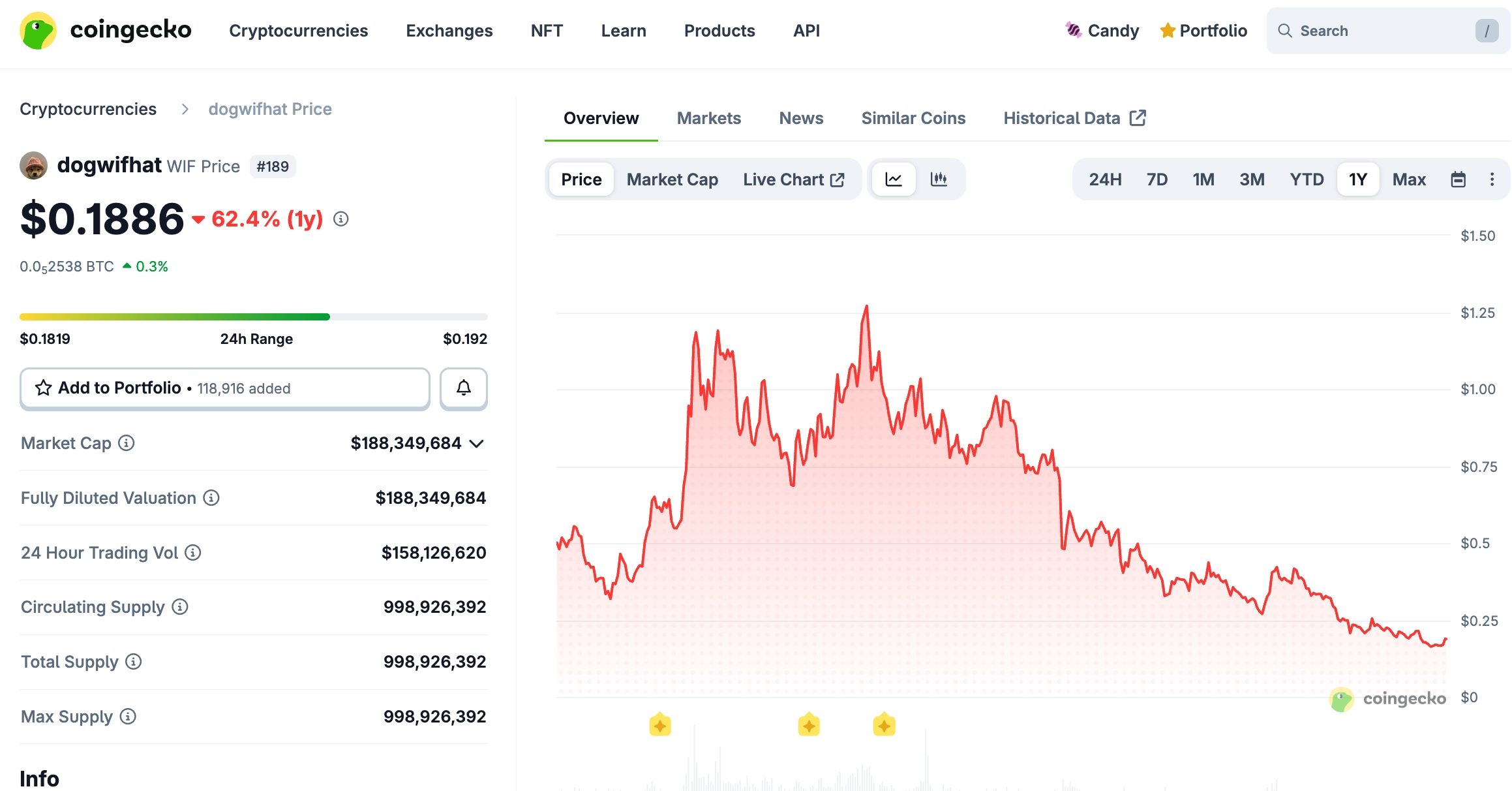
WIF is one of the cleanest $1 stories on pure supply math. With about 1 billion tokens in circulation and a March 2026 price near $0.188, a $1 target would imply about a $1 billion market cap. That is still ambitious, but it is vastly more realistic than trillion-dollar meme fantasies. Add the fact that WIF has recovered about 10.5% over the past week, and you can see why it stays near the top of every serious shortlist for the next crypto to hit $1.
Popcat and the Cat-Meme Meta: Can Feline Tokens Break the $1 Ceiling?
Source: Coingecko
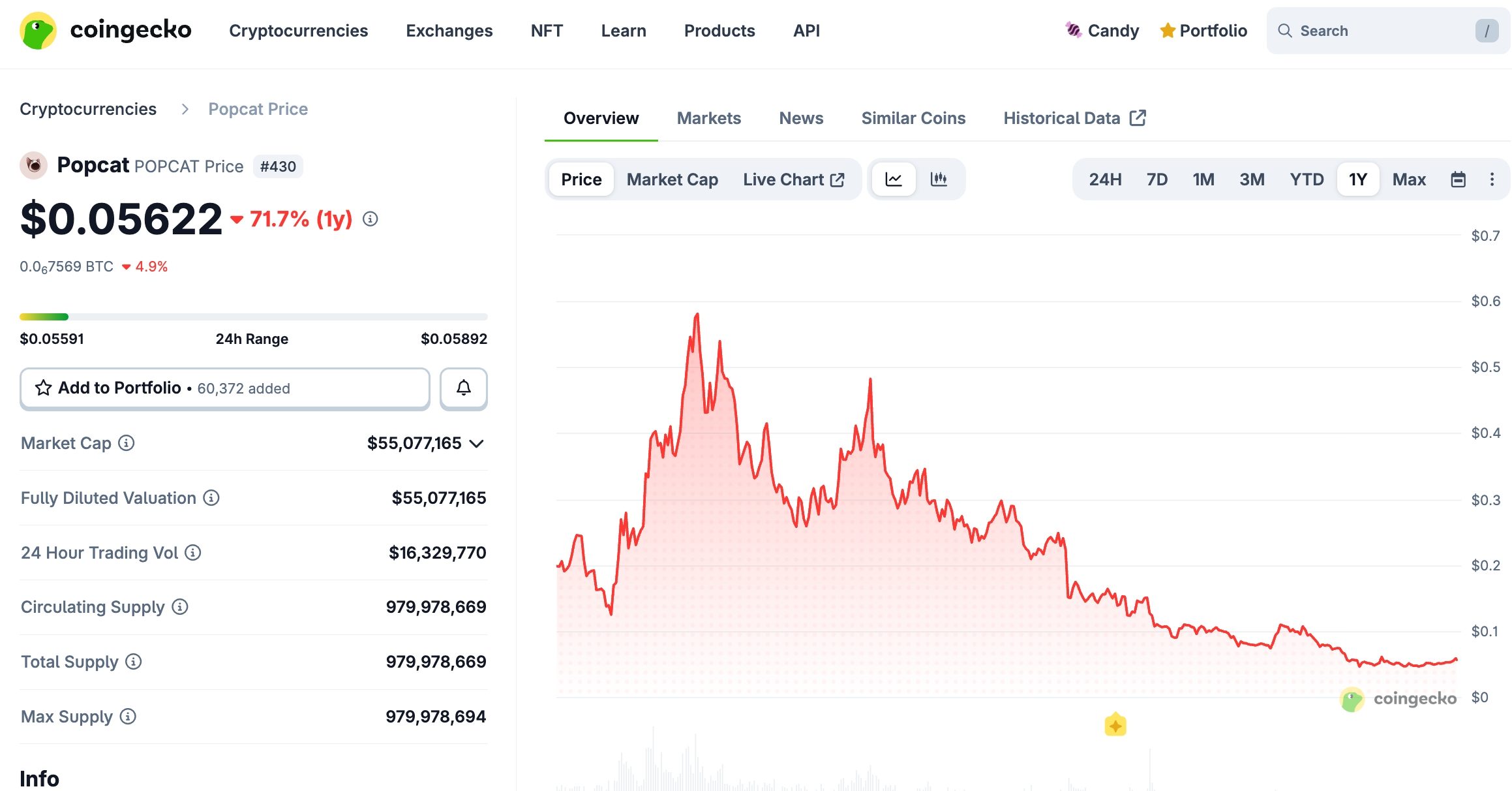
POPCAT is even more interesting than many investors realize. Its circulating supply is about 980 million, so $1 POPCAT would imply a market cap of roughly $980 million. With a current price around $0.056 and a recent weekly gain of about 8.1%, the cat-meme thesis is still alive. Among smaller-cap meme names, POPCAT has one of the most realistic supply structures for a dollar target, even if it still needs a huge 1,600%+ move.
Pnut (Peanut the Squirrel): The Political Meme Legacy
Source: Coingecko
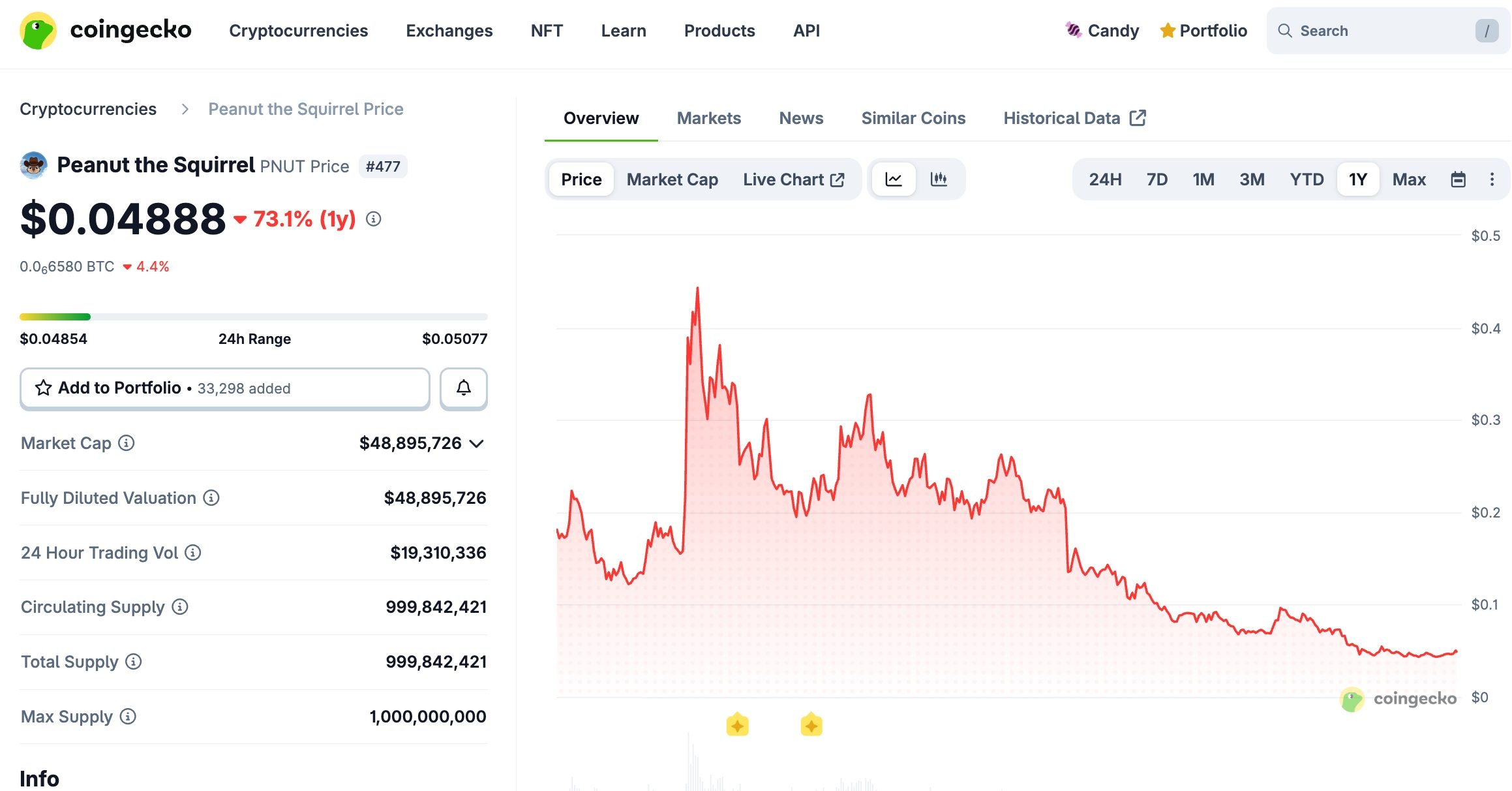
PNUT sits in a similar mathematical zone to WIF: about 1 billion tokens, a price near $0.049, and a required market cap of roughly $1 billion at $1. That makes it easier to model than mega-supply names. The reason it remains speculative is not the supply math, but narrative durability. PNUT can attract attention quickly, especially when the market tilts toward cultural or political memes, but sustaining a move all the way to $1 would require a much deeper community base than a short-lived viral cycle.
Meme Coins That Are Actually Building Tech
Shiba Inu (SHIB) & Shibarium: Transforming into a Privacy-First Layer-2
The phrase Shiba Inu coin $1 keeps ranking in search, but the math is brutal. SHIB’s ecosystem is undeniably more advanced than it used to be: the official Shib operating-system pages now describe an FHE-powered Shibarium with 800 million-plus transactions and more than 2 million wallets, and official Shib news says advanced FHE privacy features are coming to all Shiba Inu ecosystem tokens. That is real infrastructure, not just memes. But even with all of that, roughly 590 trillion SHIB in circulation means $1 would imply a market cap around $590 trillion. At roughly today’s multibillion-dollar valuation, SHIB would need a supply reduction of more than 99.999% to make a $1 price even vaguely comparable to its current scale.
Floki (FLOKI): From Meme to TokenFi and Educational Infrastructure
FLOKI is one of the better examples of a meme project trying to build an actual ecosystem. The official site highlights utilities including DeFi tools, NFTs, and a crypto education platform, while Floki’s documentation describes the University of Floki and the wider TokenFi push. That helps FLOKI stand out on branding and narrative. But price feasibility is still a separate issue: with about 9.7 trillion FLOKI in circulation and a price around $0.00003155, a $1 target would require something like a $9.7 trillion market cap. Utility can improve resilience, but it does not magically erase supply.
Pepe (PEPE): Can Culture Alone Sustain a Multibillion-Dollar Valuation?
PEPE proves that culture can support a multibillion-dollar meme asset for a long time. As of March 2026, it is still carrying a market cap around $1.6 billion. But the supply problem is massive: CoinGecko and CoinMarketCap both put its circulating supply in the 400-trillion range. That means $1 PEPE would imply a market cap around $420 trillion. So yes, PEPE can stay relevant, and yes, it can rally hard in the right market, but no serious analysis should treat $1 as a realistic near-term target under the current token structure.
The “New Wave” Moonshots: Identifying the Next $1 Breakout
AI-Generated Memes: The Intersection of LLMs and Degenerate Trading
AI will probably create faster meme cycles, more content, and quicker narrative spread. That matters for discovery, but it does not change token math. AI can help a small-supply meme coin get noticed; it cannot make a 590-trillion-supply asset suddenly fit a $1 thesis.
PolitiFi Tokens: The Impact of Election Cycles on Meme Volatility
PolitiFi-style trading thrives on attention shocks, not long-term fundamentals. That can create explosive upside for the right coin at the right moment, which is part of why PNUT stays on watchlists. But attention-driven rallies also fade fast, so these are usually better viewed as volatility plays than clean long-term $1 setups.
Base Ecosystem Memes: Leveraging Coinbase’s Retail On-Ramp
Base memes were barely part of the mainstream meme-coin conversation in older cycle guides, but they matter more in March 2026. BRETT is trading around $0.008 with about 9.9 billion tokens in circulation and is up roughly 12.2% over the past week. A $1 BRETT would still require a heavy lift, around a $9.9 billion market cap, but that is at least a believable large-cap meme outcome, not a fantasy trillion-dollar scenario. This is why traders hunting the best new meme coins keep scanning Base.
How to Identify a Meme Coin with “$1 Potential” Early
Liquidity Analysis
Liquidity is the first filter after supply. Dogecoin’s 24-hour volume is measured in the billions, while WIF trades in the hundreds of millions and smaller names like POPCAT and BRETT are far thinner. A token can look exciting on a chart, but if the order book is shallow, the path to $1 becomes much harder because every large buyer moves the market too much.
Community Sentiment Tracking
The smartest way to track meme coins now is to watch whether price, trading volume, and social velocity are all moving together. A one-day spike in mentions is not enough. What you want is a coin that keeps gaining attention while also holding liquidity and exchange support. That is the difference between a weekend pump and a real cycle leader.
Developer Transparency: Avoiding Rug Pulls
The safer meme bets are usually the ones with visible teams, public documentation, real ecosystem updates, and a product roadmap you can actually inspect. That does not guarantee returns, but it lowers the odds that you are buying into a hollow narrative. In practice, projects like SHIB and FLOKI score better here than anonymous one-week wonders. Read more on How to spot memecoins early.
The Verdict on the Next $1 Meme Coin
So, which meme coin will reach $1 first? On pure math, WIF and POPCAT have the cleanest path. DOGE remains the biggest-brand candidate and the one most likely to make a $1 run if the entire market goes risk-on. PNUT is a speculative outsider with workable supply but a weaker long-term moat. SHIB, PEPE, and FLOKI are not serious $1 candidates under their current supply structures unless something drastic changes, such as an extraordinary burn or a complete token-model reset.
That is the honest 2026 answer. If you are sorting through meme coins to buy, do not start with the cheapest sticker price. Start with supply, market cap, liquidity, and whether the coin can stay culturally relevant long enough to justify a higher valuation.
FAQ
Will Shiba Inu reach $1 in 2026?
No. With roughly 590 trillion SHIB in circulation, a $1 SHIB price would imply a market cap around $590 trillion. At roughly today’s market cap, that would require a burn of more than 99.999% of supply to make the math remotely plausible.
Which meme coin has the smallest supply?
Among the coins discussed here, POPCAT has the smallest circulating supply at about 980 million, while WIF and PNUT sit at roughly 1 billion each. That is why those three look far more realistic for a $1 target than SHIB, PEPE, or FLOKI.
Does a coin need utility to reach $1?
No. Dogecoin shows that brand, liquidity, and community can be enough to push a meme coin into the large-cap tier. But utility can help a token defend its valuation between hype cycles, which is why SHIB and FLOKI keep leaning into infrastructure, education, and privacy-focused ecosystem upgrades.
Is it too late to buy Dogecoin for a $1 target?
Not necessarily, but the hurdle is large. At around $0.10, DOGE still needs roughly an 893% move to reach $1, and that would imply a market cap near $150 billion. That is possible only in a very strong market, so investors should treat it as a high-upside but high-expectation scenario, not an easy win.