
If you have been trying to understand MimbleWimble, the easiest way to think about it is this: it is a blockchain design that makes privacy and efficiency happen at the same time. Instead of publishing reusable addresses and permanently storing every spent output forever, it hides amounts with Confidential Transactions and lets the chain merge and prune transaction history through a mechanism called cut-through.
That combination is why Mimble Wimble keeps showing up in serious privacy discussions even years after its original proposal. It is not just another “privacy coin feature.” It is a different way of structuring a blockchain so that less data has to live forever, while outsiders still cannot easily reconstruct who paid whom or how much.
Source: Coinmarketcap
In 2026, the most relevant ways to study MimbleWimble coin design are through three live ecosystems: MWC, Grin, and Beam, plus the very important Litecoin Mimblewimble experiment through MWEB. Each one reflects a different philosophy: hard-money scarcity, cypherpunk fairness, enterprise-friendly privacy, and opt-in mainstream adoption.
The Core Philosophy
The Problem with Traditional Blockchains: Bloat and Transparency
Traditional blockchains like Bitcoin make a trade-off: they are easy to audit, but they are also very transparent and increasingly heavy. Every transaction leaves behind a persistent trail of inputs, outputs, and addresses, which means the ledger grows indefinitely and chain analysis becomes easier over time. Even today, Bitcoin’s blockchain size is above 724 GB, which gives you a sense of how expensive permanent data retention becomes at scale.
That transparency is useful for verification, but it also creates two long-term problems. First, users lose financial privacy because transaction history can be traced and clustered. Second, the system keeps carrying spent history long after it stops being economically useful.
How MimbleWimble Redefines the Blockchain: No Addresses, No Amounts
MimbleWimble changes the model by removing traditional addresses from the chain and replacing visible amounts with Pedersen commitments and range-proof logic. In the MimbleWimble design analyzed by cryptography researchers, the chain does not need a standard address book like Bitcoin’s UTXO history because ownership is expressed cryptographically rather than through a publicly indexed recipient field.
That is why the protocol feels so different when you first study it. A MimbleWimble chain is not just “Bitcoin with better privacy.” It is a ledger where the visible surface area is smaller by design, because much of what other blockchains expose publicly is either hidden or unnecessary.
Privacy as a Side Effect of Efficiency: The “Cut-Through” Mechanism
The single most important concept in MimbleWimble is cut-through. Grin’s official documentation explains it very intuitively: if Alice pays Bob and Bob immediately pays Carol, the intermediate spent output can effectively disappear from the permanent chain view, because only the unspent result and the transaction kernel need to remain.
That means the blockchain can safely discard a large portion of spent transaction data while keeping public verifiability intact. The same Grin documentation says that, asymptotically, a MimbleWimble chain grows at roughly one quarter the rate of Bitcoin, and that only the kernel of a transaction has a lasting footprint of about 100 bytes.
This is the “expertise” core of the protocol. MimbleWimble is private partly because it hides transaction details, but it is also efficient because it treats spent intermediate history as removable clutter rather than sacred permanent state.
How the MimbleWimble Magic Works
Confidential Transactions: Blinding Factors and Range Proofs
At the heart of MimbleWimble are Confidential Transactions, which use Pedersen commitments to hide amounts while still allowing the network to verify that inputs equal outputs plus fees. The Grin docs and the academic MimbleWimble paper both explain the key idea: nodes do not need to see the amounts directly if the cryptography proves that no coins were created out of thin air.
That is where blinding factors matter. A transaction amount is combined with a secret blinding value inside a commitment, so observers cannot read the amount, but validators can still verify balance relations algebraically. Range proofs then prove that hidden values are non-negative and sane, which prevents inflation attacks through malformed commitments.
CoinJoin Integration: Why Every Transaction is Mixed by Default
One underrated property of MimbleWimble is that transaction aggregation behaves a lot like built-in CoinJoin. Litecoin’s MWEB explainer explicitly describes MimbleWimble as using confidential transactions with native CoinJoin-style mixing, while the original academic analysis also notes its non-interactive transaction merging.
This is why MimbleWimble’s privacy is structurally different from “optional mixer” systems. Instead of asking users to manually join coin-mixing sessions, the chain itself encourages aggregation and merging as part of normal operation. That makes privacy less dependent on special behavior and more like a protocol property.
How MimbleWimble Stays Lean While Others Grow
Source: MWC Blog
Because spent outputs can be removed after cut-through, MimbleWimble chains can prune much more aggressively than Bitcoin-like ledgers. Grin’s docs say that only the kernels and unspent outputs need to persist, while the academic paper emphasizes that this yields “tremendous space savings” and faster validation for new nodes.
A useful comparison for blockchain size per 1 million transactions looks like this:
| Network | Rough retained data per 1M tx | Why |
| Bitcoin | ~300–500 MB | Typical transactions remain permanently visible; full input/output history is retained |
| Monero | ~1.4–2.0 GB | Privacy data is heavier because RingCT/range proofs stay on-chain |
| MimbleWimble | ~100–125 MB asymptotically | Kernels remain, but many spent intermediate outputs are cut through |
This table combines Grin’s “~100 bytes per lasting kernel” and “~one quarter Bitcoin growth” guidance with widely cited Monero transaction-size estimates from Monero StackExchange and Zero to Monero. These are rough design-level comparisons, not exact chain snapshots.
MimbleWimble in Action: MWC, Beam, and Grin
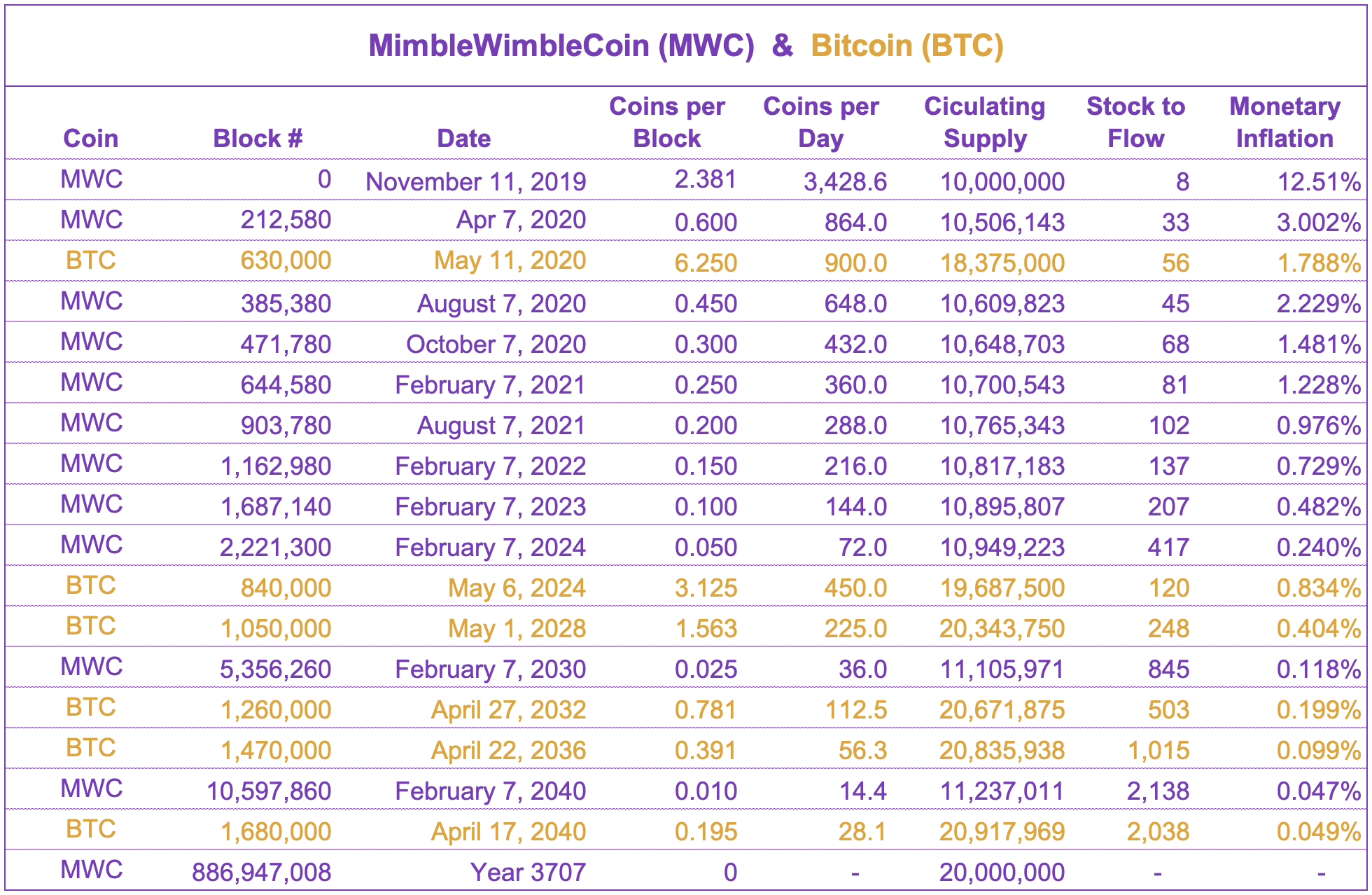
MimbleWimbleCoin (MWC): The “Superior Store of Value”
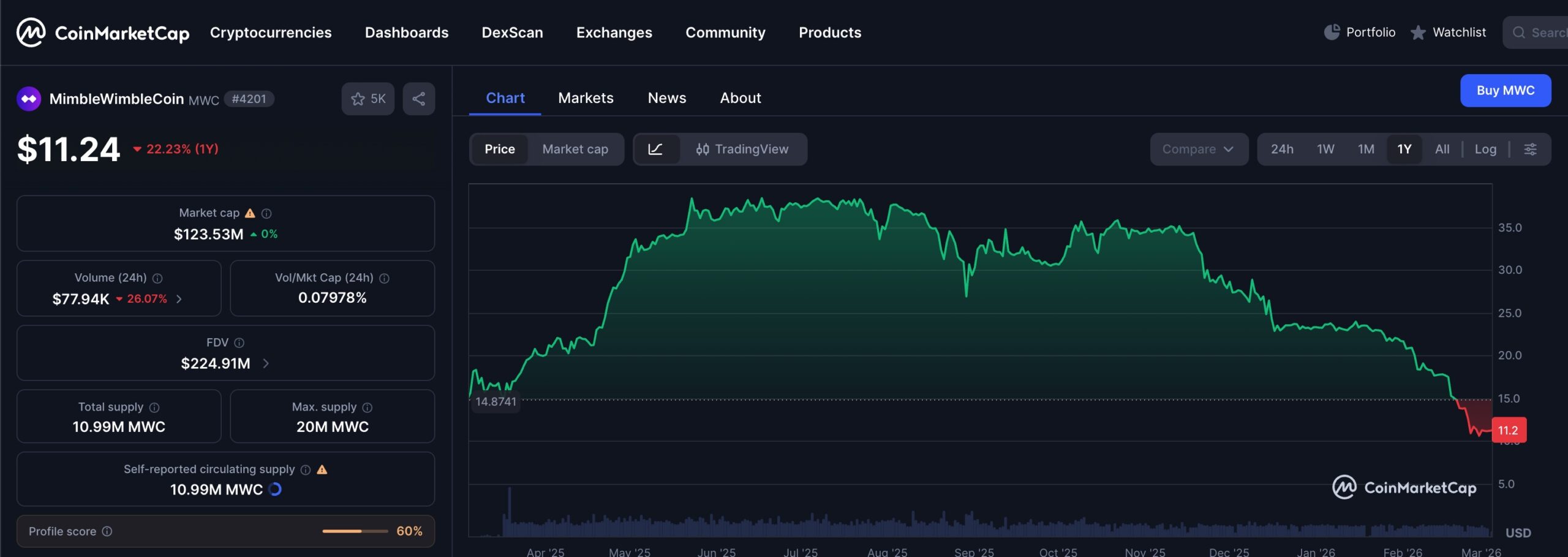
MWC is the most explicitly hard-money interpretation of MimbleWimble. Its CoinMarketCap page lists a self-reported circulating supply around 10.99 million, a max supply of 20 million, and a market price around $11 in early March 2026. Meanwhile, MWC’s own “Good Money” page argues that it was designed to maximize scarcity and stock-to-flow, and it explicitly frames MWC coin as a superior store-of-value candidate rather than a medium-first currency.
That same MWC material also references the historical HODL program and airdrop allocations from genesis, which helps explain why long-time holders often talk about MWC price in store-of-value language rather than payments language. Whether you agree with the thesis or not, MWC is the most openly scarcity-focused MimbleWimble project.
Grin: The Purest Implementation of Cypherpunk Ideals
Grin represents the opposite philosophy. Its official emission docs say new GRIN is emitted every second, forever, producing a linear monetary policy with declining inflation over time rather than a hard cap. After 10 years, the supply inflation rate falls below 10%, and after 20 years below 5%, but the chain never stops issuing.
That makes Grin intellectually clean and ideologically consistent, but not especially friendly to “number go up” investors. If MWC coin is the capped-supply MimbleWimble asset, Grin is the cypherpunk experiment that prioritizes fair distribution and long-term security spend.
Beam: Balancing Privacy with Corporate Compliance and Usability
Beam took a more productized path. Its official documentation emphasizes confidential transactions, self-sovereign accounts, and—crucially—opt-in auditability. Beam says users can create an auditing key pair so an auditor can view full transaction details with consent, while still being unable to spend funds.
That makes Beam relevant in regulatory and business discussions because it directly addresses the classic compliance objection: “If everything is private, how can a company prove its books?” Beam’s answer is that privacy and voluntary auditability can coexist.
The Litecoin Integration
The MimbleWimble Extension Block (MWEB) Upgrade
The biggest mainstream milestone for Litecoin Mimblewimble was MWEB, short for MimbleWimble Extension Blocks. Litecoin’s own learning-center article explains that MWEB adds a parallel private blockchain secured by Litecoin’s miners, with users “pegging in” from the transparent base layer and “pegging out” back to it.
What matters here is the structure: MWEB did not replace Litecoin’s transparent chain. It added an optional extension block where users could get confidential transfers and cut-through style efficiency while preserving compatibility with Litecoin’s original base layer.
How Litecoin Navigates Exchange Listings and Regulations
This opt-in design was deliberate. Elliptic argued in 2022 that regulated firms could still support Litecoin after MWEB, because privacy exposure could be screened and managed with analytics and policy controls. That was the compliance-friendly argument.
But the market also showed the limits of that compromise. The Block reported that major South Korean exchanges delisted Litecoin because of its new privacy features, and Binance later said it would not support Litecoin transactions that used MWEB directly. In other words, MWEB was a technical turning point, but also a regulatory stress test.
Has MWEB Improved Litecoin’s Market Position?
By March 2026, Litecoin still sits around $55.78 with a market cap around $4.29 billion, which suggests MWEB did not single-handedly transform Litecoin into a top-tier growth story. But it also clearly did not destroy Litecoin’s relevance: Litecoin remains liquid, widely traded, and officially continues to promote MWEB adoption through node and wallet upgrades like Litecoin Core v0.21.3.
So the fairest 2026 conclusion is mixed: MWEB improved Litecoin’s technical privacy and fungibility story, but its market impact has been incremental rather than revolutionary. It made Litecoin more interesting, not unstoppable.
Privacy Protocols in a 2026 Compliance World
MimbleWimble vs. The “Privacy Coin” Ban Narrative
The phrase “privacy coin ban” is often too blunt to be useful. What actually happens in practice is more selective: some exchanges delist, some jurisdictions overreact, and some institutions adopt better screening tools instead. The Litecoin MWEB episode illustrates this perfectly, with Elliptic taking the “manageable with controls” position while Korean exchanges moved in the opposite direction.
Auditability Features: Can You Be Private and Compliant Simultaneously?
This is where MimbleWimble-adjacent projects have quietly become more sophisticated than many critics assume. Beam has opt-in auditability keys, and Firo’s Spark architecture includes view-key style selective disclosure on the privacy side of the market too. The broader pattern is clear: modern privacy systems increasingly try to give users privacy by default without making business accounting impossible.
The Future of MimbleWimble in the Era of CBDCs and Surveillance
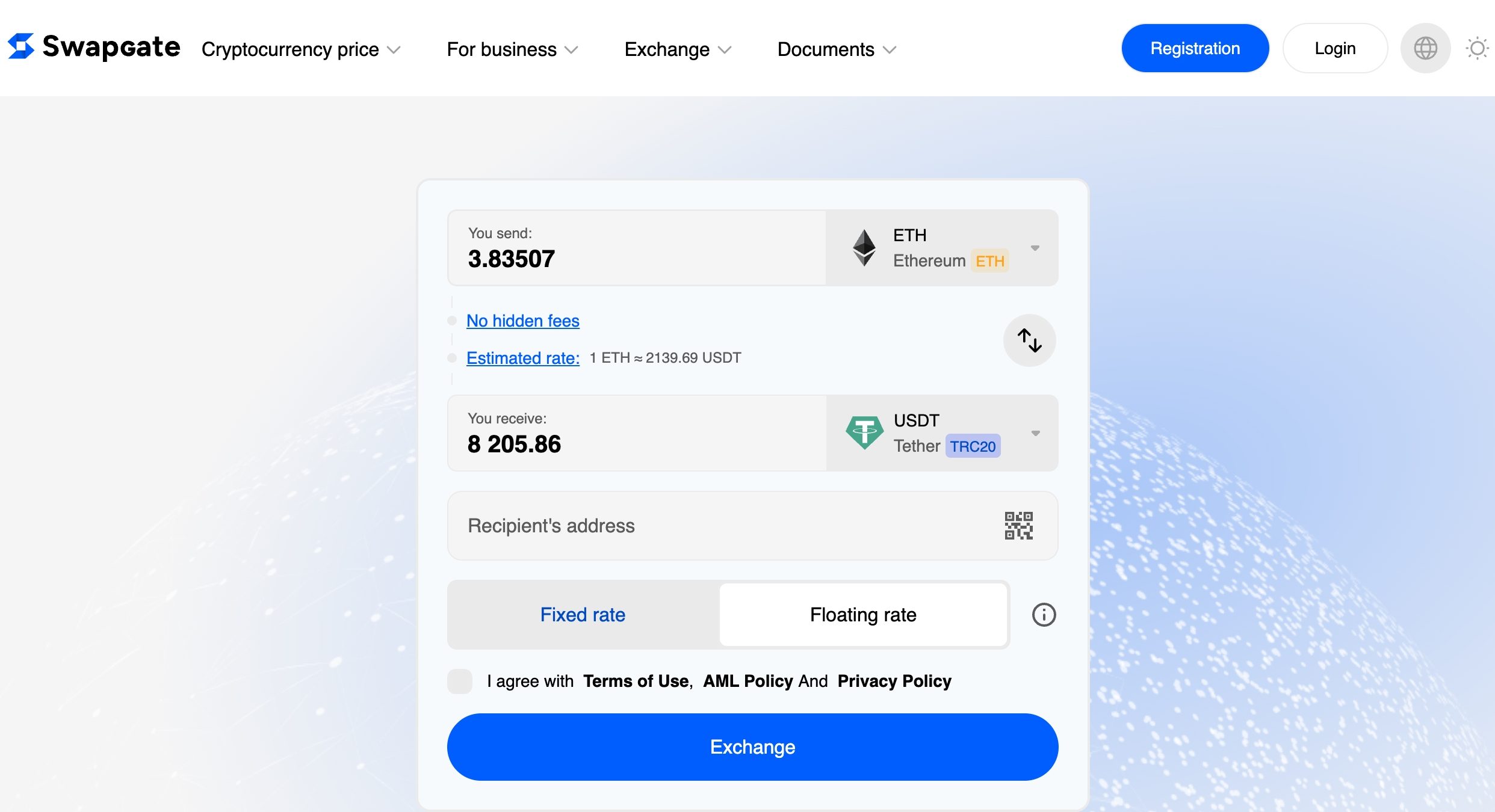
If central bank digital currencies and always-on financial surveillance keep expanding, privacy-preserving transaction systems may become more relevant, not less. The real tension is not technical viability anymore; it is whether governments and exchanges tolerate tools that reduce transaction visibility while still preserving audit options when users consent. However, it is still available on Swapgate, if you want to exchange ETH to USDT.
The Roadmap Ahead: Resistance and Smart Contracts
Preparing for the Future: Is MimbleWimble Quantum-Secure?
MimbleWimble is not quantum-secure in any strong sense today, because it still relies on standard elliptic-curve cryptography and discrete-log assumptions. That said, many privacy researchers and projects are already thinking about future-proofing primitives, and the modular design of some MimbleWimble implementations makes upgrades easier in theory than in older rigid systems.
Scriptless Scripts: Bringing DeFi to MimbleWimble
One of the most interesting technical points in the Grin docs is that MimbleWimble does not support Bitcoin-style scripts in the usual way, but can still implement useful contract-like behavior through elliptic-curve tricks. The docs specifically mention multisig, atomic swaps, timelocks, and even Lightning-style constructions.
That is where scriptless scripts matter. They let MimbleWimble chains gain some functionality normally associated with smart contracts, but without copying Ethereum’s whole execution model.
FAQ
What is MimbleWimble?
MimbleWimble is a blockchain design that removes traditional addresses and hides transaction amounts with Confidential Transactions. It also merges and cuts through transactions so much of the spent history can be removed without breaking security.
Why are there no addresses on a MimbleWimble blockchain?
Because ownership is expressed through cryptographic interaction and commitments rather than a permanent public address graph like Bitcoin’s. That design reduces the amount of metadata an outside observer can use to map relationships between users.
Does MimbleWimble support smart contracts like Ethereum?
Not in the full EVM sense. But it can support useful “scriptless” constructions like multisig, timelocks, atomic swaps, and Lightning-style setups using elliptic-curve properties instead of a general-purpose scripting language.
Is MWC a better store of value than Bitcoin?
That depends on what you value. Supporters of MWC argue that its capped 20 million supply, high stock-to-flow framing, and privacy make it a better monetary good, while Bitcoin still dominates liquidity, brand trust, and institutional acceptance.