
If you are researching Firo Coin, you are probably trying to answer a few practical questions at once: what is Firo, how private is it, how does Firo mining work, and why do some people still call it Zcoin or Z coin? The short answer is that Firo is a privacy-focused cryptocurrency that rebranded from Zcoin in 2020 and has since evolved into a far more advanced protocol centered on Lelantus Spark, GPU-friendly mining, masternode security, and selective auditability through view keys. As of early March 2026, FIRO trades around $0.78, with a market cap around $14.4 million and a circulating supply a little above 18.3 million coins.
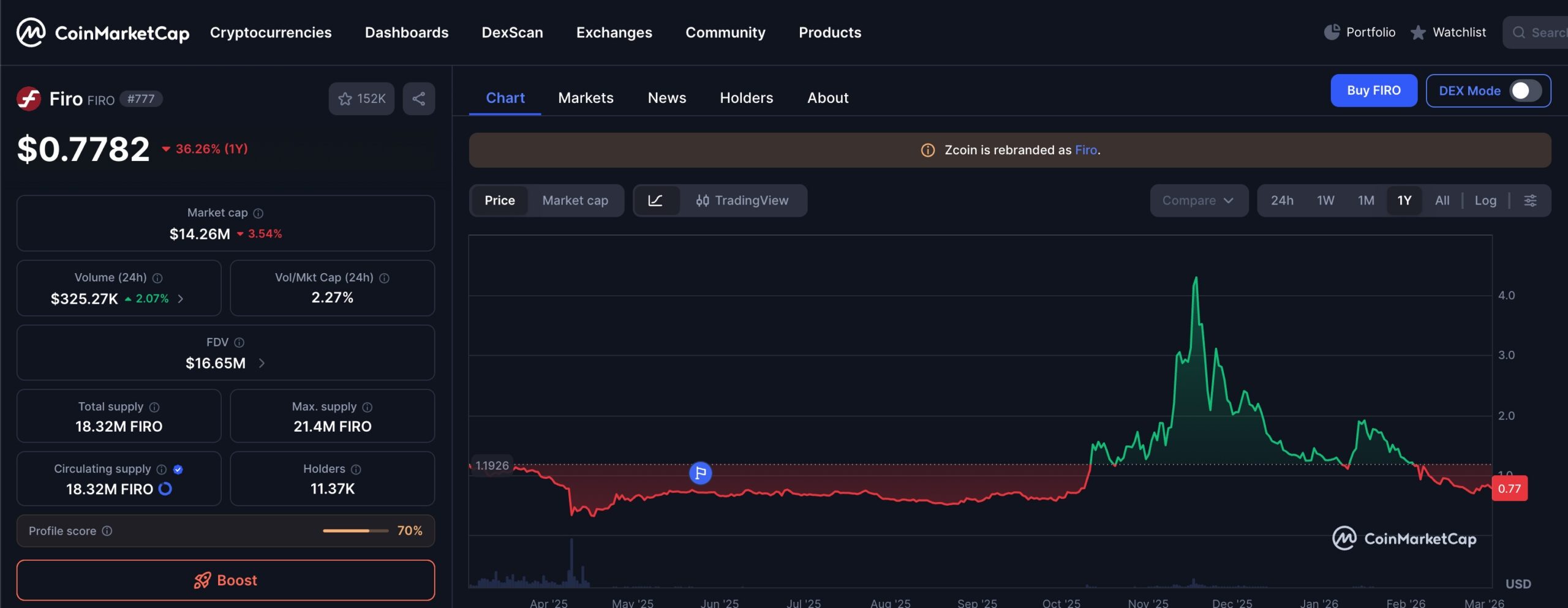
Source: Coinmarketcap
Unlike many older privacy articles that stop at “anonymous coin,” the real 2026 story is deeper. Firo is now built around Spark addresses, hidden amounts, non-searchable receiver data, and a roadmap that includes Spark Assets, Spark Swap, Curve Trees, and broader wallet integrations. In other words, Firo crypto is no longer just a legacy privacy asset. It is trying to become a modular privacy stack.
What is Firo? The Evolution from Zcoin
The Origins of Firo: Why the Rebrand from Zcoin in 2020?
Firo began as Zcoin, then formally announced its rebrand in October 2020 and completed it on November 30, 2020. The team said the new name better reflected the project’s mission and future direction, especially as it moved past the older Zerocoin association and toward newer privacy coins like Lelantus and, later, Spark. That is why people still search Zcoin, Zcoin price, or Z coin, even though the live asset is now FIRO.
The rebrand also helped clean up a common misconception: Firo is not just an old experiment that changed its logo. It is a privacy chain that has gone through several major protocol generations, and the current one is significantly more advanced than the Zcoin era most legacy articles describe.
Firo vs. Bitcoin: Enhancing the Original Vision with Privacy
Bitcoin proved that decentralized digital money could work, but it also made every transaction visible forever. Firo tries to preserve the “digital cash” idea while adding stronger privacy, optional auditability, and faster user-facing settlement through a masternode layer. In simple terms, Bitcoin optimizes for transparent scarcity, while Firo optimizes for fungible, private spending.
That distinction matters for anyone comparing Firo with mainstream coins. Bitcoin gives you strong censorship resistance and liquidity. Firo tries to give you those properties plus recipient privacy, hidden amounts, and more cash-like fungibility. That does not make Firo “better” in every context, but it does make it a very different tool.
The Mission: Why Financial Privacy is a Fundamental Human Right in 2026
Firo’s current positioning is explicit: privacy is not a niche feature, but a basic requirement for usable money. The project homepage emphasizes “untraceable transactions,” “view keys,” and selective transparency, which reveals its philosophy clearly: users should have privacy by default, but also the option to disclose information when needed.
That “selective disclosure” angle is where Firo stands out. Many privacy discussions get stuck in a false choice between total transparency and total opacity. Firo’s answer is more nuanced: private by default for ordinary users, but flexible enough for accounting, auditing, charities, or regulated businesses that need to prove payment history on their own terms.
The Lelantus Spark Protocol: The Gold Standard of Privacy
How Lelantus Spark Works: Understanding “Burn-and-Redeem”
Lelantus Spark is the core of modern Firo Coin. When Spark went live on mainnet in January 2024, Firo introduced private transactions where the sender, receiver, and amount are hidden, while Spark addresses themselves are not searchable on block explorers. The protocol builds on Firo’s earlier privacy work and upgrades it into a more flexible framework for confidential payments.
Older explanations of Firo often describe a “burn-and-redeem” mental model because the project historically used privacy designs that severed transaction history by destroying a visible coin state and recreating spendable value without linking the before-and-after path. In Spark’s current form, the user experience is cleaner and more address-based, but the intuition still helps: the goal is to break the visible history trail so outside observers cannot reconstruct ownership or payment paths.
A simple transaction path looks like this:
| Step | What happens |
| 1 | Value enters the private Spark system from a wallet flow or prior output |
| 2 | The wallet creates zero-knowledge proofs instead of exposing a public history chain |
| 3 | New private outputs are formed for recipient Spark addresses |
| 4 | The recipient detects and recovers spendable funds privately |
| 5 | If needed, the owner can later reveal history using view keys |
This simplified flow reflects the Spark paper and Firo’s launch materials.
Privacy by Default: Why Hidden Amounts and Addresses Matter
Spark’s biggest upgrade is not just sender privacy. It also hides recipient information and transaction amounts, which closes several leaks that still exist in many “privacy-lite” systems. The Spark paper explicitly describes diversified public addresses, confidential values, and recovery logic that lets recipients identify coins destined for them without exposing those relationships to everyone else.
This is why terms like Modular Privacy and Confidential Transactions matter here. Firo is not just trying to hide one field in a transaction. It is designing a privacy system where visibility levels can be adjusted without destroying the protocol’s core anonymity. That modularity is important because cryptography evolves, and Firo has openly designed Spark to be flexible enough to swap in improved components over time.
There is also a strong technical reason Spark gets attention from researchers: its future path includes Curve Trees, which Firo says can scale anonymity sets to global levels while reducing proof-size and verification bottlenecks. That makes Spark feel less like a static privacy scheme and more like an extensible privacy architecture.
Comparing Spark to Monero’s Ring Signatures and Zcash’s zk-SNARKs
A practical comparison helps:
| Feature | Lelantus Spark | Monero RingCT | Zcash zk-SNARKs / Halo |
| Sender privacy | Yes | Yes | Yes in shielded mode |
| Receiver privacy | Yes | Yes | Yes in shielded mode |
| Hidden amounts | Yes | Yes | Yes in shielded mode |
| Trusted setup required | No | No | Older systems did; modern Halo removed that need |
| View keys / selective disclosure | Yes | Yes | Available in different forms |
| Design style | Modular privacy, private addresses, upgradeable architecture | Mandatory privacy stack with ring signatures and stealth addresses | Succinct shielded proofs with strong privacy when used correctly |
This table is based on the Spark paper, Firo FAQ, and widely documented properties of Monero and Zcash privacy models.
Firo’s key advantage is flexibility. Monero is arguably stronger as a pure default-privacy environment. Zcash remains influential for zero-knowledge design. But Spark’s combination of hidden amounts, hidden recipients, view keys, and future Curve Trees gives Firo a distinct place in the privacy stack.
FiroPoW: Decentralizing Security Through ASIC-Resistance
The Transition to FiroPoW: Returning Power to Home Miners
Firo uses FiroPoW, a modified version of ProgPoW 0.9.4. The official mining guide says it is designed to utilize all parts of a GPU and adds a random sequence that changes every block, making ASIC and FPGA specialization much harder. The point is simple: keep mining accessible to normal GPU operators rather than letting industrial hardware dominate the network.
This is a major part of the Firo mining story. While many PoW coins gradually drift toward specialized hardware, Firo has repeatedly defended a home-miner model as a decentralization feature, not just a marketing line.
Why ASIC-Resistance is Critical for Network Decentralization
ASIC resistance is not just about fairness. It changes who can participate in consensus. If only large operators can mine profitably, governance and security become easier to concentrate. Firo’s design tries to widen the field by biasing the algorithm toward consumer GPUs and away from fixed-purpose chips.
The trade-off is that profitability is tighter and more hardware-sensitive. As the DAG grows, older cards age out faster. Firo’s January 2025 update openly said DAG growth is intentional and acknowledged that once the DAG moved beyond roughly 7.7 GB, many 8 GB cards would already struggle due to overhead.
Mining Firo in 2026: Hardware Requirements and Global Hashrate Trends
The official mining guide says Firo is designed for GPU mining, and current third-party network metrics put FIRO network hashrate around the low-to-mid 20 GH/s range in early 2026. Minerstat, for example, shows about 25.5 GH/s and a current miner reward of 0.3125 FIRO per block to the mining side of issuance.
For a practical 2026 mining guide, these example GPU benchmarks are useful starting points:
| GPU | Example FIRO hashrate | Example power | Notes |
| RTX 3060 Ti | ~29.4 MH/s | ~149 W | Still viable, but efficiency is no longer great |
| RTX 4070 Ti | ~33.1 MH/s | ~149 W | Better raw output and stronger efficiency |
| 8 GB cards | Varies | Varies | Increasing DAG pressure makes many borderline |
These figures come from live GPU benchmark pages and should be treated as tuning starting points, not guarantees.
A practical rule set for 2026 Firo mining:
- Prefer modern NVIDIA GPUs or newer AMD cards with comfortable VRAM headroom.
- Watch DAG growth before buying old 8 GB hardware.
- Tune for efficiency, not maximum clocks, because FiroPoW is core-heavy and heat quickly eats your margin.
- Start with conservative power limits, then test stability before tightening clocks further.
The Two-Tier Network: Miners and Firo Masternodes
The Role of Masternodes: InstantSend and Governance
Firo combines miners with a masternode layer. The official FAQ says masternodes handle critical network services, including governance and the second-layer infrastructure behind fast settlement and security. The project homepage currently lists 3,900+ masternodes, which is a meaningful figure for a network this size.
Masternode ROI in 2026
Running a masternode requires 1,000 FIRO in collateral. Current block reward distribution gives 70% of the 6.25 FIRO block reward to masternodes, equal to 4.375 FIRO per block across the active masternode set.
Here is a simple masternode profit estimation model:
| Scenario | Active masternodes | Gross reward/day | Gross reward/year | Est. ROI on 1,000 FIRO |
| 3,000 nodes | ~0.84 FIRO | ~306.6 FIRO | ~30.7% | |
| 3,900 nodes | ~0.65 FIRO | ~235.8 FIRO | ~23.6% | |
| 4,500 nodes | ~0.56 FIRO | ~204.4 FIRO | ~20.4% |
These are gross estimates based on current reward splits and an approximate 2.5-minute block interval. They do not include server costs, downtime, or coin-price volatility.
51% Attack Protection: Understanding ChainLocks and LLMQ Security
Firo activated ChainLocks in 2021. The project explains that Long-Living Masternode Quorums sign the first valid block they see, and once the threshold is reached, the block becomes effectively final and cannot be reorganized beneath that point. That dramatically raises the cost of classic 51% style attacks because an attacker would need both mining influence and meaningful control over the masternode layer.
Firo in the Global Economy: Use Cases and Adoption
Firo for Daily Payments: Speed, Low Fees, and Stealth Addresses
For everyday use, Firo’s appeal is straightforward: private transfers, fast confirmations through the service layer, and wallet tools increasingly designed for normal humans rather than only power users. Spark addresses are not explorer-searchable, and Campfire wallet defaults to Spark privacy, which makes everyday use far more practical than the old “mix first, spend later” model.
Decentralized Voting: Using Firo’s Privacy Tech for Fair Elections
Firo has one of the more interesting real-world privacy case studies in crypto: the Thai Democrat Party used Zcoin-era blockchain infrastructure in a large-scale primary election with over 127,000 eligible votes. More recently, Firo research also connects to privacy-preserving voting systems such as Aura, which aims to reduce trust in tallying authorities while keeping ballots private.
That does not mean Firo is “the blockchain voting coin.” It does mean the technology has been used in contexts where ballot secrecy and verifiability matter, which supports the broader claim that its privacy stack has applications beyond simple payments.
Firo in High-Inflation Markets: A Private Store of Value
Firo is still a small-cap asset, so it should not be oversold as a mainstream inflation hedge. But privacy-preserving coins often attract users in places where financial surveillance, capital controls, or unstable local currencies increase the value of self-custodied money. Firo’s own community funding and outreach discussions show ongoing efforts in markets like Turkey and Nigeria, where those themes are especially relevant.
The Firo Ecosystem: Wallets, Exchanges, and Atomic Swaps
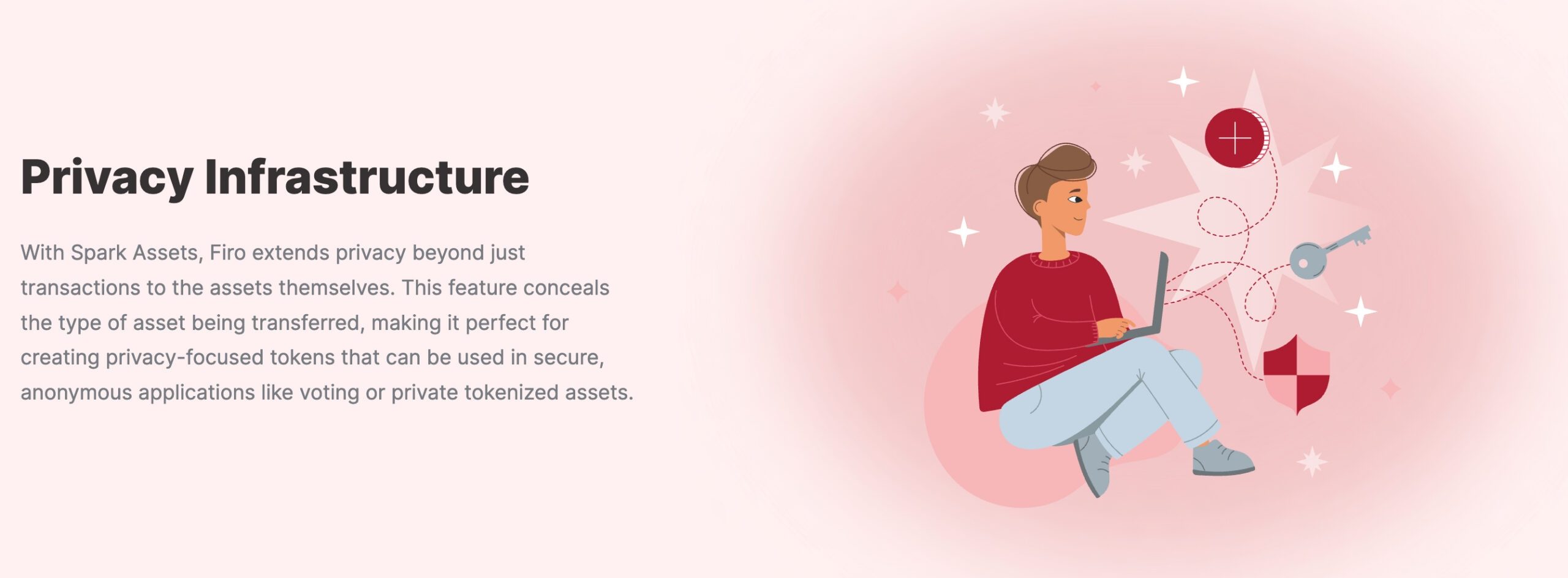
Source: Firo
Firo Client Wallets: Managing Your Privacy on Desktop and Mobile
If you are looking for a Firo wallet, the official download page and Campfire are the best starting points. Firo recommends its own wallet suite, and Campfire is specifically positioned as a Firo-only wallet with Spark privacy on by default, built-in Tor, EX-address support, and support across desktop and mobile.
Cross-Chain Interoperability: Atomic Swaps with Bitcoin and Litecoin
Firo has supported trustless swap efforts for years, and the ecosystem now integrates with BasicSwap. Firo announced BasicSwap installer support in late 2023, and the 2025 roadmap includes Spark Swap, aimed at atomic swaps between Spark assets and/or Firo without exposing users through transparent addresses. BasicSwap itself describes its product as non-custodial atomic swapping without middlemen or wrapped assets.
The Binance and DEX Landscape: Where to Trade FIRO in 2026
This section needs honesty. Binance delisted FIRO in April 2025, and Firo published a withdrawal guide telling users to self-custody before Binance stopped withdrawals in June 2025. That means exchange access in 2026 is more fragmented than it used to be. For many users, non-custodial swap and DEX-style routes matter more than centralized exchange convenience now.
Tokenomics: The Scarcity and Emission Model
Total Supply and the Halving Cycle: 21 Million Max Cap
Firo’s 2024 tokenomics finalization changed the emission model. The network now uses a fixed 6.25 FIRO per block until the supply reaches 21.4 million, after which it transitions to a 1 FIRO tail emission. That gives Firo a scarcity narrative similar in spirit to Bitcoin, but with a softer long-term issuance floor to support ongoing security.
Block Reward Distribution: Miners vs. Masternodes vs. Community Fund
Current distribution is:
- 70% masternodes
- 5% miners
- 15% development fund
- 10% community fund
This is one of the biggest practical differences between modern Firo and the older Zcoin era. Mining still matters, but the network now strongly favors infrastructure and long-term development.
The Firo Community Fund (FCF): How the DAO Finances Innovation
Firo has a real funding mechanism, not just a vague community slogan. The funding portal and community-fund processes show proposals for outreach, education, community support, and ecosystem work. That treasury layer is small compared with major L1 treasuries, but it gives Firo a way to finance tools and campaigns without depending entirely on outside capital.
Competitive Landscape: Firo vs. The Privacy Giants
Firo vs. Monero (XMR): Comparing Scalability and Privacy Proofs
Monero still has the strongest brand in default private payments. Its privacy is mandatory, which is excellent for uniform anonymity but less flexible for users who need selective disclosure. Firo’s edge is its Spark architecture, view keys, and the roadmap toward global anonymity sets via Curve Trees. Monero is the incumbent. Firo is the modular challenger.
Firo vs. Zcash (ZEC): The Debate Between Trustless Setup and SNARKs
Zcash remains the best-known zero-knowledge privacy chain, but setup assumptions and user complexity have historically shaped its adoption story. Spark’s trustless setup and selective transparency are core selling points for Firo here. That is why searchers who still compare Firo with Zcoin or Zcash should treat it as its own modern privacy design, not a copy of either.
Firo vs. Railgun and Tornado Cash: Native L1 Privacy vs. L2 Solutions
Railgun and Tornado-style tools operate as privacy overlays or smart-contract privacy layers. Firo’s value proposition is different: privacy is native to the base asset and the base chain. That removes some bridging and smart-contract assumptions, though it also means Firo does not inherit the liquidity of major smart-contract ecosystems by default.
FAQ: Everything You Need to Know About Firo
Is Firo still based on the Zerocoin protocol?
No, not in the way older articles imply. Firo began as Zcoin, but modern Firo has moved through multiple privacy generations and is now centered on Lelantus Spark rather than the old Zerocoin-era model.
Does Firo require a “Trusted Setup” in 2026?
No. Firo explicitly presents Spark as a trustless-setup privacy protocol, which is one of its major differentiators.
What is the difference between “Transparent” and “Private” transactions?
Transparent transactions expose more conventional blockchain data and are useful for compatibility and exchange workflows. Spark private transactions hide the sender, receiver, and amount, while Spark addresses themselves are not explorer-searchable. Firo also supports view keys and EX-addresses to make compliance-oriented flows possible where needed.
How do ChainLocks prevent 51% attacks on Firo?
ChainLocks use masternode quorums to sign the first valid block at a given height. Once enough quorum members sign, reorging that block becomes far harder, because an attacker would need influence over both the mining layer and the quorum-backed service layer.