
If you are looking for information on what Dash’s you might be searching for what is Dash crypto or what is Dash coin. The simple answer is that Dash is a cryptocurrency that is designed to make payments cheaply and with a lot of features that are easy to use. It was launched in 2014. It has a special two-tier system that includes miners and masternodes. Now Dash combines its payment system with the newer Dash Evolution platform, which includes usernames, data storage and features that are friendly to apps.
When people compare Dash coin, Dash cryptocurrency, Dash currency or Dash token it is important to remember that Dash is actually a coin, not an ERC-20 token. Some people call it a token. The official name of the project is just Dash, which is short for digital cash.
Introduction to Dash: More Than a Bitcoin Fork
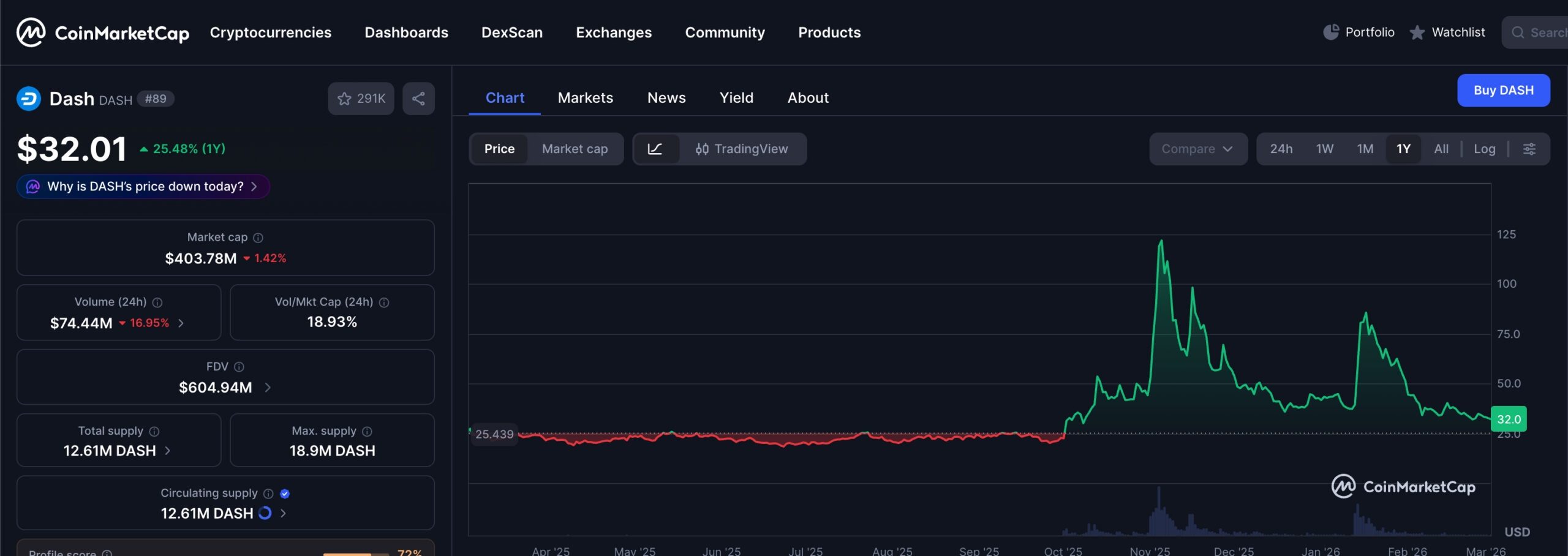
Source: Coinmarketcap
As of March 2 2026 the current price of Dash on CoinMarketCap is around $32.01 with a market value of $404 million around 12.61 million Dash in circulation and a maximum supply of about 18.9 million. This gives us an idea of where Dash stands: it is not as popular as it used to be but it is still a working network with new developments, merchants who accept it funding and a very ambitious plan for the future.
The idea of “Digital Cash” is about speed, privacy and ease of use. Dash was created to make it easier for people to move value on the blockchain. For years its main goal has been the fast payments, low fees, optional privacy and a system of governance that can fund new developments. The official Dash documentation talks about InstantSend for fast payments, CoinJoin for privacy, ChainLocks for stronger protection and a treasury model that puts some of the money it makes into growing the ecosystem.
What sets Dash apart from other cryptocurrency projects is its focus on making payments. While some projects talk about how transactions they can handle or just try to be popular Dash is still focused on being a usable form of money. That is why people often search for the price of Dash crypto, Dash coin and Dash cryptocurrency along with information about merchants who accept it and tools for spending it. The coin is meant to be used, not just bought and sold.
From XCoin to Dash: A Brief History of Innovation (2014–2026)
Dash started in January 2014 as XCoin then quickly changed its name to Darkcoin. Finally became Dash in March 2015 to focus on mainstream payments instead of being associated with the darknet. Over time it added masternodes, InstantSend, PrivateSend, treasury governance, ChainLocks and a long-term plan for Evolution, which’s its layer for apps.
A big milestone was reached in 2024 when Dash announced the Genesis release of Evolution as a mainnet beta. This was important because it took Dash beyond transferring coins and into usernames, identity, decentralized storage and app infrastructure. In 2025 and early 2026 Dash also started using encrypted metadata backups in DashPay allowed payments through Zebec partnered with a merchant called AEON and started working on shielded transactions for Evolution using Zcash Orchard technology.
Dash vs. Bitcoin: Key Differences in Architecture and Philosophy
At a level Bitcoin is simpler and more cautious. Dash is like a finished product. Bitcoin uses proof-of-work. Relies on many nodes with transactions usually taking about 10–20 minutes to start being confirmed. Dash also uses proof-of-work. It adds masternodes to make InstantSend, ChainLocks, treasury voting and platform services possible.
The comparison below shows the differences in design, between Dash, Bitcoin and Litecoin.
| Feature | Dash | Bitcoin | Litecoin |
| Launch year | 2014 | 2009 | 2011 |
| Consensus | PoW + masternode layer | PoW | PoW |
| Mining algorithm | X11 | SHA-256 | Scrypt |
| Typical block interval | ~2.5 minutes | ~10 minutes | ~2.5 minutes |
| Fast payment feature | InstantSend (~2 seconds) | No native instant finality feature | Faster blocks, but no Dash-style InstantSend |
| Governance treasury | Yes | No on-chain treasury | No on-chain treasury |
| Privacy model | Optional CoinJoin / upcoming Evolution shielded pool | Transparent by default | Transparent by default, optional MWEB on supported paths |
| Max supply | ~18.9M upper bound | 21M | 84M |
The Dash Evolution Platform: A New Era for Web3
What is Dash Evolution? Moving Beyond Simple Transactions
Dash Evolution is the umbrella name for Dash’s effort to make crypto feel less like raw infrastructure and more like a usable financial app. The 2024 Genesis release described Evolution as a mainnet beta built around a queryable decentralized database and a decentralized API, with usernames and DashPay activation as key goals of the rollout.
That is important because it changes the answer to what is Dash crypto. Dash is no longer just a coin with fast transactions. It is also a platform for identity, application data, and wallet experiences that feel closer to consumer fintech than early-wallet crypto.
Decentralized Identifiers (DIDs)
Dash Platform identities are a foundational primitive recorded on the platform chain. On top of those identities sits DPNS, the Dash Platform Name Service, which lets users register human-readable names rather than relying only on wallet addresses. In plain English, that means paying “alice.Dash” is easier than copying a long hash-like destination.
This is one of the cleanest answers to the search phrase what is Dash coin from a usability angle: Dash is trying to turn crypto payments into a username-based experience. That sounds basic, but it is exactly the kind of UX improvement most blockchains still lack.
Dash Platform Protocol (DPP): Enabling Decentralized Data Contracts
Dash Platform Protocol, or DPP, defines the validation and serialization rules for the platform’s core data structures: data contracts, documents, and state transitions. Data contracts function like schemas that tell the network what kind of application data can be stored and queried.
This is where Dash becomes more than a payment rail. A developer can define application-specific structures, publish them to the network, and let users create documents that conform to those rules. It is a more structured, database-like model than the generic “just deploy a smart contract and hope for the best” approach common elsewhere.
GroveDB: The Technology Powering Decentralized Storage
Dash Platform stores application data in Drive, its decentralized storage component, and Drive uses GroveDB for verifiable data storage and proof-backed query responses. The GroveDB repository describes it as a storage solution with proofs and secondary indices built on hierarchical authenticated data structures.
This matters for SEO and for actual users. Plenty of crypto guides stop at “Dash has DAPI,” but the more complete story is that Dash built a data layer where responses can be verified, not merely trusted. That is the kind of detail missing from most Wikipedia-style summaries.
The Two-Tier Network: Masternodes and Miners
Layer 1: Proof-of-Work (PoW) and X11 Hashing Security
Dash’s base chain is still proof-of-work. The network uses the X11 hashing algorithm and emits new coins through mining, while the emission rate falls by roughly one-fourteenth, or about 7.14%, every 210,240 blocks. That slower, annual-style reduction makes Dash’s supply curve smoother than Bitcoin’s four-year halving rhythm.
From an investment and tokenomics point of view, that smoother issuance is one reason long-time users still watch Dash coin price and Dash cryptocurrency price closely. The supply schedule is predictable, but it does not shock the market the same way Bitcoin halving cycles do.
Layer 2: The Masternode Network and Its Critical Functions
The second layer is Dash’s masternode network. Masternodes provide services such as InstantSend, CoinJoin, governance, and treasury voting. They also power DAPI access and, in the Evolution era, support broader platform services through higher-performance nodes. Dash documentation describes masternodes as the feature that enables its industry-leading payment and governance functionality.
This is arguably Dash’s biggest architectural differentiator. Bitcoin and Litecoin have miners and nodes. Dash adds a collateralized service layer that can do more than simply validate blocks. That extra complexity brings benefits, but it also explains why Dash is often discussed as a “network product” rather than merely a coin ticker.
InstantSend & ChainLocks: Achieving 1-Second Finality
Dash says InstantSend transactions are fully confirmed within about two seconds, while ChainLocks protect against blockchain reorganization attacks by having long-living masternode quorums sign blocks as they are mined. In practical terms, that combination is designed to make retail acceptance safer and faster.
No system is magic, but Dash’s approach is unusual in crypto because it tries to solve merchant UX directly. If a coffee shop or app wants a crypto payment that feels final immediately, Dash has been chasing that use case for years.
How Dash Navigates the 2026 Regulatory Landscape
PrivateSend Explained: The Evolution of Decentralized Coin Mixing
Dash’s original privacy story on the Core chain is optional CoinJoin-style mixing, historically branded through PrivateSend and now described in docs as CoinJoin-based privacy. Unlike privacy-by-default systems, Dash users choose when to use privacy features.
That matters because some exchanges and regulators have treated privacy-preserving assets more cautiously. Dash’s optional model has often been easier to position as a compliance-minded middle path than fully opaque-by-default systems.
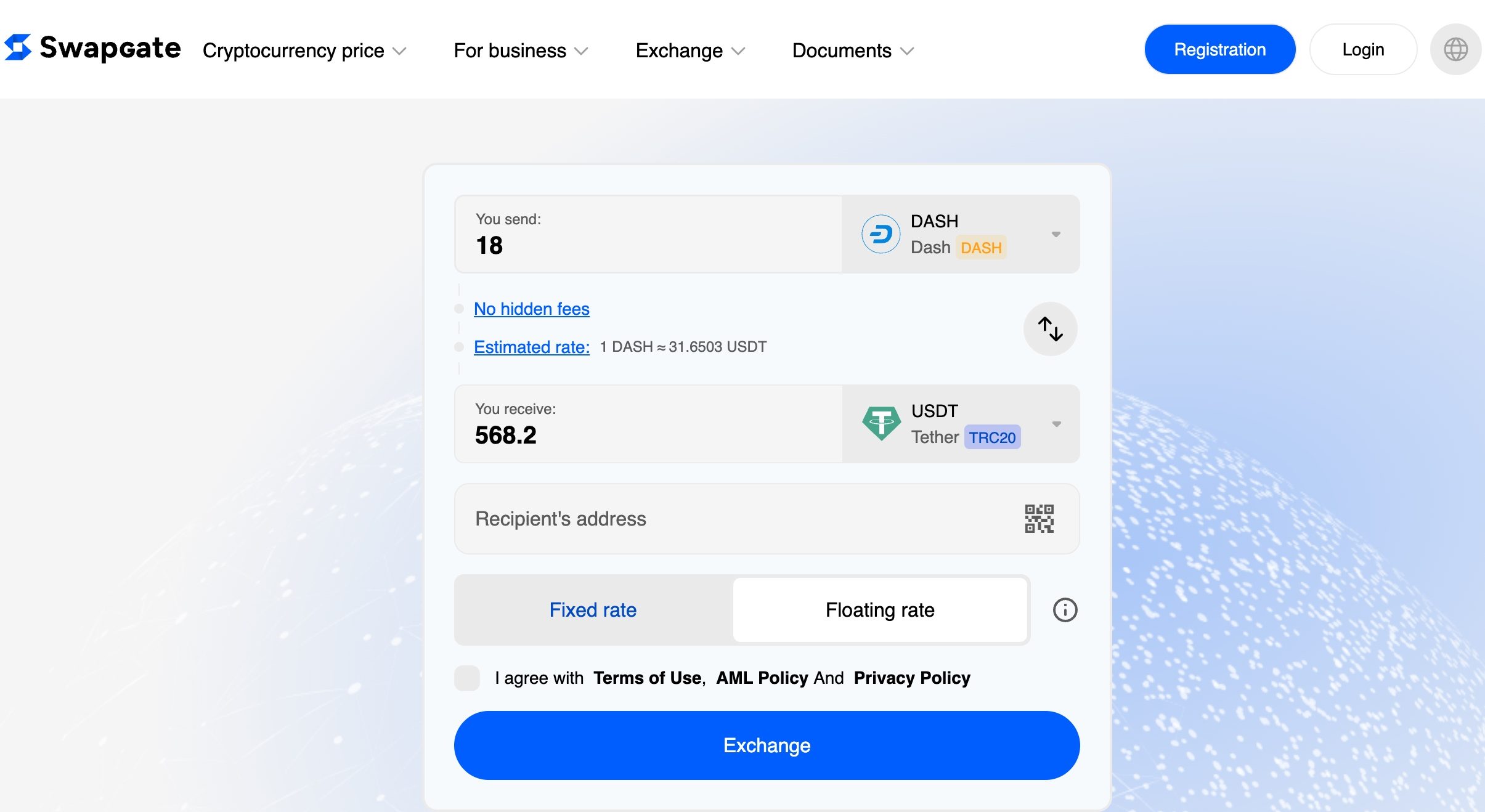
Though Dash is still available for a swap on Swapgate. For example, you can exchange Dash to USDT.
Opt-in Privacy vs. Mandatory Privacy: Dash’s Compliance Strategy
Compared with Monero, which hides sender, receiver, and amount by default using stealth addresses, ring signatures, and RingCT, Dash has historically offered optional privacy rather than mandatory privacy. Compared with Zcash, which uses shielded pools and zero-knowledge proofs, Dash’s privacy model has been more limited on the legacy chain but is now evolving.
The 2026 privacy twist is significant: Dash announced it is integrating shielded transactions for the Evolution chain using Zcash Orchard technology. According to the project, this should bring confidential transfers to Evolution while retaining Dash’s fast-finality design.
Dash vs. Monero (XMR) and Zcash (ZEC)
Monero remains stronger for default on-chain privacy. Zcash remains stronger in pure zero-knowledge privacy design. Dash sits in a hybrid position: optional privacy on the Core side, and a newer roadmap for shielded privacy on Evolution. That means Dash is probably the more mainstream payments-facing choice, but not the strongest anonymity tool in crypto.
For users, the realistic takeaway is this: Dash is trying to combine spendability, usability, and privacy in a way that is easier to integrate into everyday finance than pure privacy coins. Whether it succeeds depends on wallet support, audits, and partner adoption.
Decentralized Governance and the DAO Treasury
The Self-Funding Model: How 10% of Block Rewards Build the Future
Dash is one of the oldest live examples of an on-chain treasury model. In 2023, the network approved a treasury expansion, and current docs show the approximate allocation as 20% for miners, 20% for the governance budget, and 60% for masternodes.
That funding model is a big reason Dash has survived. Many projects depend on foundations or venture backing. Dash uses protocol issuance to pay for development, integrations, marketing, and infrastructure if masternodes vote proposals through.
The Proposal System: How Masternodes Vote on Development
Each masternode gets one vote on governance proposals. In practice, that means major product decisions, funding requests, and ecosystem campaigns can be approved or rejected by network stakeholders rather than by a single corporation.
This has pros and cons. It is genuinely decentralized funding, but governance can still be political, uneven, or slow. Even so, Dash’s DAO remains one of the more battle-tested treasury systems in crypto.
How the Dash DAO Funded Global Adoption Campaigns
Dash’s treasury has historically helped fund merchant campaigns and regional adoption work, especially in countries facing inflation and banking friction. Dash’s own reports and merchant initiatives repeatedly highlighted Venezuela as a key market, including around 1,000 verified merchants in 2019 and ongoing business-development focus in 2022.
That does not mean Dash dominates those regions today. It does mean the network has more real-world payments history than many newer chains.
Dash in the Real World: Adoption and Use Cases
Dash as a Hedge: Case Studies from Venezuela, Nigeria, and Turkey
Dash’s strongest real-world narrative has always been in economies where inflation, capital controls, or weak banking rails push users toward crypto alternatives. Reuters has documented broader crypto usage in Venezuela and Nigeria as a response to local currency stress, while Dash’s own materials have repeatedly emphasized Venezuela as a flagship market for wallet downloads and merchant activity. Turkey and Nigeria also rank highly in broader crypto ownership surveys, which helps explain why Dash’s digital-cash thesis resonates there.
In other words, Dash’s story in emerging markets is credible, but nuanced. It is less about “Dash owns the market” and more about Dash being one of the few coins intentionally built for unstable-money environments.
Point-of-Sale (PoS) Integrations
Dash has a long history of merchant and point-of-sale pilots, from Latin American integrations to direct spend tools. The project’s spend page still markets Dash for online shopping in the U.S. and local retail use in Venezuela, and newer 2026 partnerships point toward broader merchant rails again.
The biggest fresh headline is AEON. Dash says AEON Pay has processed nearly 994,000 transactions and more than $29 million in volume across a merchant network spanning tens of millions of offline merchants, with Dash now enabled for online and offline purchases through that stack.
Using Crypto for Instant Gift Cards and Everyday Purchases
Dash also leaned into everyday-spend tooling through gift-card and card-style products. The older DashDirect system allowed exact-amount gift card purchases at checkout, and newer Zebec integrations now give Dash users virtual prepaid cards that can be loaded from BIP70-compatible wallets and used in 140 countries, with Apple Pay and Google Pay support for in-person spending.
For actual lifestyle utility, this is one of Dash’s strongest points. Even if direct merchant acceptance is uneven, bridges like gift cards, bill pay, and virtual cards make Dash currency more usable in daily life than many pure “store of value” coins.
The Technical Deep Dive: Dash Architecture and Scaling
Dash Drive: The Decentralized Cloud Storage Layer
Drive is Dash Platform’s decentralized storage layer. Instead of forcing all app data into the legacy payment blockchain, Dash stores application state in Drive, hosted across masternodes and queryable through DAPI.
That design gives Dash a more app-oriented architecture than most payment coins. It is not just a ledger; it is a stateful environment for identity and data.
DAPI (Decentralized API): Connecting Developers to the Masternode Tier
DAPI is a decentralized HTTP API with JSON-RPC and gRPC endpoints that lets developers interact with both Dash Core and Dash Platform through a single interface. The key promise is lower infrastructure friction without having to trust a single centralized API provider.
For developers, this is a practical advantage. Instead of saying “run your own full node or rely on Infura-style middleware,” Dash tries to bake the interface directly into network infrastructure.
Scaling to Millions: How Dash Plans to Handle Global Transaction Volume
Dash’s scaling approach is layered: fast payments on the Core chain, data and identity on Evolution, and application logic structured through contracts and state transitions. It is not identical to Ethereum’s smart-contract model, but it is explicitly designed to support large-scale consumer and developer use.
Whether Dash reaches “global money” scale is still open. But unlike many legacy payment coins, it has a clear architecture for trying.
The Dash Ecosystem: Wallets, Exchanges, and Apps
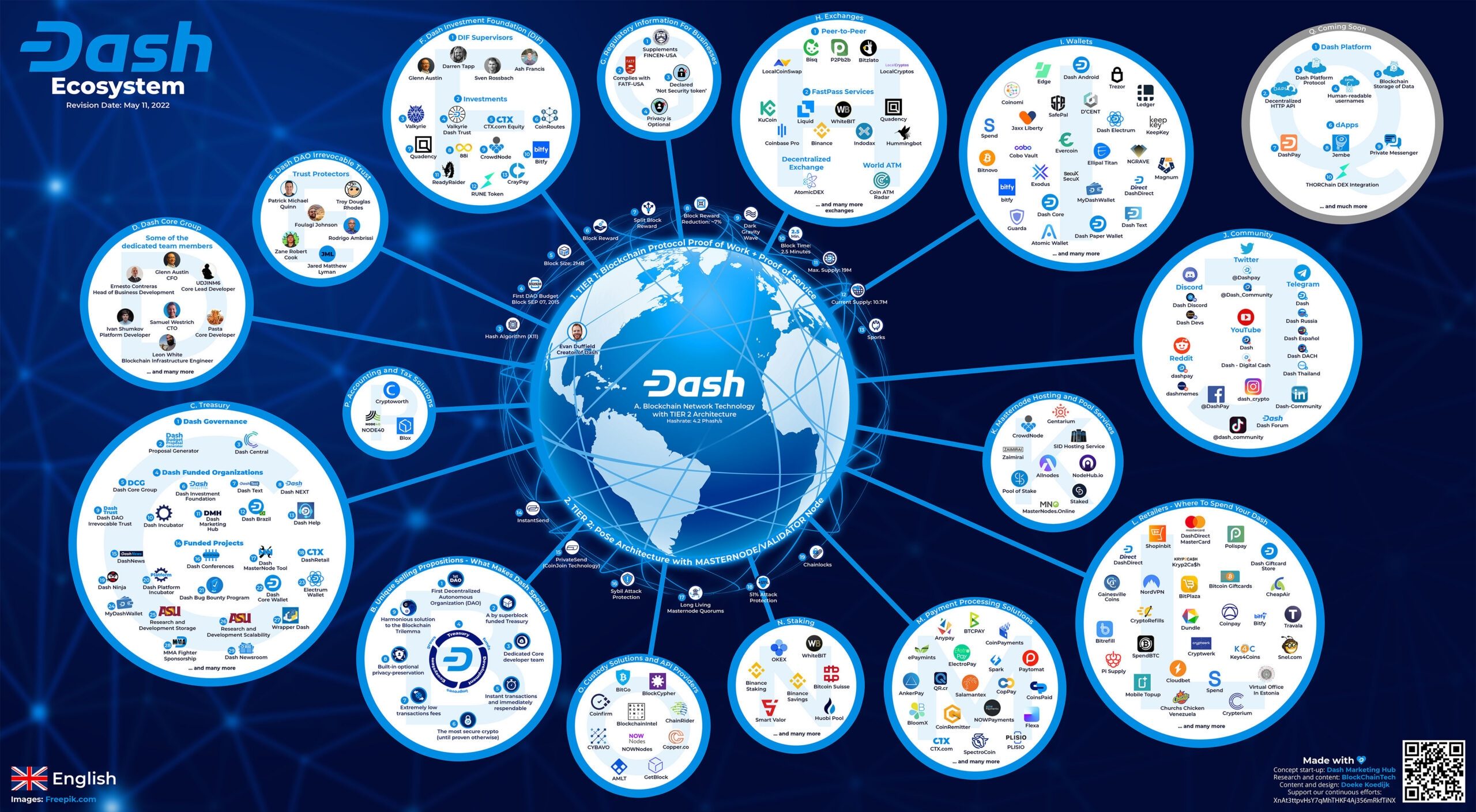
Source: Dash
DashPay: The Social Payment Experience for Mobile Users
DashPay is one of the first flagship applications built on Dash Platform. Docs describe it as a contract-driven wallet experience with usernames, avatars, bios, contact requests, payment history, and encrypted participant protection.
That social-payments angle is central to Dash’s long-term identity. It is trying to make crypto feel less like raw addresses and more like sending money to people you know.
Hardware Wallet Support
Dash documentation still lists Ledger, KeepKey, and Trezor among the major hardware wallet families supporting Dash, but with an important caveat: Dash docs note that Trezor’s newest Safe 3 and Safe 5 devices do not support Dash, and Trezor Suite dropped Dash support in February 2025.
So if you hold Dash long term, double-check device compatibility before buying hardware. In 2026, that detail matters more than generic wallet advice.
Building on Dash: Opportunities for Developers in the Evolution Era
For developers, Dash’s best opportunity is not “another EVM chain.” It is the combination of DAPI, data contracts, Drive, identities, and proof-backed queryable storage. If the ecosystem grows, Dash could appeal to builders who want structured Web3 apps with better native UX than address-only wallets allow.
Tokenomics: The Economic Engine of Dash
The Emission Schedule: Understanding the 7.14% Annual Supply Reduction
Dash reduces issuance by about 7.14% every 210,240 blocks, or roughly every 383 days. That makes emission smoother than Bitcoin’s halving system and creates a long-tail issuance curve extending far into the future.
Block Reward Distribution: Miners vs. Masternodes vs. Treasury
Today’s reward split is effectively 20% miners, 20% treasury, and 60% masternodes, with the masternode share itself divided between Core-chain payouts and the platform credit pool for Evolution services.
Scarcity and Utility: Why the 18.9 Million Max Supply Matters
Dash’s projected terminal supply depends partly on treasury usage, but official docs place the upper-bound total around 18.9 million Dash. Scarcity alone does not create value, of course. The more interesting question is whether Dash can turn that scarce supply into actual network demand through payments, platform usage, and treasury-funded expansion.
Conclusion: The Role of Dash in the Future of Finance
Dash is not the loudest brand in crypto anymore, but it may be one of the most misunderstood. It still offers fast payments, a mature governance treasury, optional privacy, and a product stack that now reaches into usernames, decentralized storage, and app development. In 2026, the strongest case for Dash crypto is not hype. It is durability.
If you came here asking what is Dash, the honest answer is this: Dash is a long-running digital cash network that has evolved into a broader Web3 payments-and-data platform. It is riskier and smaller than Bitcoin, less private than Monero, and less dominant than Ethereum-style ecosystems. But it still does a few things unusually well, and that is why Dash cryptocurrency remains relevant.
Frequently Asked Questions About Dash
Is Dash a “Privacy Coin”?
Not in the same sense as Monero. Dash has optional privacy features on its Core chain and is now working on shielded Evolution transfers using Zcash Orchard technology, but it is not private-by-default across the whole network.
How do I earn rewards for running a Dash Masternode?
You must operate a masternode with the required collateral and infrastructure, then participate in the service layer that powers network features. Masternodes receive a share of block rewards, and current docs place the overall masternode allocation at 60% of block subsidy, split between Core and Platform functions.
Can I use Dash on the Solana or Ethereum networks?
Native Dash lives on the Dash network. You can swap Dash for assets on Ethereum or Solana through exchanges and third-party services, but that is not the same thing as using native Dash directly on those chains. If you see wrapped or mirrored versions elsewhere, those introduce extra trust and bridge risk.
Is Dash energy-efficient compared to Bitcoin?
Dash and Bitcoin are both proof-of-work systems, so neither belongs in the ultra-low-energy proof-of-stake category. Dash likely uses less total energy than Bitcoin simply because its network is much smaller, but its security still depends on mining. So the fair answer is: more lightweight in absolute scale, yes; fundamentally energy-light, no.