
Quick Overview:
Bitcoin Ordinals let you inscribe images, text, or other data directly onto individual satoshis using Bitcoin witness data, creating NFT-like digital artifacts stored fully on-chain. Developer Casey Rodarmor launched the protocol in January 2023, building on the 2021 Taproot upgrade. Ordinals sparked BRC-20 tokens and Runes, and remain controversial for adding network congestion to a chain built for payments.
What Are Bitcoin Ordinals?
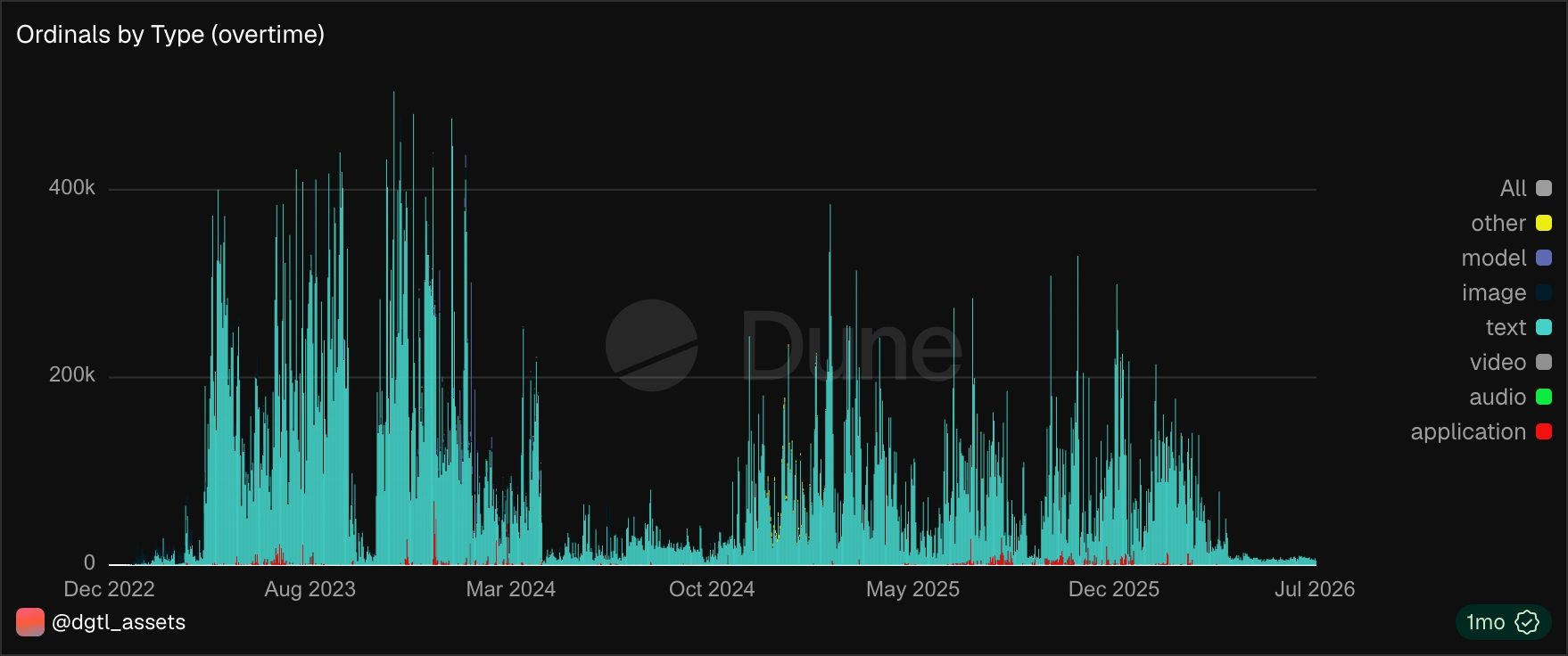
Source: Dune
Bitcoin Ordinals are a way to inscribe permanent data, images, text, audio, even small pieces of software, directly onto individual satoshis, the smallest unit of Bitcoin, and track that satoshi as it moves through the blockchain afterward. Once inscribed, the content lives forever inside Bitcoin’s own transaction data, replicated across every full node on the network, with no external server, no IPFS link, and nothing that can go offline or get taken down the way most NFT image files can.
That last point is the detail that actually distinguishes Ordinals from the NFT model most people are already familiar with. An Ethereum NFT typically stores only a token ID and a metadata pointer on-chain, while the actual image usually lives somewhere off-chain, a centralized server or a decentralized storage network like IPFS, that a smart contract simply references. An inscription puts the entire file, image, text, whatever it is, directly inside Bitcoin’s blockchain itself. There’s no smart contract, no external link that can break, and nothing that changes after the fact, since the content is baked into an immutable Bitcoin transaction.
The person behind all of this is Casey Rodarmor, a Bitcoin developer who inscribed the very first Ordinal in December 2022 as essentially a proof of concept, then formally opened the protocol to the public in January 2023. What started as a fairly niche technical curiosity turned into a genuine cultural and economic phenomenon within Bitcoin’s own community, tens of millions of inscriptions now exist on the Bitcoin blockchain, spanning pixel art, entire books, source code, audio clips, and at least one team’s attempt to inscribe a working Nintendo 64 emulator.
How Do Bitcoin Ordinals Work?
Ordinals rely on two earlier Bitcoin upgrades that weren’t originally built with this use case in mind: SegWit (Segregated Witness), activated in 2017, and Taproot, activated in November 2021 at block 709,632. SegWit separated transaction signature data (witness data) from the main transaction body, and Taproot expanded what could legitimately live inside that witness section using Schnorr signatures and a scripting structure called MAST. Neither upgrade was designed to enable inscriptions specifically, that was more a side effect the Ordinals protocol later exploited deliberately, but together they created just enough room to embed meaningful amounts of arbitrary data, up to roughly 4 megabytes per inscription, directly inside a valid Bitcoin transaction.
Creating an inscription uses what’s called a commit-reveal pattern, essentially a two-step transaction process. The commit transaction locks a specific satoshi to a Taproot output containing a script with the inscription’s content hidden inside it. The reveal transaction then spends that output, exposing the script and pushing the actual content, the image, text, or file, into the transaction’s witness data in a structure called the envelope format. Once that reveal transaction confirms, the inscription is permanently part of the Bitcoin blockchain, tied to that specific satoshi for as long as Bitcoin itself exists.
The “ordinal” part of the name refers to a numbering system, Ordinals theory, that Rodarmor separately devised to track individual satoshis through Bitcoin’s UTXO model. Every one of the roughly 2.1 quadrillion satoshis that will ever exist (100 million per Bitcoin, times a 21 million Bitcoin cap) gets a unique, sequential number based on the order it was mined, and Ordinals-aware wallets follow specific rules to track exactly which satoshi carries which inscription as it moves between wallets over time, rather than letting inscribed and un-inscribed satoshis get mixed together indistinguishably.
How Much Does It Cost to Create an Inscription?
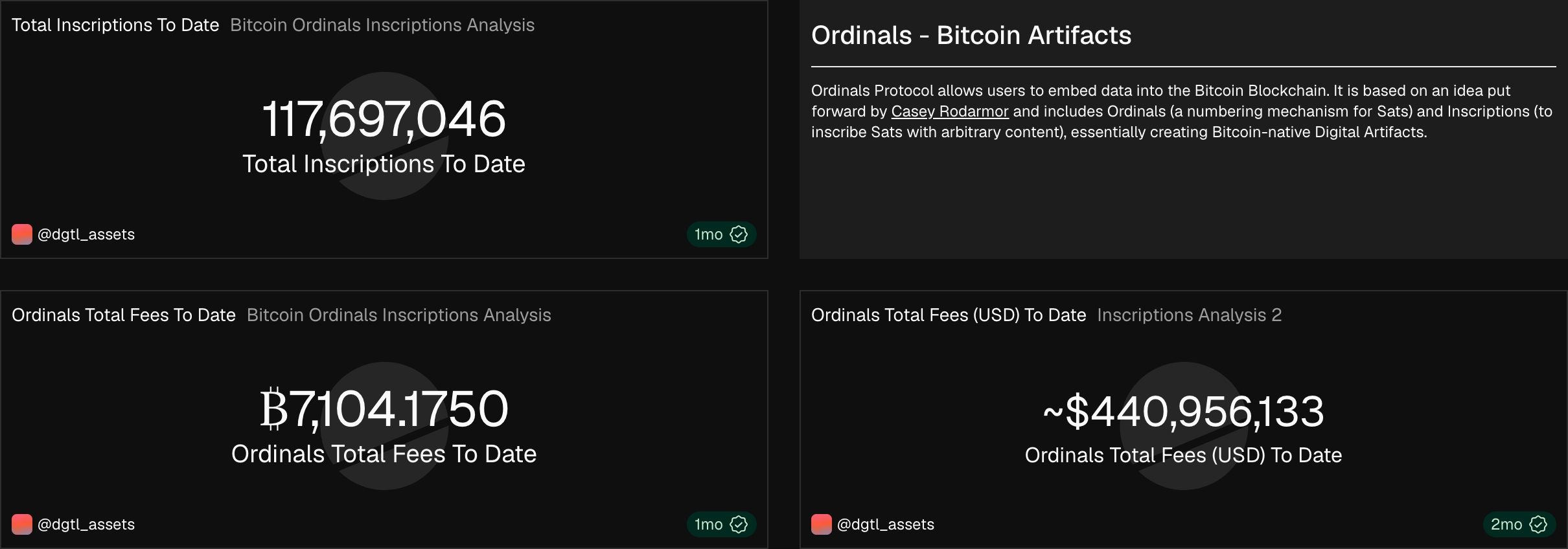
Source: Dune
Inscribing a typical small image, in the tens of kilobytes, generally costs somewhere between $5 and $30 in 2026, depending heavily on current Bitcoin network fees and how large the file actually is, since fees for an inscription transaction scale directly with the amount of data being embedded. Larger files, high-resolution art, audio, or anything approaching the 4-megabyte ceiling, can cost dramatically more, especially during periods of high network congestion when block space is scarce and competitive.
For anyone who wants to inscribe something without touching command-line tools, services like Gamma.io or OrdinalsBot handle the entire process end to end: upload a file, pay the quoted fee, and receive the finished inscription directly in a compatible wallet. Wallets with built-in inscription support, UniSat is the most commonly cited example, let more hands-on users inscribe directly without a third-party service standing in the middle. At the far end of the spectrum, technically confident users can run the official open-source ord command-line tool for maximum control and independence from any hosted service.
A recursive inscription technique has also become common by 2026, letting new inscriptions reference the content of existing ones rather than re-embedding duplicate data from scratch. This meaningfully reduces the cost of building larger, more complex on-chain artworks or collections, since shared visual elements only need to exist on-chain once and can be referenced repeatedly by later inscriptions rather than paid for again with every new piece.
What Are BRC-20 Tokens and Runes?
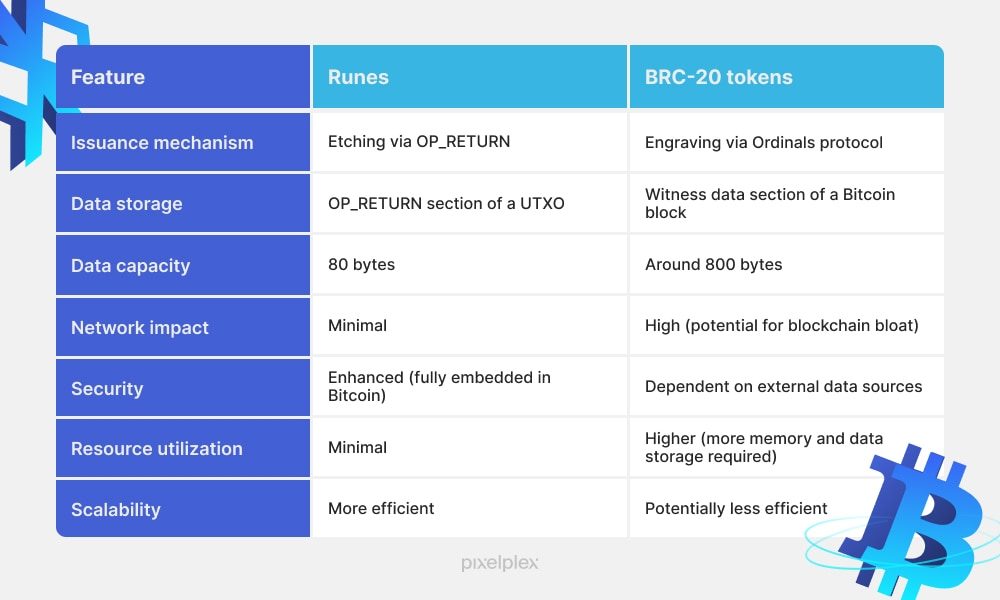
Source: Pixelplex
BRC-20 is a token standard built on top of the Ordinals protocol, introduced by a pseudonymous developer known as domo in March 2023, just two months after Ordinals itself launched. The name deliberately echoes Ethereum’s ERC-20 standard, but the underlying mechanism is completely different: a BRC-20 token is created by inscribing plain JSON data onto a satoshi that defines a token’s name, total supply, and transfer rules. There’s no smart contract anywhere in this process. Instead, off-chain indexers read every relevant inscription across the blockchain and maintain a separate ledger tracking who holds what, essentially reconstructing token balances by interpreting a trail of inscribed text.
BRC-20 tokens found real market traction surprisingly fast. ORDI, one of the earliest and most recognized BRC-20 tokens, reached a market capitalization over $1 billion by late 2023, alongside other tokens like SATS gaining meaningful trading volume of their own. That said, the reliance on off-chain indexers rather than on-chain smart-contract logic is a structural tradeoff worth understanding: your BRC-20 balance genuinely depends on an indexer correctly and honestly interpreting the inscription data, which is a fundamentally different trust model than a self-contained smart contract enforcing its own rules directly on-chain.
Runes, launched by Rodarmor himself in April 2024, emerged specifically to address BRC-20’s biggest technical weakness. Rather than using inscriptions, Runes uses Bitcoin’s existing OP_RETURN field, a part of a transaction explicitly designed to hold small amounts of arbitrary data, to record token information. This produces meaningfully less “junk” UTXO clutter than the BRC-20 approach, since Runes doesn’t leave behind the same trail of small, awkward, low-value unspent transaction outputs that BRC-20 inscriptions tend to generate. By 2026, BRC-20, Runes, and a handful of smaller competing standards coexist on Bitcoin, each with different tradeoffs around efficiency, indexer dependency, and ecosystem adoption.
Which Wallets and Marketplaces Support Ordinals?
Xverse is generally considered the best all-around starting point for most people in 2026, supporting Ordinals, BRC-20 tokens, Runes, and standard Bitcoin transactions in one interface, with direct integration into major marketplaces. It’s available as both a browser extension and a mobile app, and it automatically separates addresses by purpose: a Native SegWit address for ordinary BTC, and a distinct Taproot address specifically for holding Ordinals, which matters because sending regular Bitcoin carelessly from an Ordinals-holding wallet can accidentally spend the very satoshi an inscription lives on.
UniSat is the wallet most active BRC-20 and Runes traders reach for specifically, since it offers some of the deepest built-in tooling for minting, trading, and managing those token standards directly. Leather is another well-regarded option with strong inscription-tracking support. For users who want the maximum possible sovereignty and don’t mind a steeper technical learning curve, pairing Sparrow Wallet with the official ord command-line tool provides full independent control without relying on any hosted indexing service.
On the marketplace side, Magic Eden expanded from its Solana NFT origins into one of the largest Bitcoin Ordinals marketplaces, and remains one of the most recognized names for browsing and trading inscriptions. Whichever wallet or marketplace combination you choose, always pair a software wallet holding meaningful value with a hardware wallet, Ledger or Trezor both support the relevant address types, for any inscriptions genuinely worth protecting, the same cold-storage logic that applies to regular Bitcoin holdings applies here too.
Are Bitcoin Ordinals Worth Anything?
Some individual Ordinals have sold for genuinely enormous sums, though as with any collectible market, the vast majority of inscriptions carry little to no resale value at all. Taproot Wizards, a collection launched by longtime Bitcoin developer and educator Udi Wertheimer, made history when its genesis inscription filled an entire 4-megabyte Bitcoin block, the largest single transaction in Bitcoin’s history at the time, and individual Wizards from that collection have sold for several hundred thousand dollars at their peak.
NodeMonkes, another prominent early collection, saw individual pieces trade for eye-watering sums, one NodeMonkes inscription reportedly changed hands for over 200 BTC in a private deal with collector punk6529. Beyond curated collections, so-called “rare sats”, satoshis carrying specific historical significance, such as ones mined in Bitcoin’s Block 9 and widely attributed to Satoshi Nakamoto himself, have traded at premiums exceeding 1,000 times their face value purely because of that provenance, independent of any inscribed content at all.
These headline sales are the exception rather than the norm, and it’s worth treating them the way you’d treat headline sales in any collectibles market, real, but not representative of typical outcomes. The overwhelming majority of inscriptions never trade for anything close to these figures, and plenty sit essentially valueless once initial hype around a given collection fades.
Why Are Bitcoin Ordinals Controversial?
Ordinals triggered one of the more genuinely contentious debates in Bitcoin’s recent history, centered on a real tension: Bitcoin was originally designed as a peer-to-peer payment system, and Ordinals use its block space for something else entirely, image and data storage, competing for the same limited resource. In May 2023, at the height of Ordinals’ first wave of popularity, Bitcoin network congestion got bad enough that Binance temporarily paused Bitcoin withdrawals for several hours, citing the need to raise withdrawal fees to keep transactions moving.
Critics, including Ocean mining pool co-founder Luke Dashjr, a long-standing Bitcoin Core developer, have described inscriptions bluntly as a spam attack exploiting an unintended gap in Bitcoin’s transaction-relay rules, and raised specific concerns about UTXO bloat: inscription techniques that leave behind large numbers of small, awkward unspent transaction outputs, which can make running a full Bitcoin node more resource-intensive over time. Ocean’s mining pool has gone as far as offering miners a block template option that filters out non-financial transactions like inscriptions, alongside the Bitcoin Core default, which doesn’t.
Supporters counter with a straightforwardly economic argument: Ordinals-related transactions have generated well over $100 million in network fees, real revenue for the miners who secure the Bitcoin network, at a point in Bitcoin’s long-term roadmap where fee revenue is specifically meant to gradually replace the shrinking block subsidy as scheduled halvings continue. From that view, more demand for Bitcoin’s limited block space, whatever its source, strengthens the network’s long-term security budget rather than threatening it.
The debate hasn’t stayed purely theoretical. A 2025 proposal from developer Peter Todd to relax the long-standing 80-byte cap on Bitcoin’s OP_RETURN field reignited the same fight in a new form, and a separate, informally named “The Cat” BIP draft has proposed freezing certain non-monetary UTXOs specifically to curb the bloat inscriptions can cause, a change that could functionally strip transferability from some existing inscriptions if it ever gained consensus. As of 2026, none of the more restrictive proposals have actually been merged into Bitcoin Core’s default settings, and inscription transactions remain fully valid, relayable, and mineable exactly as they have been since Ordinals launched, since Bitcoin’s own consensus rules simply don’t distinguish between financial and non-financial transaction content.
Where Can You Buy or Exchange Crypto?
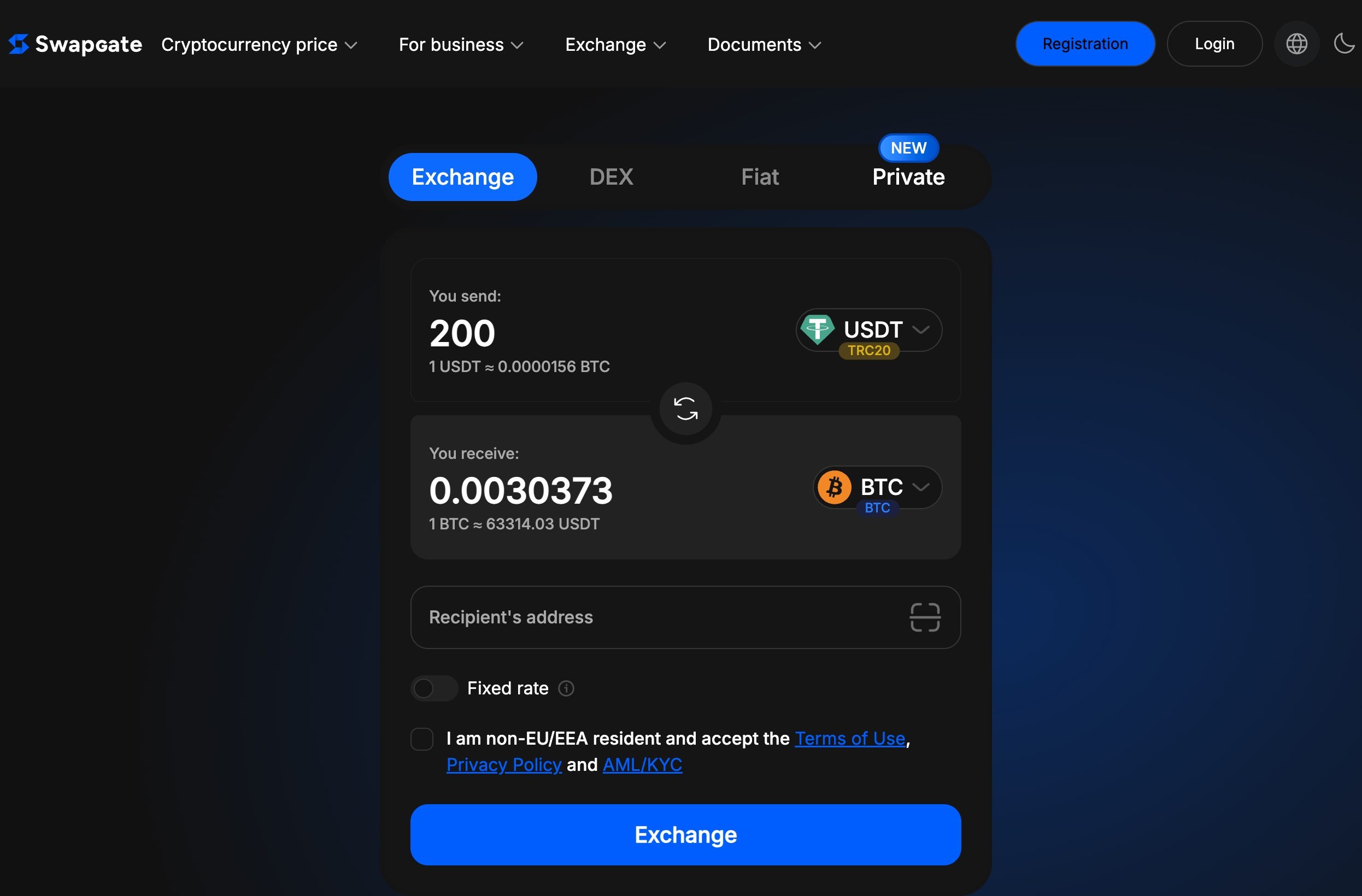
Getting started with Ordinals means first getting Bitcoin into a compatible wallet, and there are two broad paths for that: centralized exchanges that require identity verification, and no-KYC swap services that convert one crypto directly into another without an account. Which one fits depends mostly on whether you’re buying with fiat for the first time or already hold crypto you want to convert ETH into BTC.
Swapgate is one example of that second category, an instant swap platform operating since 2022 that supports Bitcoin alongside a wide range of other cryptocurrencies, generally cited around 50 or more supported assets depending on the source. No account or registration is required to swap, and pricing and speed both get consistently positive marks in user reviews.
For a first-time fiat purchase, a fully KYC-verified exchange remains the more predictable route, since it directly handles card or bank transfer conversion in a way most swap services don’t. Once you’re holding BTC, moving it into an Ordinals-compatible wallet like Xverse or UniSat is straightforward, just make sure you’re sending to the correct address type your wallet generates for holding inscriptions, rather than accidentally mixing inscribed and ordinary satoshis together.
Frequently Asked Questions
What are Bitcoin Ordinals in simple terms?
Bitcoin Ordinals let you permanently attach data, like an image or text, directly to an individual satoshi, creating an NFT-like digital collectible stored fully on the Bitcoin blockchain itself.
Unlike most NFTs on other blockchains, which typically point to an image stored somewhere off-chain, an Ordinal’s actual content lives inside Bitcoin’s own transaction data, replicated on every full node. The protocol was created by developer Casey Rodarmor and launched publicly in January 2023.
Is buying Bitcoin Ordinals a good investment?
It’s highly speculative, some inscriptions have sold for six or seven figures, but the vast majority carry little to no resale value, similar to most collectibles markets.
Headline sales like Taproot Wizards or NodeMonkes pieces get most of the attention, but they represent a small fraction of all inscriptions, most of which never trade for anything close to those figures. Treat Ordinals as a speculative collectible category rather than a reliable store of value.
What is the difference between Ordinals and BRC-20 tokens?
Ordinals refers to the broader protocol for inscribing any data onto satoshis, while BRC-20 is a specific token standard built on top of Ordinals for creating fungible tokens using inscribed JSON data.
An Ordinal can be a one-of-a-kind image or collectible, while a BRC-20 token behaves more like a fungible currency with a defined supply, tracked through off-chain indexers reading inscription data rather than through a smart contract. Runes, launched later in April 2024, is a separate, more efficient token standard built using a different Bitcoin feature entirely.
Do I need a special wallet for Bitcoin Ordinals?
Yes, a standard Bitcoin wallet generally isn’t sufficient; you need an Ordinals-aware wallet like Xverse, UniSat, or Leather that can track and display inscribed satoshis correctly.
Using a regular Bitcoin wallet without inscription support risks accidentally spending a satoshi that carries an inscription in a normal transaction, effectively losing the inscribed asset. Ordinals-compatible wallets typically separate addresses specifically to prevent this kind of accidental loss.
Why do some people think Bitcoin Ordinals are bad for Bitcoin?
Critics argue inscriptions clog block space meant for financial transactions, drive up fees, and create UTXO bloat that makes running a full node more resource-intensive over time.
Bitcoin Core developer Luke Dashjr has called inscriptions a spam attack exploiting an unintended gap in transaction-relay rules, while supporters point to over $100 million in network fees generated as a benefit to Bitcoin’s long-term mining security budget. The debate remains unresolved, and no restrictive proposal has been merged into Bitcoin Core’s default settings as of 2026.
Disclaimer: The material in this article is not financial or investment advice. Everything stated here reflects the author's personal view and should not be treated as a recommendation to trade or invest. We make no warranties regarding the accuracy, reliability or completeness of the information presented. Cryptocurrency markets are highly volatile and can move unpredictably. Before committing any funds, every investor, trader or crypto user should study several independent sources and check the regulations that apply in their own jurisdiction.