
If you’ve spent more than five minutes on crypto Twitter (or X), you’ve probably seen people bragging about crazy 100x gains, while others are just quietly holding their Bitcoin in a cold wallet. This massive divide in how people interact with the market basically boils down to one major topic: spot vs futures.
Maybe you’re tired of just buying and holding. Or maybe you’re trading futures right now and getting completely liquidated because you aren’t sure how the mechanics actually work. Wherever you’re at, understanding the difference between spot and futures is quite literally the barrier between being a profitable trader and gambling your money away.
Key Takeaways:
- Spot Trading: You buy and actually own the cryptocurrency. You can move it to a personal wallet. You only make money if the price goes up. Maximum loss is your initial investment (if the coin goes to zero). It’s simpler and lower risk.
- Futures Trading: You don’t own the crypto. You buy a contract betting on whether the price will go up (long) or down (short). You can use borrowed money (leverage) to multiply your gains, but this also multiplies your losses. High risk, high reward.
- The Bottom Line: If you want to invest and hold, stick to spot. If you want to day trade, use leverage, and profit from falling markets, futures are your playground.
What is Spot Trading?
Imagine you walk into a farmer’s market. You see a basket of apples, hand the farmer $5, and walk away with the apples. You own them. You can eat them, bake a pie, or let them rot on your counter.
That is spot trading in a nutshell.
When you execute a spot trade on an exchange like Binance, Coinbase, or Kraken, you are buying the actual underlying asset “on the spot.” The transaction settles immediately. If you buy 1 Ethereum (ETH), your exchange wallet will now hold 1 ETH. You can withdraw that ETH to your Ledger or Trezor hardware wallet and lock it in a safe. It belongs to you.
The Mechanics of the Spot Market
In the spot market, your profitability is incredibly straightforward. It is a traditional “buy low, sell high” environment.
If you buy $1,000 worth of Bitcoin at $50,000 and the price jumps to $60,000, your stack is now worth $1,200. You made $200. Awesome. But what if the market tanks? What if Bitcoin drops to $25,000? Well, your portfolio value drops by 50%, and you’re down to $500.
However, and this is a massive point: you still own the exact same amount of Bitcoin. You haven’t actually locked in that loss until you hit the sell button. You can just wait (or “HODL”) for the price to recover. Nobody is going to knock on your door and force you to sell.
Pros and Cons of the Spot Market
Pros:
- True Ownership: You hold the keys (if you withdraw to a self-custody wallet).
- Lower Stress: There are no margin calls. You don’t have to wake up in a cold sweat at 3 AM to check if you’ve been liquidated.
- Simplicity: It’s intuitive. You buy something, hoping it becomes more valuable later.
Cons:
- Limited Profit Potential: Without leverage, a 5% move in the market means a 5% gain for you. For small accounts, growing your wealth via spot can take a very long time.
- No Shorting: In traditional spot markets, you can only make money when the market goes up. If we enter a two-year bear market, your options are basically to sell and wait in cash, or sit on your hands and watch your portfolio bleed.
What is Futures Trading?
Okay, let’s step away from the farmer’s market and walk into a casino… well, a highly regulated, mathematical casino.
When you look at future trading vs spot trading, the biggest mind-shift is realizing that in futures, you aren’t buying the crypto. You are buying a piece of paper (a digital contract) that tracks the price of that crypto.
Futures trading allows you to speculate on the future price of an asset without ever owning it. You and the exchange enter into an agreement: “I bet the price of Solana will be higher than it is today by next week.”
The Magic (and Terror) of Leverage
The reason most people flock to futures is a little concept called leverage. Leverage lets you borrow capital from the exchange to supercharge your buying power.
Let’s look at a scenario. You have $1,000.
- In Spot: You buy $1,000 of Bitcoin. It goes up 10%. You make $100.
- In Futures (with 10x Leverage): You use your $1,000 as collateral to open a $10,000 position. Bitcoin goes up 10%. You make $1,000! You just doubled your money on a tiny 10% move.
Sounds amazing, right? Why would anyone ever do anything else?
Because leverage is a double-edged sword that swings both ways. If you use 10x leverage and the price of Bitcoin drops by just 10%, your $10,000 position loses $1,000. But wait: you only had $1,000 to begin with!
At this point, the exchange steps in, forcefully closes your trade, and takes your $1,000 to cover the loss. This is called getting liquidated. You are left with exactly zero dollars.
Going Short: Profiting in a Bear Market
The other massive advantage in the futures vs spot debate is the ability to “go short.”
When you short a market, you are betting that the price will go down. If Bitcoin is at $60,000 and you think it’s going to crash, you can open a short position. If it drops to $50,000, you make a profit. This means that skilled futures traders can make money regardless of whether the market is booming or crashing.
The Big Showdown: Spot vs Futures
So, how do these two stack up side-by-side? When people ask me about the difference between spot and futures trading, I usually show them a breakdown like this.
Here is a clear comparison matrix:
| Feature | Spot Trading | Futures Trading |
| Asset Ownership | Yes. You own the actual coin. | No. You own a contract tracking the price. |
| Leverage | No (typically 1:1). | Yes (often up to 100x or 125x). |
| Market Direction | Profit only when prices go UP. | Profit when prices go UP (Long) or DOWN (Short). |
| Risk of Liquidation | None. Your balance only hits $0 if the coin goes to $0. | High. A small price move against you can wipe out your account. |
| Holding Costs | None. Hold forever for free. | Yes. “Funding rates” apply for holding positions open. |
| Complexity | Beginner-friendly. Vanilla investing. | Advanced. Requires deep risk management skills. |
Breaking Down the Core Differences
Let’s unpack a few of those table rows to really understand the difference between spot and futures, because the devil is absolutely in the details.
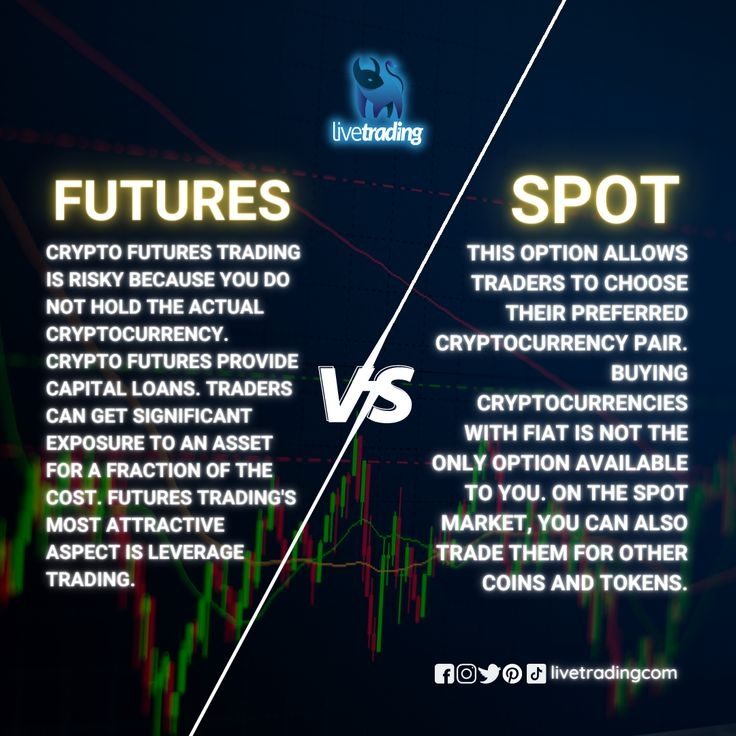
Source: Pinterest
1. The Reality of Asset Ownership
We touched on this, but it bears repeating. In the crypto world, there is a famous saying: “Not your keys, not your coins.” When you buy on the spot market, you can take custody of your assets. If the crypto exchange goes bankrupt tomorrow (looking at you, FTX), your spot bags are safe as long as you moved them to a cold wallet. With futures contracts, your money is entirely locked on the exchange as collateral. If the exchange goes down, your money goes down with it.
2. Funding Rates (The Hidden Cost of Futures)
When comparing spot trading vs futures trading, beginners always forget about funding rates. Because futures contracts don’t involve swapping real assets, the exchanges use a mechanism called a “funding rate” to keep the contract price tied to the real-world spot price.
- If the market is wildly bullish and everyone is opening “Long” positions, the Longs have to pay a fee to the Shorts every 8 hours.
- If the market is bearish, Shorts pay the Longs. If you hold a leveraged futures position open for weeks during a strong trend, these funding fees will quietly eat away at your capital. Spot trading has no such holding fees.
3. Psychological Warfare
I can’t write a guide on futures vs spot trading without talking about your mental health. Spot is peaceful. You buy some Ethereum, you check the price once a week, and you sleep like a baby. Futures trading is high-octane. Because you are using leverage, every tiny tick on the 1-minute chart feels like life or death. The psychological pressure of knowing you could be liquidated makes people do irrational things. Overtrading, revenge trading, and panic selling are much more common in futures.
Which One is Actually Better?
This is the million-dollar question. Which one should you choose? The annoying but true answer is: it depends on who you are.
When You Should Choose Spot
You should stick to the spot market if:
- You are a beginner: If you are still figuring out how wallets work and what a blockchain is, stay far away from futures. Cut your teeth on spot.
- You are investing long-term: If your goal is to buy Bitcoin for your retirement in 10 years, spot is the only way. You can’t hold a futures contract for a decade efficiently.
- You have low risk tolerance: If losing 20% of your net worth in an hour would make you sick, leverage will destroy your nervous system. Stick to buying the asset outright.
When You Should Choose Futures
You might be ready for the futures market if:
- You are an active day trader: If you sit at the screens for 4 hours a day looking for quick, 15-minute setups, futures give you the capital efficiency you need.
- You want to hedge your portfolio: Smart investors use futures to protect their spot holdings. If you own $100k of spot Bitcoin and think a crash is coming, you can open a small, leveraged Short position in futures. If the market crashes, your spot bags lose value, but your futures Short makes a massive profit, balancing you out.
- You have strict risk management: You know what a stop-loss is, and you actually use it. You only risk 1% of your account per trade.
Conclusion
When we look at the landscape of spot vs futures crypto, it’s clear they aren’t enemies; they are two sides of the same coin. They serve completely different purposes.
Spot trading is the foundation. It’s the bread and butter of crypto adoption, allowing normal people to own digital property. It’s the safest, most reliable way to build wealth in this space over the span of years.
Futures trading is the accelerator pedal. It’s a professional tool designed for hedging, capital efficiency, and extracting money from market volatility in both directions.
My advice? Start with spot. Build your portfolio. Once you have consistent, proven profitability over a period of at least six months to a year, then, and only then, consider dedicating a tiny portion of your portfolio (maybe 5%) to learning the ropes of futures trading.
The market isn’t going anywhere. There is no need to rush into 50x leverage just because a guy on TikTok told you to. Trade smart, manage your risk, and survive to trade another day.
Frequently Asked Questions
What is the main difference between spot and futures trading?
The core difference between spot and futures is ownership and leverage. In spot, you buy and own the actual cryptocurrency. In futures, you buy a contract predicting the future price, which allows you to use borrowed money (leverage) and bet on the price going down (shorting).
Is futures trading more profitable than spot trading?
It can be, but it is also significantly more dangerous. Because of leverage, your percentage gains in future trading vs spot trading can be massively higher. However, that same leverage means you can lose your entire investment in a matter of minutes.
Can I get in debt from crypto futures?
Usually, no. Most modern crypto exchanges use an “isolated margin” or “cross margin” system with an auto-liquidation engine. If your trade goes too far into the negative, the exchange will automatically sell your position and take your collateral, meaning your balance will hit zero, but generally won’t go negative.
Why do prices slightly differ between spot and futures markets?
Spot prices are the exact current market price. Futures prices reflect what the market expects the price to be in the future, plus the cost of carrying the contract. This creates a small gap, though arbitrage traders usually keep the two prices very close together.
Which is better for a beginner: spot vs futures?
Without a doubt, spot trading is better for beginners. It removes the risk of liquidation, eliminates funding fees, and allows new investors to hold their assets securely while they learn the natural rhythms of the crypto market.
References:
- Crypto futures and perpetual swaps trading volume is nearly four times the size of the crypto spot market as of September 2023 (EY Exploring Crypto Derivatives Report — https://www.ey.com/content/dam/ey-unified-site/ey-com/en-us/insights/financial-services/documents/ey-exploring-crypto-derivatives.pdf).
- Exploring Crypto Derivatives, EY, February 2024• Year: 2024• URL: https://www.ey.com/content/dam/ey-unified-site/ey-com/en-us/insights/financial-services/documents/ey-exploring-crypto-derivatives.pdf
- Crypto carry (futures-spot basis) can reach exceptionally high levels, sometimes exceeding 40% per annum (BIS Crypto Carry Working Paper — https://www.bis.org/publ/work1087.pdf).
- Crypto Carry, BIS Working Papers No 1087• Year: 2023 (revised 2025)• URL: https://www.bis.org/publ/work1087.pdf
- CME offers different Bitcoin futures contract sizes: Micro (0.1 BTC), Friday (1/50 BTC), Standard (5 BTC) for flexibility in spot vs futures comparison (CME Bitcoin Futures Comparison — https://www.cmegroup.com/markets/cryptocurrencies/files/bff-comparison-guide-fact-card.pdf).
- A side-by-side comparison of Bitcoin futures, CME Group• Year: 2024• URL: https://www.cmegroup.com/markets/cryptocurrencies/files/bff-comparison-guide-fact-card.pdf
- Two primary trader types in CME Bitcoin futures: concentrated (BTC-focused) and diversified (portfolio) traders (CFTC Who Trades Bitcoin Futures Report — https://www.cftc.gov/sites/default/files/2021-11/WhoTradesBTC_V2_ada.pdf).
- Who Trades Bitcoin Futures and Why?, CFTC• Year: 2021• URL: https://www.cftc.gov/sites/default/files/2021-11/WhoTradesBTC_V2_ada.pdf
Disclaimer: The material in this article is not financial or investment advice. Everything stated here reflects the author's personal view and should not be treated as a recommendation to trade or invest. We make no warranties regarding the accuracy, reliability or completeness of the information presented. Cryptocurrency markets are highly volatile and can move unpredictably. Before committing any funds, every investor, trader or crypto user should study several independent sources and check the regulations that apply in their own jurisdiction.