
Quick Summary:
PNL stands for profit and loss, the number showing how much you have gained or lost on a crypto trade or portfolio. It comes in two forms: unrealized PNL on open positions that changes with the market, and realized PNL locked in once you close. Exchanges show gross PNL by default, but fees, funding rates, and leverage all affect what you actually take home.
What Does PNL Mean in Crypto?
PNL stands for profit and loss, sometimes written as P&L or P/L, and it’s the single number that tells you whether a trade or your whole portfolio is currently up or down. Every major exchange, Binance, Bybit, Coinbase, OKX, displays it directly on your positions page, usually color-coded: green for a gain, red for a loss. If you’ve opened a trading app and seen a number swinging next to your holdings, that number is your PNL.
The term comes straight out of traditional finance, where P&L historically referred to a company’s income statement summarizing revenue and expenses over a reporting period. In trading, crypto included, it means something narrower and more personal: the gain or loss on an individual position or across your account, not a corporate financial document. Someone posting a PNL screenshot in a Discord server is using the exact same concept as a trading terminal displaying it on a dashboard, just casually.
What makes PNL more specific than just saying “profit” is that it explicitly captures losses too, as negative numbers, and it exists in two fundamentally different states depending on whether a position is still open or already closed. Understanding that distinction, covered in the next section, is the single most important thing to get right before PNL numbers actually mean anything useful to you.
What Is the Difference Between Realized and Unrealized PNL?
Source: Skilling
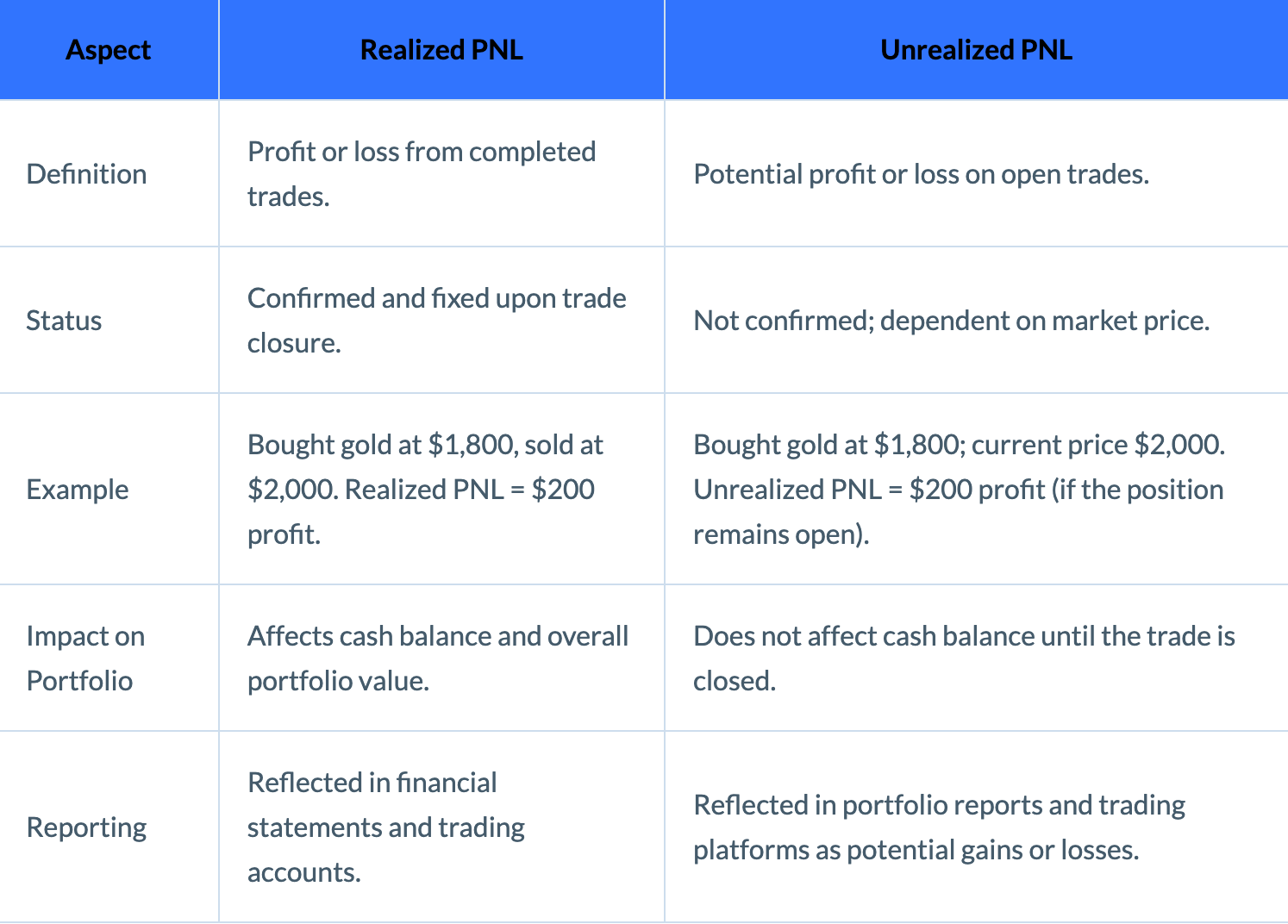
- Unrealized PNL is the profit or loss on a position you’re still holding, calculated in real time against the current market price. It’s sometimes called paper PNL or floating PNL, because it exists only on paper until you actually close the position, and it can vanish or flip to a loss before you ever act on it. If you bought 1 BTC at $90,000 and the price is currently $95,000, you have $5,000 in unrealized profit, but you haven’t actually banked a single dollar of it yet.
- Realized PNL is what happens the moment you close that position, sell the asset, or exit the trade. At that instant, the number stops moving and becomes a permanent part of your trading history, whatever the market does afterward has zero effect on it. If you sold that same Bitcoin at $95,000 after buying at $90,000, your $5,000 gain is now realized, locked in, and reportable for tax purposes in most jurisdictions.
The practical distinction matters more than it might seem. A trader sitting on a large unrealized gain hasn’t actually won anything yet, and a common, expensive mistake is treating unrealized profit as if it were already spendable money. The reverse applies too: a scary unrealized loss on an open position is not the same as an actual, permanent loss, since the price can recover before you close, provided you haven’t been forced out by liquidation in the meantime.
How Do You Calculate PNL in Crypto?
Source: Binance Academy
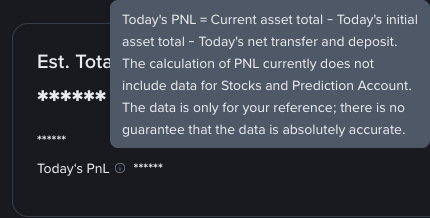
For a simple spot trade, the core formula is straightforward: PNL equals (exit price minus entry price) multiplied by the quantity you’re holding, for a long position where you’re betting the price goes up. If you bought 2 ETH at $3,000 and the current or exit price is $3,400, your PNL is (3,400 minus 3,000) times 2, which comes out to $800.
Short positions, where you’re betting the price falls, flip the subtraction: PNL equals (entry price minus exit price) multiplied by quantity. If you shorted 2 ETH at $3,400 and the price drops to $3,000, your PNL is (3,400 minus 3,000) times 2, again $800, because the price moved in the direction you bet on.
That’s the gross figure, though, the number before fees. Exchanges charge a maker fee (for limit orders that add liquidity) typically around 0.01% to 0.02%, and a taker fee (for market orders that remove liquidity) typically around 0.04% to 0.06%, though exact rates vary by platform and your trading volume tier. Net PNL subtracts both the entry and exit trading fees from the gross figure, and for perpetual futures positions, it also subtracts any funding payments accumulated over the life of the trade. Ignoring fees and funding when eyeballing your performance is one of the most common reasons a trader’s perceived PNL diverges from what their account balance actually shows.
How Does Leverage Affect PNL and ROI?
Here’s the detail that trips up a lot of newer traders: leverage does not change the PNL formula itself, it changes your position size relative to your own capital. With 10x leverage on $1,000 of margin, you’re controlling a $10,000 position, so the same 5% price move that would produce $50 of PNL unleveraged instead produces $500, because the position size feeding into the formula is ten times larger, not because the formula changed.
This is where PNL and ROI (or ROE, return on equity) start to mean genuinely different things, and mixing them up causes real confusion. PNL is the absolute dollar amount you gained or lost. ROI or ROE is that PNL expressed as a percentage of the actual capital you put up, your margin, not the full position value. A $500 PNL on $1,000 of margin at 10x leverage is a 50% ROE, an eye-catching number, even though the underlying price only moved 5%. Leverage amplifies your percentage return dramatically without changing your dollar PNL formula at all, which is exactly why highly leveraged positions feel so much more dramatic on the way up and the way down.
Two more mechanics specific to leveraged futures trading are worth knowing. First, unrealized PNL on a futures position is typically calculated against the mark price, an average reference price designed to prevent manipulation, rather than the last traded price, so your displayed PNL can differ slightly from a naive price-difference calculation. Second, perpetual futures charge a funding rate, typically every eight hours, based on your full position size rather than your margin, and at meaningful leverage this can compound into a real, ongoing cost that quietly erodes PNL on positions held for more than a few hours.
PNL Calculation Examples: Spot, Long Futures, and Short Futures
Walking through a few concrete scenarios makes all of the formulas above click in a way abstract explanations don’t. Here are three common setups worked out step by step, from a simple spot trade to leveraged long and short futures positions.
- Example one: a spot trade with no leverage. You buy 0.5 BTC at $88,000, spending $44,000. Bitcoin rises to $92,000, and you sell. Gross PNL is (92,000 minus 88,000) times 0.5, which equals $2,000. If your exchange charges a 0.05% taker fee on both the buy and the sell, that’s roughly $44 on entry and $46 on exit, about $90 total, bringing net PNL to approximately $1,910. Your ROI on the $44,000 you actually spent is about 4.3%, a modest but real, fully realized gain once you’ve sold.
- Example two: a leveraged long futures position. You open a $10,000 position on ETH using $1,000 of margin at 10x leverage, entering at $3,000. ETH rises to $3,150, a 5% move. Gross PNL is (3,150 minus 3,000) times the position size in ETH (roughly 3.33 ETH at $3,000 entry), which comes out to about $500. Against your $1,000 margin, that’s a 50% ROE, a striking figure driven entirely by the 10x multiplier on position size, not by any change to the underlying formula. Subtract entry and exit fees plus roughly three eight-hour funding periods (say a combined 0.3% of position value), around $30, and net PNL lands closer to $470, still a healthy 47% ROE on the margin you actually risked.
- Example three: a leveraged short futures position, where the trade profits if price falls. You short $10,000 of BTC at 5x leverage ($2,000 margin) at an entry price of $95,000, and BTC drops to $90,000, a decline of roughly 5.3%. Gross PNL for a short is (entry price minus exit price) multiplied by position size in BTC (about 0.105 BTC), which comes out to roughly $525. Against your $2,000 margin, that’s about a 26% ROE. If funding rates were negative during the holding period, which happens when short positions are paying longs rather than the more common reverse, that would be an additional cost subtracted from this figure rather than a credit.
Notice the pattern across all three: the core formula (price difference multiplied by position size) never changes, only the position size, the direction of the subtraction for longs versus shorts, and the additional costs layered on top for leveraged futures positions specifically. Once that pattern clicks, calculating PNL for any new scenario is mostly a matter of correctly identifying which inputs apply.
How Does PNL Relate to Liquidation?
Liquidation is what happens when unrealized losses on a leveraged position eat through your margin down to a maintenance threshold, at which point the exchange automatically closes the position to prevent your losses from exceeding what you deposited. It represents the single worst-case realized PNL outcome on a leveraged trade, and unlike a voluntary exit, you don’t get to choose the timing.
The liquidation price sits at a specific distance from your entry price, and that distance shrinks as leverage increases. At 10x leverage, roughly a 10% adverse price move (before fees and maintenance margin adjustments) is enough to wipe out your entire margin and trigger liquidation. At 50x or 100x leverage, that cushion shrinks to just 2% or 1%, meaning fairly ordinary, unremarkable price volatility can end a position entirely. This is exactly why professional traders overwhelmingly favor lower leverage, commonly in the 3x to 20x range, despite exchanges advertising and offering leverage up to 100x or even 125x on major pairs.
A stop-loss order placed before your liquidation price is reached converts an otherwise open-ended, exchange-forced liquidation into a realized loss you actually chose and controlled the size of. Setting one isn’t just a risk-management nicety, it’s the practical difference between a bounded, planned loss showing up in your realized PNL and an unbounded one decided entirely by the exchange’s liquidation engine.
PNL Dollar Amount vs. PNL Percentage: Which Matters More?
Both numbers matter, but they answer different questions, and relying on only one gives you an incomplete picture of how a trade or a strategy is actually performing. The dollar PNL tells you the real financial impact, what actually changed in your account balance. The percentage figure, whether expressed as ROI against total position value or ROE against margin, tells you how efficiently your capital was used to generate that outcome.
A trader comparing two closed trades side by side needs the percentage figure to judge which one was actually the better use of capital, since a $1,000 gain on a $2,000 position is a vastly better outcome than the same $1,000 gain on a $50,000 position, even though the dollar PNL looks identical. But the dollar figure is what actually pays your rent, and percentage returns on tiny position sizes can look impressive while being functionally irrelevant to your real financial situation.
| Metric | What It Shows | Best Used For | Key Limitation |
|---|---|---|---|
| Gross PNL | Raw price-difference gain or loss before fees | Quick, rough sense of a trade’s outcome | Overstates real performance by ignoring fees and funding |
| Net PNL | PNL after trading fees and funding costs | Accurate accounting of what you actually earned or lost | Requires tracking fees and funding separately, which most dashboards don’t break out clearly |
| Unrealized PNL | Live paper gain or loss on an open position | Monitoring a position you haven’t closed yet | Can vanish or reverse entirely before you act on it |
| Realized PNL | Permanent gain or loss after closing a position | Tax reporting and genuine performance history | Says nothing about how a still-open position is currently doing |
| ROI / ROE (%) | PNL as a percentage of position value or margin | Comparing capital efficiency across different trade sizes | Can look dramatic on small positions while being financially trivial |
The healthiest habit is tracking both together rather than anchoring on whichever number happens to look better in the moment, a large percentage gain on a token position you barely funded, and a modest-looking dollar gain on your largest position, can both be true at once and both be worth understanding on their own terms.
What Mistakes Do People Make When Reading Their PNL?
The most common one is treating a large unrealized gain as if it were already real, spendable money, and adjusting spending or risk-taking based on a number that could evaporate before you ever close the position. Unrealized PNL is a live estimate, not a bank balance, and the gap between those two ideas is where a lot of avoidable financial regret comes from in crypto specifically, since prices move so much faster than in most other markets.
A second common mistake is comparing gross PNL figures across different trades or platforms without normalizing for fees, funding, and leverage. A trade showing a bigger raw dollar PNL isn’t necessarily the better trade once you account for how much capital and risk it actually required to produce that number. Comparing ROI or ROE side by side, not just the dollar figures, is what actually lets you judge whether one strategy or trade genuinely outperformed another.
A third mistake, particularly common with copy trading and social-media PNL screenshots, is assuming a single snapshot represents a trader’s typical, repeatable performance rather than one outcome cherry-picked from many. A screenshot only ever shows one moment, usually a favorable one someone chose to share, and says nothing about that trader’s overall win rate, position sizing discipline, or how many losing trades came before or after the one being shown.
How Do You Track PNL Across Multiple Trades and Exchanges?
A single trade’s PNL is straightforward once you have the formula down, but most active traders hold positions across several exchanges and want a genuine picture of overall performance, not just a scattered collection of individual dashboards that don’t talk to each other. That’s where dedicated tracking becomes worth the setup effort.
Portfolio trackers like CoinStats, Delta, or CoinTracker aggregate holdings and trade history across multiple exchanges and wallets into a single combined PNL view, generally by connecting through read-only API keys or public wallet addresses rather than requiring withdrawal permissions. This solves the real problem of realized PNL being scattered: a gain on one exchange and a loss on another might net out to a genuinely different overall picture than either platform shows you in isolation.
For tax purposes specifically, tools like Koinly and CoinLedger go a step further, importing full trade history and automatically calculating realized gains and losses in the format most tax authorities expect, since manually reconstructing a year of realized PNL across multiple platforms by hand is genuinely impractical for anyone trading with any regularity. Exporting trade history periodically, monthly is a reasonable habit, rather than trying to reconstruct a full year at tax time from memory or scattered exchange statements, saves a significant amount of pain later.
Whatever tool you use, keep the reconciliation habit simple: your net realized PNL across all platforms, minus total fees and funding paid, should roughly match the actual change in your combined account balances over the same period, adjusted for any deposits or withdrawals you made. When those two numbers diverge significantly, it usually means a fee, a funding payment, or a transaction somewhere didn’t get captured correctly, worth chasing down before it compounds into a genuinely misleading picture of how you’re actually doing.
Where Can You Buy or Exchange Crypto?
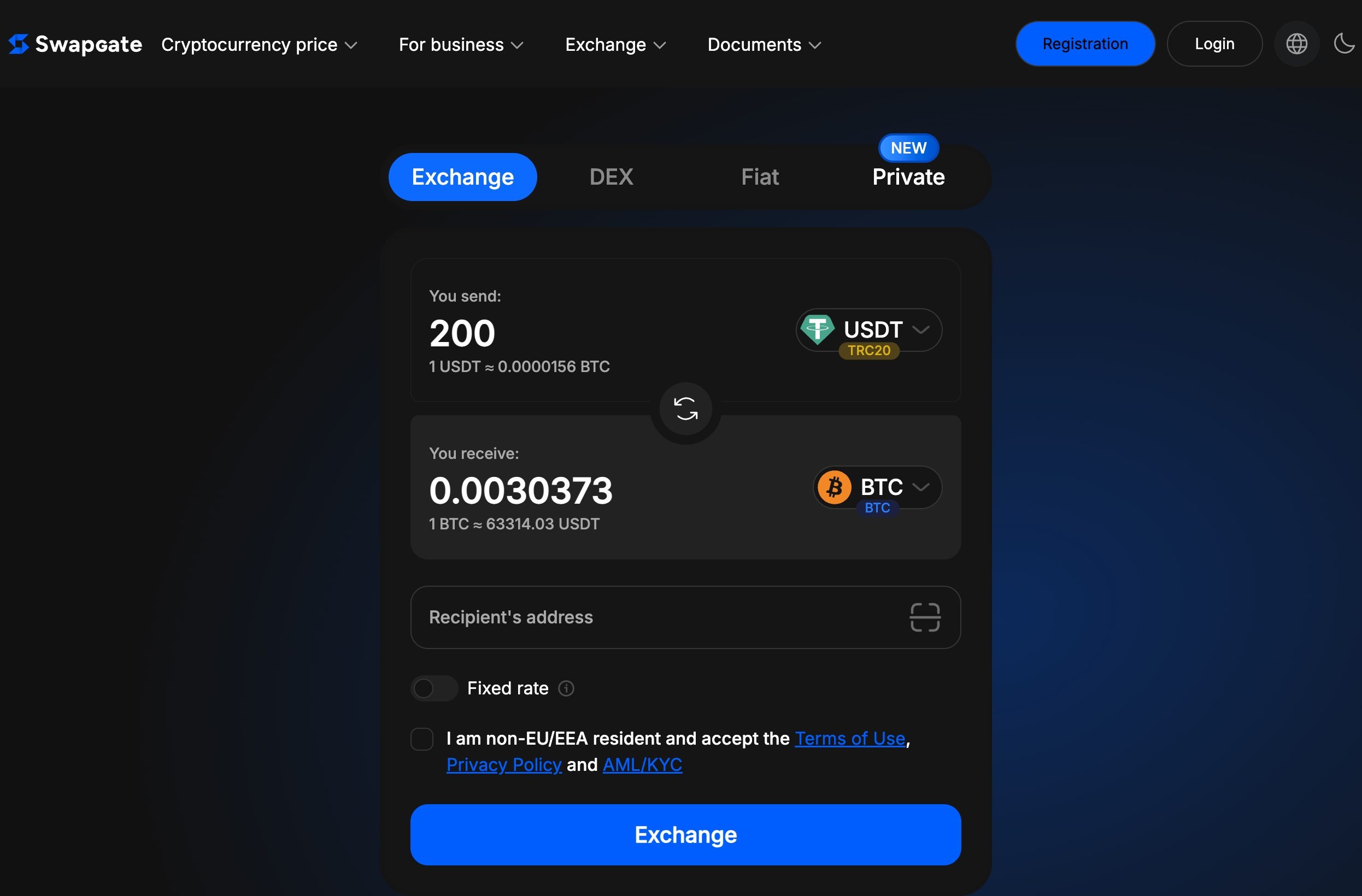
If tracking your PNL has you thinking about rebalancing a position, or you’re just looking to acquire crypto for the first time, there are two broad paths: centralized exchanges that require identity verification, and no-KYC swap services that convert one crypto directly into another without an account. Which one fits depends mostly on whether you’re buying with fiat for the first time or already hold crypto and want to move between assets.
Swapgate is one example of that second category, an instant swap platform that supports Bitcoin, Ethereum, and a wide range of other cryptocurrencies. No account or registration is required to swap, and pricing and speed both get consistently positive marks in user reviews.
For a first-time fiat purchase, a fully KYC-verified exchange remains the more predictable route, since it directly handles card or bank transfer conversion in a way most swap services don’t. Once you’re holding crypto already, a no-KYC swap service becomes a genuinely fast way to move between assets like BTC, ETH, or USDT without repeating identity verification on every single trade, understanding upfront that a flagged deposit is a real, documented possibility rather than a remote edge case.
Frequently Asked Questions
What does PNL stand for in crypto?
PNL stands for profit and loss, the metric showing how much you have gained or lost on a trade or your overall portfolio.
It’s sometimes written as P&L or P/L, all three refer to the same concept. The term originates in traditional finance and accounting, but in trading, including crypto, it specifically tracks the gain or loss on a position rather than a company’s broader financial statements.
Is unrealized PNL taxable?
In most jurisdictions, no, unrealized PNL is not taxable because no sale or closing transaction has actually occurred.
Tax liability generally begins once you realize a gain by closing a position or selling an asset, converting the paper profit into an actual, reportable event. Tax rules vary significantly by country and change frequently, and some jurisdictions treat derivatives and futures contracts differently from spot holdings, so checking current local rules is worthwhile rather than assuming a blanket answer applies everywhere.
Why is my realized PNL different from my unrealized PNL before I closed the trade?
The two numbers rarely match exactly because fees, funding payments, and price movement between your last check and the actual close all factor into realized PNL but may not have been reflected in the unrealized figure you were watching.
Unrealized PNL is often calculated against a mark price rather than the exact price your order actually executed at, and it typically doesn’t subtract trading fees until the position is actually closed. Once you close, all of those costs get applied and finalized, which is why the realized number that appears afterward can look meaningfully different from what the dashboard showed moments before.
Does leverage increase my dollar PNL or just my percentage return?
Leverage increases your dollar PNL by increasing your position size, but the outsized percentage returns people associate with leverage come from comparing that larger PNL against your smaller margin amount.
The underlying PNL formula, price difference multiplied by position size, never changes; what changes is that leverage lets a small amount of margin control a much larger position. That’s why the same percentage price move produces a much bigger dollar PNL and an even more dramatic percentage ROI or ROE at higher leverage, in both directions.
What is a good PNL percentage in crypto trading?
There’s no universal good number, it depends heavily on your timeframe, strategy, position sizing, and how much risk you took to get there.
A 5% gain achieved with no leverage and tight risk controls can represent better trading than a 50% gain achieved by taking on enormous leverage and risk of liquidation. Consistency and risk-adjusted performance over many trades matter far more than any single PNL percentage viewed in isolation.
Can PNL be negative even if I haven’t sold anything?
Yes, a negative unrealized PNL simply means your open position is currently worth less than what you paid, whether or not you ever sell at that price.
That negative figure only becomes a real, permanent loss if you close the position while it’s still negative; otherwise, it’s a paper loss that can recover if the price moves back in your favor. The exception is a forced liquidation, where the exchange closes the position for you once losses reach a certain threshold, converting what was still an unrealized loss into a realized one without your input.
Disclaimer: The material in this article is not financial or investment advice. Everything stated here reflects the author's personal view and should not be treated as a recommendation to trade or invest. We make no warranties regarding the accuracy, reliability or completeness of the information presented. Cryptocurrency markets are highly volatile and can move unpredictably. Before committing any funds, every investor, trader or crypto user should study several independent sources and check the regulations that apply in their own jurisdiction.