
Whether you are a seasoned trader or someone who just bought their first fraction of Ethereum, understanding how to generate passive income on your digital assets is a game-changer. In this guide, we’ll look at where these returns actually come from, dig into the mechanics of yield farming, and help you figure out if these strategies are right for your portfolio.
Key Takeaways:
- Crypto yield is simply the interest or rewards you earn by putting your digital assets to work rather than just holding them in a wallet.
- You can earn this through staking (helping secure a network), lending (loaning assets for interest), or providing liquidity (funding decentralized exchanges).
- Yield farming is a more aggressive strategy where investors move their crypto between different decentralized finance (DeFi) protocols to chase the highest possible returns.
- While the payouts can be massive compared to traditional banking, the risks—like smart contract bugs and impermanent loss—are equally significant.
The Basics: What Is Yield Crypto?

In traditional finance (TradFi), yield is the cash return you get on an investment. If a bank pays you 4% APY on your savings, that 4% is your yield. The bank takes your money, lends it out for mortgages or personal loans at a higher rate, and gives you a cut of the profits.
When we talk about yield crypto, the foundational concept is identical: you are being compensated for providing your assets to a system that needs them to function.
However, the mechanisms are entirely different. Instead of a bank acting as the middleman, taking the lion’s share of the profit, crypto relies on computer code (smart contracts) to automate the process. This automation cuts out the overhead, which is why crypto returns historically dwarf the interest rates offered by your local credit union.
Where Does the Money Actually Come From?
If you are earning 10% on your digital assets, you should absolutely be asking, “Where is this money coming from?” If you don’t know where the yield comes from, you are the yield.
Generally, legitimate crypto yield comes from three main sources:
- Network Inflation: Blockchains like Ethereum need people to lock up their coins to secure the network (staking). In return, the network prints new coins and gives them to the stakers as a reward.
- Trading Fees: Decentralized exchanges (DEXs) need user funds to facilitate trades. If you provide those funds, you get a cut of every trading fee paid by other users.
- Borrowing Interest: Just like in the real world, people want leverage. They will borrow your crypto and pay you an interest rate to do so.
The Big Question: What Is Yield Farming?
If earning basic interest on your crypto is like keeping your money in a savings account, yield farming is like being an aggressive day trader who constantly moves capital between hedge funds to squeeze out every last drop of profit.
So, what is yield farming exactly?
Also known as liquidity mining, it is the practice of locking up your cryptocurrencies in decentralized finance (DeFi) protocols to generate rewards. But a “farmer” doesn’t just deposit funds and walk away. They actively hunt for the best returns, constantly moving their liquidity from one pool to another, sometimes borrowing against their own deposits to leverage their positions and stack rewards on top of rewards.
It’s complex, it’s fast-paced, and it’s the heartbeat of the modern DeFi ecosystem.
The Mechanics: How Does Yield Farming Work?
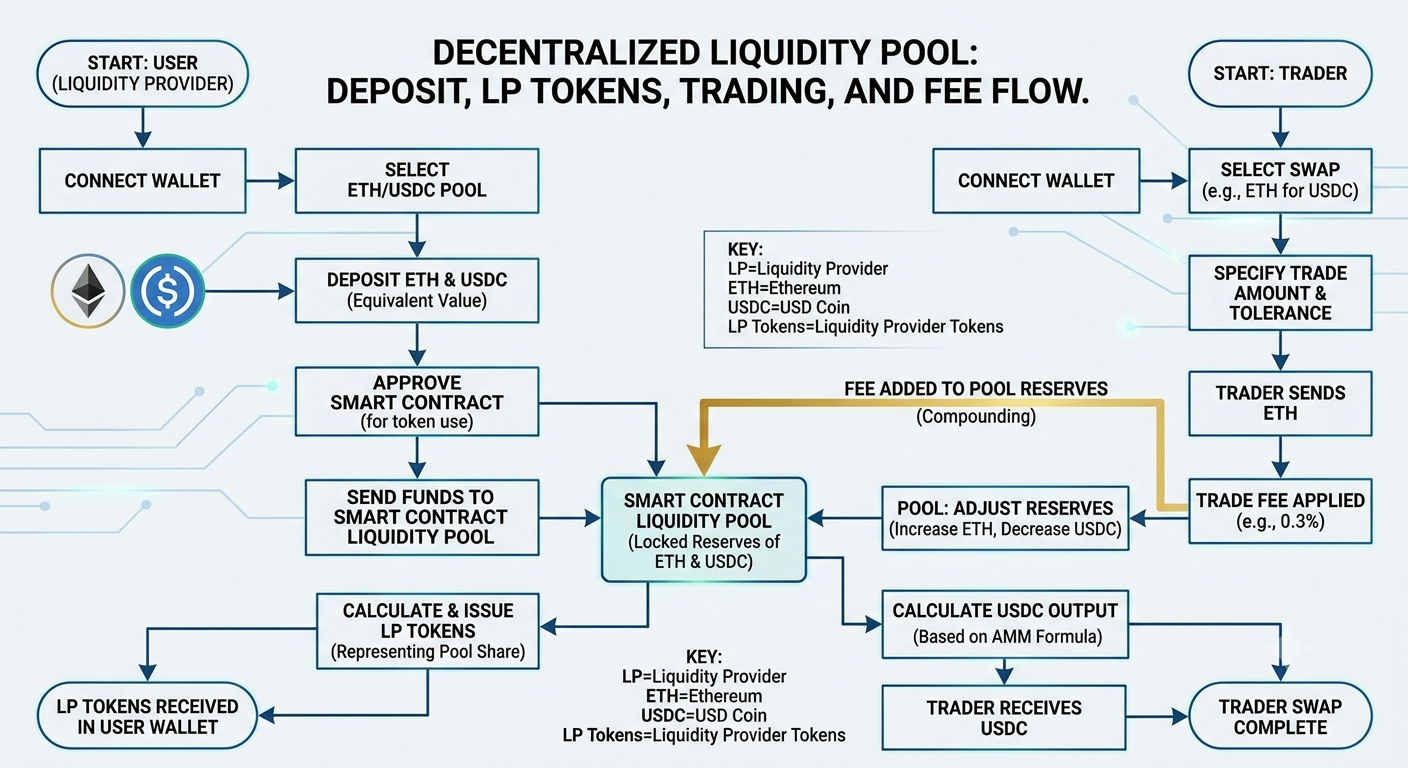
To really grasp how does yield farming work, you have to understand Automated Market Makers (AMMs) and Liquidity Pools.
In traditional stock markets, a centralized exchange matches buyers with sellers using an order book. If you want to sell Apple stock at $150, the exchange waits until someone wants to buy it at $150.
Decentralized crypto exchanges (like Swapgate) don’t have order books. They use Liquidity Pools. A liquidity pool is simply a massive digital pot of funds locked in a smart contract.
Here is a step-by-step breakdown of the mechanics:
- The Deposit: A user (the yield farmer) deposits a pair of tokens into a liquidity pool—for example, $1,000 worth of Ethereum and $1,000 worth of USDC.
- The LP Token: In exchange for providing this liquidity, the protocol gives the farmer a “Liquidity Provider (LP) token.” This token is basically a digital receipt proving they own a share of that specific pool.
- The Trading Fees: Whenever regular traders swap BTC to USDT using that pool, they pay a small fee (usually around 0.3%). That fee goes directly back into the pool, proportionally growing the value of the farmer’s LP token.
- The Extra Incentives: This is where the “farming” really kicks in. To attract massive amounts of capital, new platforms will often reward farmers with their own native platform tokens on top of the standard trading fees.
The farmer can then take those freshly earned reward tokens, sell them for more Ethereum, and repeat the cycle.
Navigating DeFi Yield Farming vs. CeFi
When you decide you want to put your assets to work, you generally have two paths: Centralized Finance (CeFi) and Decentralized Finance (DeFi).
CeFi Yield
Think of platforms like Binance, Nexo, or Coinbase. You give them custody of your crypto, and they pay you a yield. It is user-friendly, requires very little technical knowledge, and feels like using a traditional banking app. However, you are giving up control of your keys. If the company goes bankrupt (like we saw with Celsius and BlockFi in 2022), your money is gone.
DeFi Yield Farming
This is the wild west. When you engage in defi yield farming, you retain total control of your funds via your own self-custody wallet (like MetaMask). You interact directly with the smart contracts. There are no customer support lines, no KYC (Know Your Customer) forms, and no bailouts. It requires more technical skill, but it eliminates corporate mismanagement risk.
The Anomaly: Bitcoin Yield Farming
You might be thinking, “Wait, Bitcoin doesn’t have smart contracts like Ethereum. Can I even earn yield on it?”
It’s a great question. Because the Bitcoin network itself is a Proof-of-Work system (miners secure the network, not stakers), native bitcoin yield farming on the base layer isn’t really a thing. You can’t just lock BTC in a smart contract on the Bitcoin mainnet to farm tokens.
However, the crypto market is highly inventive. Here is how people currently farm yield with Bitcoin:
- Wrapped Bitcoin (WBTC): Investors “wrap” their Bitcoin, converting it into a token that mirrors BTC’s price but lives on the Ethereum blockchain. Once it’s on Ethereum, that WBTC can be deployed into DeFi protocols for lending, borrowing, and farming just like any other asset.
- CeFi Lending: Depositing native Bitcoin into centralized platforms that lend it out to institutional short-sellers.
- Bitcoin Layer 2s: Newer networks built on top of Bitcoin (like Stacks or Rootstock) are beginning to introduce DeFi capabilities closer to the native chain, though this space is still highly experimental.
Yield Farming Explained: The Risks vs. Rewards
We’ve talked a lot about the upside. Now let’s look at the dark side. If someone tells you that earning 50% APY on a random dog-themed token is “safe passive income,” they are lying to you.
When having yield farming explained to a beginner, understanding the risk profile is more important than understanding the potential profit.
The Balancing Act
| Feature/Risk Factor | The Reward (Why We Do It) | The Risk (What Can Go Wrong) |
| Smart Contracts | Code automates everything, cutting out expensive middlemen for higher payouts. | Smart Contract Bugs: If the code has a flaw, hackers can exploit it and drain the entire liquidity pool. There is no FDIC insurance here. |
| Asset Volatility | If you are earning yield in a token that suddenly pumps in price, your overall returns skyrocket. | Token Dumps: You might earn 100% APY in a platform token, but if that token’s price crashes by 90%, you still lose money overall. |
| Market Making | You earn continuous fees 24/7 just by letting your assets sit in a pool. | Impermanent Loss: If the price of one token in your pair heavily outperforms the other, the AMM rebalances your pool. You might end up with less total value than if you had just held the two assets separately. |
| Leverage | You can borrow against your own assets to multiply your farming positions. | Liquidation: If the market dips sharply, your collateral drops in value, and the protocol will automatically sell your assets at a loss to repay the debt. |
Step-by-Step: Getting Started with Yield Farming Crypto
If you’ve weighed the risks and want to try your hand at yield farming crypto, here is a highly simplified roadmap for a beginner.
Step 1: Get a Self-Custody Wallet
Download a reputable Web3 wallet like MetaMask, Trust Wallet, or Phantom. Secure your 12-word seed phrase offline (never take a screenshot of it).
Step 2: Fund Your Wallet
Buy some baseline crypto (like Ethereum, Solana, or MATIC) on a centralized exchange, and transfer it to your new self-custody wallet. Make sure to keep a little extra to pay for transaction fees (gas).
Step 3: Choose a Reputable Protocol
Don’t chase the shiny 10,000% APY on a platform that launched yesterday. Start with blue-chip DeFi protocols that have been heavily audited and have stood the test of time. Look at Aave (for lending), Uniswap (for providing liquidity), or Lido (for liquid staking).
Step 4: Deposit and Monitor
Connect your wallet to the decentralized application (dApp). Follow the prompts to supply your assets. Once deposited, track your position closely. DeFi is not a “set it and forget it” environment.
Conclusion: Is Chasing Crypto Yield Worth It?
Ultimately, incorporating crypto yield into your investment strategy is a fantastic way to compound your wealth over time. Instead of letting your digital bags gather virtual dust, you can put them to work.
However, the days of throwing money at any random food-themed DeFi protocol and making a fortune are largely behind us. Today, successful yield farming requires education, active risk management, and a healthy dose of skepticism. Start small. Learn how the plumbing of decentralized finance works. Try lending a stablecoin like USDC on a major protocol for a modest 5% return before you start taking aggressive, leveraged positions. The yield is out there, waiting to be harvested. You just have to know how to navigate the farm.
FAQ: Frequently Asked Questions
Is crypto yield considered taxable income?
Yes. In most jurisdictions, including the US, UK, and Australia, earning yield on your cryptocurrency is treated similarly to earning interest in a bank or receiving dividends. You owe income tax based on the fair market value of the crypto at the moment you received it. Always consult a tax professional.
Can I lose my initial investment while yield farming?
Absolutely. You can lose your principal through smart contract hacks, extreme impermanent loss, protocol bankruptcy, or if you use leverage and get liquidated during a market flash crash. Never farm with money you cannot afford to lose.
What is the safest way to earn yield crypto?
“Safe” is a relative term in crypto. However, the lowest-risk methods generally include holding stablecoins on top-tier, over-collateralized lending protocols (like Aave or Compound) or directly staking native layer-1 tokens (like Ethereum or Solana) to help secure the network.
Why are DeFi yield farming rates sometimes so high?
Astronomical APYs (like 500%+) are usually subsidized by the protocol printing its own native tokens out of thin air to attract early users. These rates are heavily inflationary and mathematically unsustainable long-term. As more people join the pool, the slice of the pie gets smaller, and the APY drops rapidly.