
YiFi is a full-spectrum crypto swap and yield platform built around two core products: Swap, which routes trades across DEXs, CEXs, and other liquidity sources to find best-price execution, and Earn, a modular DeFi yield aggregator that gives users a way to deploy idle assets into vetted strategies without manually researching or interacting with each underlying protocol themselves. Both products are non-custodial: YiFi never takes control of a user’s funds, private keys, or withdrawal permissions at any point.
The platform aggregates more than 20 liquidity and yield sources, spanning DEX and CEX swap routing through partners like Swapgate, LI.FI, Rango Exchange, 0x, ChangeNOW, and Quickex, and yield strategies sourced from protocols including Aave, Pendle, and Morpho. Beyond the consumer-facing Swap and Earn interfaces, YiFi runs a Telegram Mini App for mobile-first access, a full developer API layer for both products, and a Partner Portal aimed at wallets, dApps, and integrators who want to embed swap and yield functionality directly into their own products rather than sending users elsewhere.
This overview walks through each of these pieces: what Swap and Earn actually do, how the platform handles security and custody, what the Partner Portal and APIs offer for integrators, and where to go to start using or building on the platform.
Swap: Best-Price Execution Across Multiple Liquidity Types
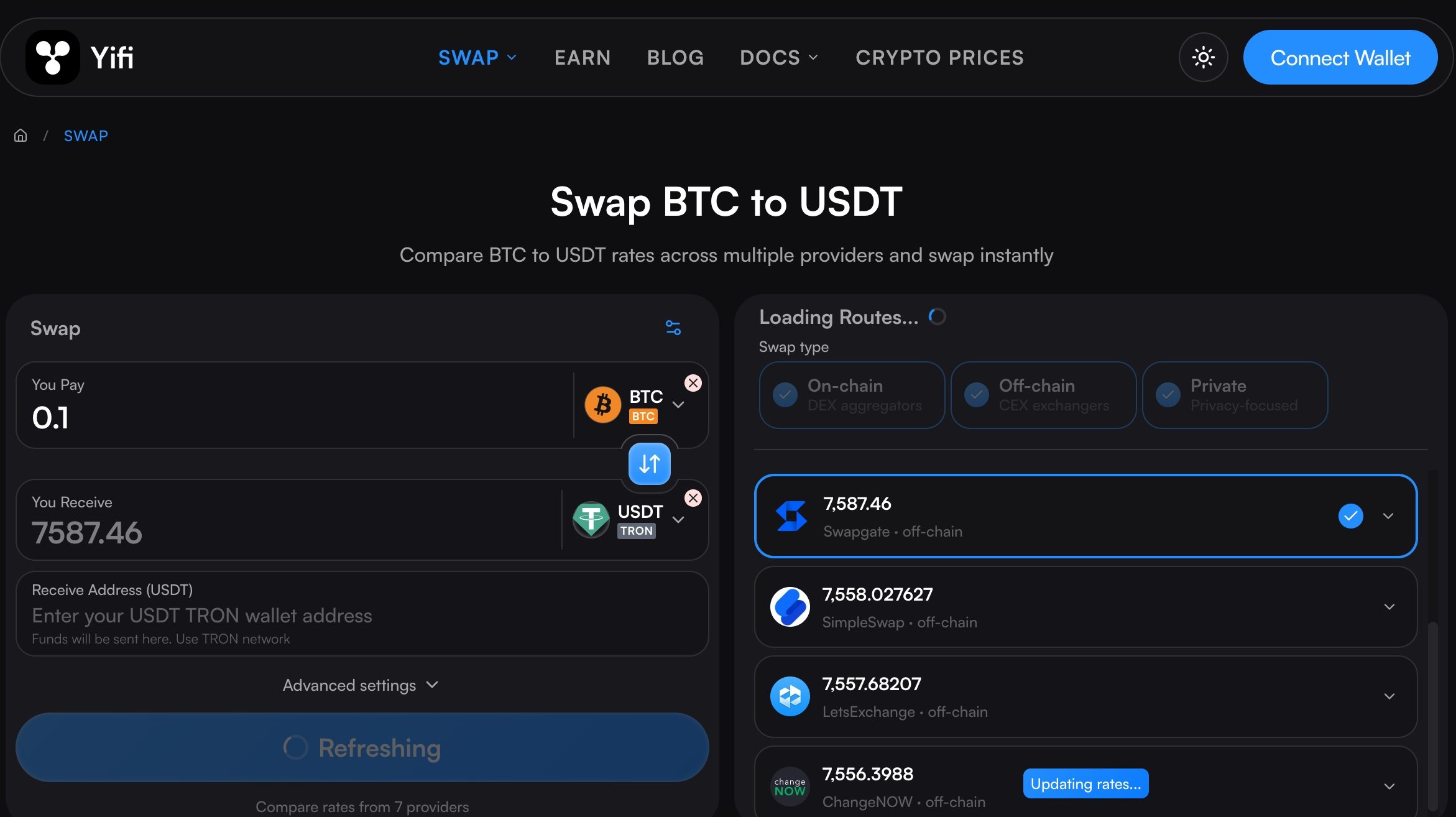
YiFi’s Swap product is built around a single idea: liquidity for any given trade is fragmented across many different venues, DEXs, CEXs, and other liquidity sources, and no single one of them consistently offers the best price. Rather than routing a trade through one fixed venue, YiFi’s Smart Routing algorithm simultaneously analyzes dozens of major decentralized exchanges, centralized exchanges, and other liquidity sources, comparing real-time prices, liquidity depth, and fees to identify the most optimal single execution path for that specific trade.
This unified approach means a user or an integrated application doesn’t need to separately evaluate DEX liquidity against CEX liquidity to find the better price; YiFi does that comparison automatically and routes to whichever source, or combination of sources, delivers the best final execution. For advanced users and integrators who want more control, the platform also allows filtering routing results to include only DEX liquidity or only CEX liquidity, rather than always defaulting to the unified comparison.
Execution quality on large trades. For sizable trades specifically, Smart Routing is built to minimize market impact and protect execution quality: it prioritizes routes with the deepest available liquidity and fastest execution speed to reduce slippage, and it’s designed to prevent transaction details from being exploited by front-running bots before a trade confirms, a category of exploitation more commonly known as MEV. The goal is that a large order actually executes at close to the price it was quoted at, rather than a materially worse price caused by the trade’s own visibility in the process of confirming on-chain.
No platform markup. YiFi doesn’t add its own fee on top of a swap. Users pay the standard network gas fees required to process any on-chain transaction, plus whatever fees the underlying exchange or liquidity provider charges, but nothing additional from YiFi itself. The Smart Router also factors gas cost into route selection, optimizing for the lowest-cost path available for a given trade, not just the best headline price.
Continuously updated coverage. Rather than a fixed, periodically-updated list of supported pools, YiFi’s routing system is built to continuously integrate new liquidity pools and providers, aiming for broader market coverage than a typical aggregator and keeping routing decisions based on current, not stale, market data.
For end users, all of this is available through the YiFi Swap directly. For developers and integrators, the same routing logic is available programmatically through the Swap API, covered in detail below.
YiFi Swap: The API for Developers
For wallets, dApps, and trading tools that want to offer swap functionality without building routing and liquidity infrastructure from scratch, YiFi exposes this through a public REST API. The API is organized around the core pieces you’d expect from a swap aggregation service:
- Chains and providers. Endpoints to list supported chains and the liquidity providers YiFi routes through, giving an integrator visibility into exactly what network and venue coverage is available before building against it.
- Tokens and pairs. Endpoints to look up supported tokens and search available exchange pairs, including which counterpart tokens are tradeable against a given asset, useful for building a swap interface that only surfaces valid, liquid pairs to end users.
- Quotes. A quote endpoint that returns pricing for a prospective swap before it’s submitted, letting an integrator show users an expected rate ahead of execution.
- Swap execution. An endpoint to create an actual swap order once a user commits to a quoted trade, plus a transactions endpoint to check the status of an order after submission, useful for surfacing real-time progress to end users rather than leaving them without feedback while a swap is processing.
The API also includes an aggregator-specific set of endpoints covering the same core functionality, providers, quotes, pairs, and swap creation, structured for integrators building specifically around YiFi’s liquidity aggregation layer.
For the full technical reference, including endpoint parameters and response formats, see the YiFi Swap API documentation.
Earn: Putting Idle Assets to Work
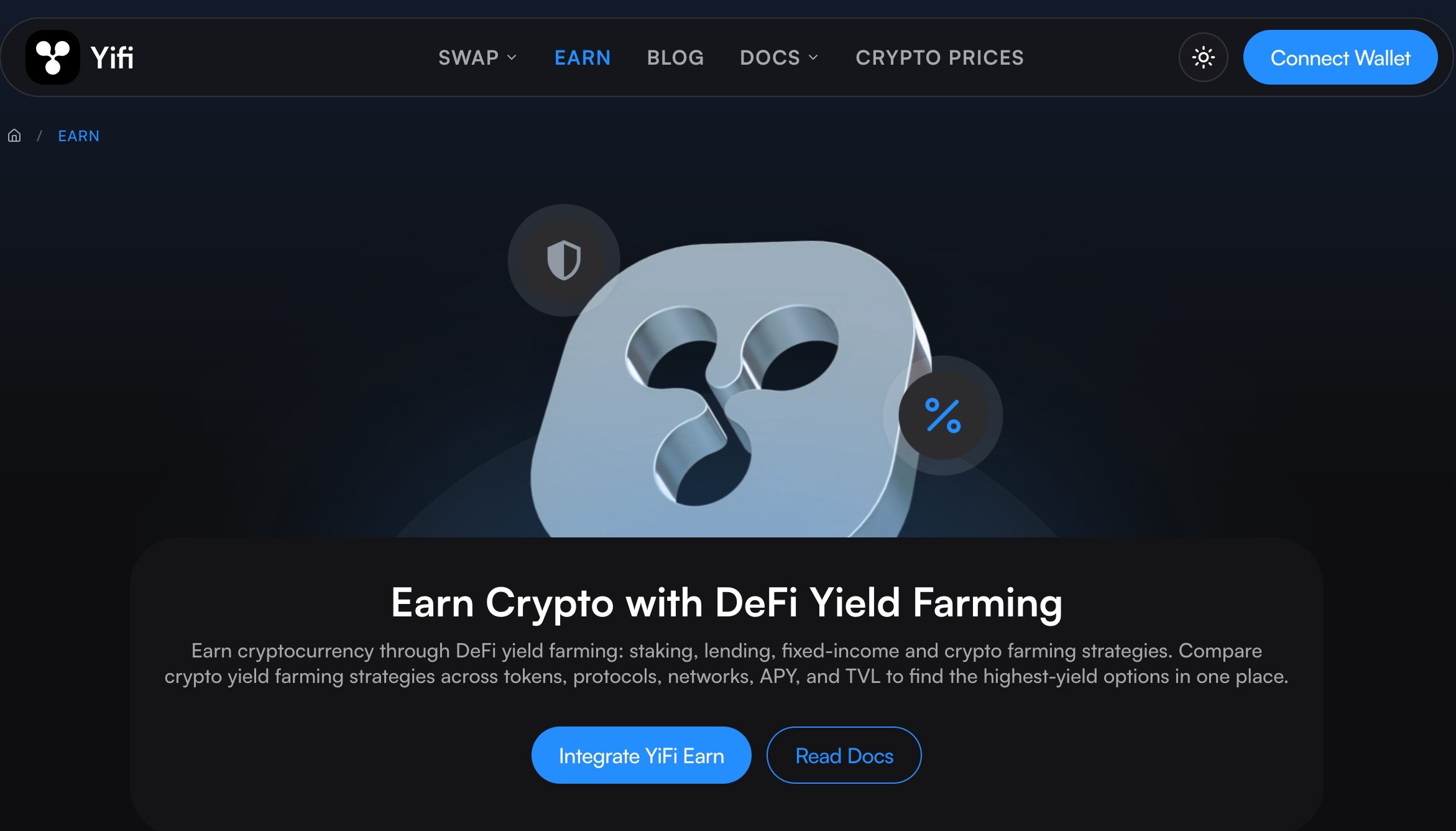
Where Swap handles moving from one asset to another, Earn is built for deploying assets into yield-generating positions, lending, staking, and similar strategies across supported protocols, without requiring a user or integrator to separately research and manually interact with each underlying protocol. YiFi describes Earn as yield aggregation with a specific mechanic: you deposit one asset, and YiFi handles the swaps, bridging, and execution needed to get that deposit into the target strategy under the hood, through a single-click action the platform calls a Zap.
Strategy coverage and current ranges. As of this writing, YiFi surfaces more than 20 strategies across roughly 15 underlying providers, with advertised APY ranges spanning approximately 2% to 10% depending on the specific strategy, asset, and risk profile. These figures move with market conditions; check the live Earn interface for current rates before making any decision.
Risk transparency. Every strategy on the platform comes with a risk rating calculated through YiFi’s internal Risk Scoring Layer. Rather than a single opaque score, users can see which protocols a given strategy uses, which specific assets they’d be exposed to, the expected APY range, and which categories of risk apply, smart contract risk, market risk, and liquidity risk are evaluated and disclosed separately rather than collapsed into one number.
Custody and execution. YiFi is explicit that it functions as an aggregator, not a market maker: it doesn’t supply its own liquidity, and it doesn’t hold user funds. Every route is requested on-chain, execution happens through audited underlying protocols, and a user retains the ability to withdraw their position directly on-chain at any time. This is the same non-custodial principle that applies to Swap, extended to the yield side of the platform.
Supported assets and chains. Earn supports commonly held assets across chains, including USDT, USDC, ETH, and BTC (via WBTC), along with native tokens depending on the specific network. Chain coverage spans multiple L1 and L2 ecosystems, including Ethereum, Arbitrum, BNB Chain, and Base, with non-EVM chain support in active development.
For end users, all of this is available through the YiFi Earn interface, where available strategies, their current rates, and relevant risk information are surfaced directly. For developers and partners integrating yield functionality into their own products, the Earn API mirrors the same underlying data and execution layer, covered in detail below.
YiFi Earn: The API for Developers
The Earn API is structured around a few distinct concepts that reflect how yield strategies actually work, rather than treating “earn” as a single undifferentiated feature:
- Reference data. Endpoints covering categories, supported chains, and platforms, giving integrators a way to filter and organize available strategies by the dimensions that matter to their own product.
- Tokens and markets. Endpoints for token groups, tags, and metrics, alongside market-level data including token roles within a given market and historical metrics, useful for surfacing meaningful context around a specific yield opportunity rather than just a headline rate.
- Strategies. The core of the Earn API: endpoints to list available strategies, get details and historical data on a specific one, and retrieve yield information, along with supporting endpoints for the underlying execution engines, rate formats, risk scores, and strategy status. This structure lets an integrator build a filtered, risk-aware view of available yield options rather than surfacing a flat, undifferentiated list.
- Zap. The execution layer for Earn: endpoints to get a quote for a zap (a combined swap-and-deposit action), build the zap transaction itself, and check transaction status after submission.
- Partners. A dedicated set of endpoints for partner-level account management: supported chains, API key creation and management, claim address configuration, fee balance lookup, and fee claiming, both individually and in bulk, plus partner metrics, policy configuration, and summary data. This is the programmatic counterpart to the Partner Portal, letting a partner manage their integration and commission settings directly through the API rather than only through the dashboard interface.
For the full technical reference, see the YiFi Earn API documentation.
Telegram Mini App
Beyond the web interfaces, YiFi’s Swap and Earn functionality is also available through a Telegram Mini App, accessible directly via @yifi_io_bot. This gives users access to swaps and yield strategies without leaving Telegram or installing a separate application, opening directly from a chat with the same underlying routing and execution as the main web platform. For users who already spend time in Telegram-based crypto communities, this removes a step that would otherwise mean switching context to a browser or a separate app entirely.
Partner Portal and Revenue Models for Integrators
For wallets, dApps, and other platforms that want to earn from embedding YiFi’s Swap or Earn functionality, YiFi supports several distinct partnership models rather than a single fixed arrangement:
- Revenue share per zap-in, where a partner earns a portion of fees generated as their users execute yield deposits through the integration.
- White-label strategy UI, letting a partner present YiFi’s underlying strategy catalog under their own product’s branding rather than a visibly third-party interface.
- Affiliate and tracking IDs, for routing and attributing yield or swap contributions back to a specific partner without requiring a fully white-labeled integration.
On the Swap side specifically, integrators who route trades through the platform can earn a percentage of the fees generated by underlying liquidity providers on every successful swap processed through their integration.
All of this is managed through the Partner Portal, which gives partners a central place to track referred volume, manage API keys, and monitor performance. Partners can also filter which strategies surface inside their own product by asset type (stablecoins, liquid staking tokens, blue-chip assets), risk profile, chain, or APY range, rather than exposing their users to the platform’s full unfiltered strategy catalog.
On-chain fee settlement for Earn partners. For partners integrating Earn specifically, YiFi has deployed FeeSplitter, a smart contract that handles partner fee distribution directly on-chain across eight EVM networks. Rather than the more common industry pattern of running affiliate fee-sharing off-chain through an internal ledger, FeeSplitter assigns a partner’s fee share on-chain at the moment a transaction settles. Partners claim their accrued fees themselves, using their own key, and every accrual and claim is independently verifiable both on a block explorer and through the Partner API, removing the need to rely solely on YiFi’s own reporting to confirm what’s owed.
Security and Custody
Non-custodial design is a consistent principle across both Swap and Earn, not a feature limited to one product. YiFi states plainly that it never takes control of a user’s private keys or withdrawal permissions. Funds remain in a user’s own wallet throughout, and all actions, whether a swap or a yield deposit, execute on-chain through audited protocols rather than through an internal YiFi-controlled balance.
For integrators evaluating the platform, this matters specifically because it changes what liability and custody risk actually sits with the integrating product: since YiFi doesn’t hold user funds at any point, a wallet or dApp embedding YiFi’s Swap or Earn functionality isn’t introducing an additional custodial relationship into its own product by doing so.
Conclusion
To explore YiFi’s products directly, visit yifi.io for the currently supported chains and tokens, live cryptocurrency price data, and access to the Partner Portal for integrators and referral partners.
For technical integration, start with the Swap API documentation if you’re building swap functionality into a wallet or app, or the Earn API documentation if you’re integrating yield strategies specifically. Both APIs are built to be used independently or together, depending on what your product needs, and both are backed by dedicated integration support, semantic versioning with advance notice for breaking changes, and documentation aimed at getting a new integration to production with minimal back-and-forth.
Disclaimer: The material in this article is not financial or investment advice. Everything stated here reflects the author's personal view and should not be treated as a recommendation to trade or invest. We make no warranties regarding the accuracy, reliability or completeness of the information presented. Cryptocurrency markets are highly volatile and can move unpredictably. Before committing any funds, every investor, trader or crypto user should study several independent sources and check the regulations that apply in their own jurisdiction.