
Bitcoin is the most valuable crypto asset; but by design, it can’t “speak” smart contracts the way Ethereum can. That’s where WBTC comes in: it turns Bitcoin’s value into an ERC-20 format so it can be used in DeFi without selling BTC. In 2026, the big story isn’t just utility; it’s trust, especially after the BitGo/BiT Global custody transition and renewed focus on Proof of Reserves.
The Core Concept
WBTC (Wrapped Bitcoin) is a 1:1 backed ERC-20 token that represents Bitcoin on the Ethereum blockchain. When BTC is deposited with an approved custodian, the same amount of WBTC is minted, letting Bitcoin holders use DeFi apps without selling BTC and keep parity via redemption.
Why “Wrap” Bitcoin? Solving the Interoperability Problem
Source: Coingecko
Bitcoin is excellent at being Bitcoin: secure, simple, and widely held. But most DeFi rails – lending markets, DEX liquidity, onchain derivatives live on smart contract platforms, especially Ethereum and its L2s. Wrapping is the “adapter” that makes BTC composable: you keep BTC price exposure while gaining DeFi functionality like collateralized borrowing, liquidity provisioning, and onchain trading.
That’s the real answer to whats Wrapped Bitcoin in one line: it’s Bitcoin liquidity, made programmable.
Wrapped Bitcoin vs Bitcoin
The peg is the promise that Wrapped BTC should trade at roughly the same price as BTC because it’s redeemable 1:1. In practice, WBTC can trade at tiny premiums/discounts due to liquidity, redemption frictions, and market stress, but arbitrage (mint/redeem) typically keeps it close.
So Wrapped Bitcoin vs Bitcoin is really about trade-offs:
- BTC: maximal sovereignty, minimal counterparty risk (if self-custodied).
- WBTC: composability + DeFi utility, but introduces custodial + smart contract risk.
The Role of the ERC-20 Standard in Unlocking Bitcoin’s Utility
WBTC uses the ERC-20 standard, which means it plugs into almost everything on Ethereum and many EVM L2s. That’s why you’ll see WBTC used in protocols like Aave and Uniswap across Ethereum and L2 networks such as Arbitrum and Optimism (via bridged representations).
How WBTC Works: The Custodial Architecture
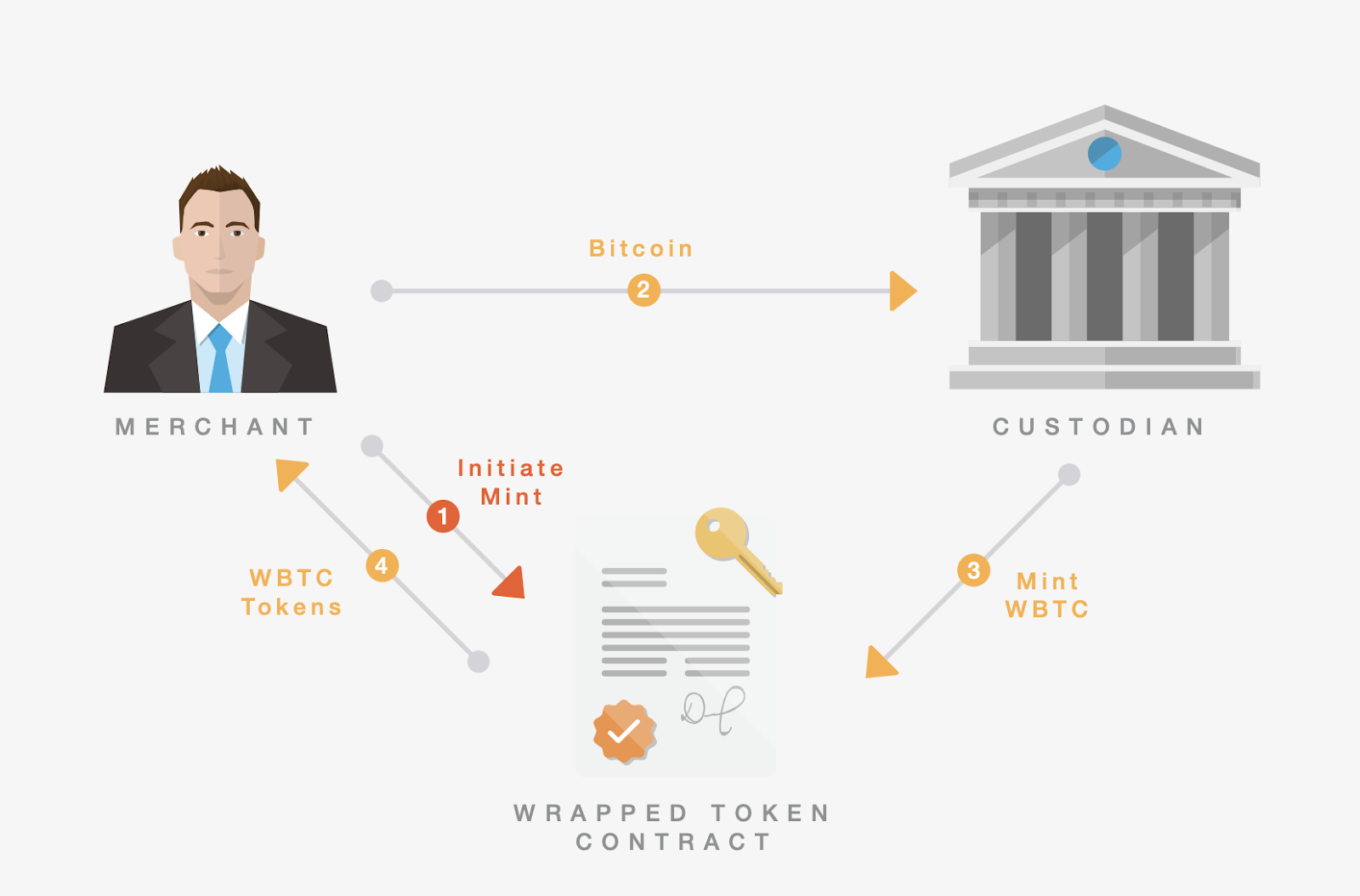
The Three Pillars: Custodians, Merchants, and the User
Most beginner guides miss this: WBTC isn’t “just a token.” It’s a system with roles.
- Custodian: holds the underlying BTC in custody and mints/burns WBTC.
- Merchant: interfaces with users/institutions to request minting/burning.
- User: holds and uses WBTC in DeFi.
The Minting Process: How Your Bitcoin Becomes WBTC
Here’s the clean version of how does Wrapped Bitcoin work when minting:
- Choose a merchant (an approved entity that can request minting).
- Complete required checks (many merchants operate with AML/KYC checks depending on jurisdiction and size).
- Send BTC to the custodian-controlled address (the merchant coordinates this step).
- Custodian mints WBTC on Ethereum equal to the BTC deposited (1:1).
- Merchant delivers WBTC to the user’s Ethereum address (or to a DeFi destination).
Important: most everyday users don’t mint directly; they usually buy WBTC on exchanges or swap BTC to USDT. The mint path is more institutional/merchant-oriented.
Burning and Redeeming: Converting WBTC Back to Native Bitcoin
Burning is the reverse of minting:
- User sends WBTC to a merchant (requesting redemption).
- Merchant requests a burn from the custodian for that WBTC amount.
- WBTC is burned on Ethereum (supply decreases).
- Custodian releases BTC 1:1 to the user’s Bitcoin address (minus applicable fees).
That redemption loop is what anchors parity and explains why WBTC is typically very close to BTC’s price.
The Trust Model: Who Controls the Keys?
The Role of BitGo and the 2024/2025 Strategic Partnership Shifts
Historically, BitGo was the best-known WBTC custodian, and early WBTC messaging highlighted BitGo custody plus public Proof of Assets dashboards.
Then came the 2024 custody shift. On August 9, 2024, BitGo announced it would move WBTC to a multi-jurisdictional custody setup via a joint venture with BiT Global, diversifying operations and cold storage across multiple locations.
That announcement triggered real DeFi scrutiny: risk teams published assessments and some protocols revisited collateral policies because custody governance suddenly mattered more.
By 2026, the key “freshness” point is this: WBTC is still widely used, but serious users now treat custody structure as part of the asset’s risk premium.
Proof of Reserves: How to Verify the Bitcoin Backing the WBTC Supply
WBTC’s credibility rests on one thing: can anyone verify that the BTC exists?
WBTC’s official site states that every WBTC is backed 1:1 by BTC in custody and that backing is verifiable through on-chain Proof of Reserves.
BitGo’s original launch post emphasized a public dashboard where users can validate the circulating WBTC supply and the BTC held in custody addresses.
A practical “verify it yourself” checklist:
- Check the WBTC total supply on Ethereum (token contract dashboards / explorers).
- Check the published BTC reserve addresses associated with WBTC custody.
- Compare BTC reserves vs WBTC supply (they should match 1:1, allowing for operational timing).
If you’re the kind of investor who wants receipts, this is where you spend your time, not on influencer threads.
The DAO Governance: Who Decides Which Custodians are Trusted?
WBTC has governance components often described as a DAO model: the DAO governs contract changes and the addition or removal of merchants and custodians
This matters more after custody transitions. In early 2026, investigative reporting raised questions about whether some custodian/merchant changes were fully reflected across all governance surfaces (website listings vs onchain member contracts).
The takeaway: governance exists, but “who controls what” should be verified in the places that actually enforce rules (contracts, custody agreements, published reserve addresses), not just in marketing pages.
Is Wrapped Bitcoin Safe in 2026?
Centralization Risks: The Single Point of Failure Discussion
The biggest WBTC risk is not price volatility, it’s counterparty concentration. If custody operations are frozen, compromised, or legally blocked, redemption can break, and the peg can wobble.
The 2024 move to multi-jurisdiction custody was explicitly positioned as diversification, but it also introduced new stakeholders and new trust assumptions, exactly why DeFi risk teams treated it as a meaningful event.
What Happens if the WBTC Contract is Breached?
WBTC is a smart contract asset, so it inherits smart contract risk. While WBTC is long-lived and widely integrated, the risk is never zero:
- contract bug or exploit
- bridge wrapper issues (on L2s or other networks)
- protocol integration risk (the DeFi app you deposit WBTC into can fail)
This is why “WBTC is Bitcoin” is wrong. It tracks Bitcoin’s price, but it doesn’t inherit Bitcoin’s simplicity.
Regulatory Scrutiny: How KYC/AML Affects the WBTC Minting Process
Most retail users swap into WBTC without interacting with the custodian. But minting/redeeming through merchants typically intersects with compliance. WBTC’s own descriptions emphasize licensed custody, and exchange/education materials describe merchants as approved entities coordinating mint/burn, which is where KYC/AML tends to live in practice.
If you’re building a DeFi product that relies on WBTC liquidity, regulatory constraints can matter indirectly: not because your wallet gets KYC’d, but because liquidity and redemption rails depend on regulated intermediaries.
The Evolution of Wrapped Assets
Bitcoin wrappers are now a competitive market. The result: users can choose different trust models depending on what they value (liquidity, decentralization, transparency, or institutional brand).
WBTC vs. cbBTC (Coinbase): The Battle for Institutional Trust
Coinbase’s cbBTC leans hard into institutional trust and transparency. Coinbase publishes a Proof of Reserves page that shows total BTC reserves and total cbBTC supply and refreshes data frequently (the page shows a refresh timestamp).
That’s a meaningful differentiator. In 2026, “show me the reserves” is no longer optional marketing, it’s the baseline expectation.
WBTC vs. tBTC and Threshold Network: The Decentralized Alternative
tBTC is designed as a more decentralized bridge: it uses threshold cryptography and a network of operators rather than a single custodian holding the keys. Threshold Network’s technical overview explains threshold signatures and how groups of signers can collectively control a single public key without any one party holding the full private key.
tBTC tries to reduce the “one company controls redemption” risk that custodial wrappers inherently carry.
BTC on L2s: How Arbitrum and Optimism Handle Bitcoin Liquidity
On Ethereum L2s like Arbitrum and Optimism, “Bitcoin liquidity” usually means bridged representations of WBTC or other tokenized BTC assets. WBTC’s ecosystem page explicitly lists major protocols using WBTC across Ethereum and L2s such as Arbitrum and Optimism.
The trade-off is simple:
- L2s reduce fees and improve UX
- but add another layer (bridges/wrappers) where risk can appear
Comparison Table: WBTC vs cbBTC vs tBTC
| Feature | WBTC | cbBTC | tBTC |
| Model | Custodial (merchant + custodian) | Custodial (Coinbase custody) | Decentralized / threshold cryptography |
| Proof of Reserves | On-chain PoR claimed; reserve addresses published | Public PoR dashboard with reserves vs supply | Backing via threshold system; design docs describe decentralized custody |
| Best at | Deep DeFi liquidity + legacy integrations | Institutional brand + clear PoR UI | Reducing single-custodian risk |
| Main risk | Custody / governance / regulatory choke points | Custody + platform dependence | Complexity + adoption relative to incumbents |
The Future of Bitcoin on Other Chains
Beyond Ethereum: WBTC on Solana, Avalanche, and Base
The cleanest home for WBTC is Ethereum and EVM networks, because it’s an ERC-20 asset. That’s why it’s naturally present across Ethereum and popular EVM L2 ecosystems like Arbitrum and Optimism in major DeFi apps.
On non-EVM chains (like Solana), “Bitcoin onchain” typically uses different wrapped BTC formats or specialized bridging systems rather than native WBTC as-is. The bigger point: Bitcoin liquidity will keep spreading, but the wrapper you choose will depend on chain compatibility and trust model.
Does Bitcoin Need a Native Layer 2?
Wrapped BTC assets solve a practical problem today: immediate DeFi composability. Bitcoin-native L2 approaches (like Stacks-style ecosystems) aim to build smart contract utility closer to Bitcoin itself, potentially reducing reliance on custodial wrappers.
Well, it’s not either/or. Wrapped assets will likely stay dominant for cross-chain liquidity, while Bitcoin L2s compete on “BTC-native” security assumptions and developer ecosystems.
Questions About Wrapped Bitcoin
Is WBTC safer than holding native Bitcoin?
For pure custody safety, self-custodied BTC is usually safer because it avoids smart contract and custodian risk. WBTC can be “safer” only in the sense that it can be deployed productively in DeFi, if you accept the added layers of risk.
Why are there fees for minting and burning WBTC?
Because minting and redemption involve custodial operations, compliance processes, Bitcoin/Ethereum network fees, and merchant service costs. The peg works because redemption exists, but redemption isn’t free.
Can I wrap Bitcoin myself without a merchant?
Typically, no. WBTC’s standard process runs through merchants who coordinate with the custodian. Most individuals get WBTC by swapping on exchanges or DEXs rather than minting directly.
What happens to WBTC if BitGo goes offline?
That’s the centralization nightmare scenario: if custody operations are disrupted, redemptions could slow or halt, which can break market confidence and widen peg deviations. The 2024–2025 custody restructuring debate is exactly why serious users track governance, key control, and reserves closely.