
If you are asking what is SUI crypto, what is SUI blockchain, or what is SUI coin, the clean answer is this: SUI is the native asset of the SUI blockchain, a Layer 1 built by Mysten Labs to make crypto apps feel faster, more composable, and less painful for normal users. The project came out of the Meta/Diem talent pool, but it is not a Diem fork; Sui’s founders brought over the Move language DNA and then rebuilt the architecture around an object-centric model designed for parallel execution. For anyone trying to understand SUI meaning, think of it as both the economic fuel of the network and the coordination asset for a broader full-stack platform that now includes execution, storage, access control, and data tooling.
Why Sui is Redefining the Layer-1 Landscape
The Origins of Sui
Mysten Labs was founded by former Meta/Novi leaders who worked on Diem and Move, including Evan Cheng, Sam Blackshear, Adeniyi Abiodun, George Danezis, and others. That matters because Sui did not start as a copycat Layer 1 chasing cheap fees; it started as an attempt to rethink the underlying data model, execution engine, and user experience. The result is a chain that uses Move, but adapts it around objects, ownership, and parallelization in ways that differ meaningfully from earlier Move-based systems.
Objects vs. Accounts: Sui’s Unique Data Model
Unlike Bitcoin or Ethereum, which rely on accounts or UTXOs, Sui treats every onchain asset and data record as an object. That design enables parallel execution, so the network can process many independent transactions simultaneously without creating congestion bottlenecks today.
That one design choice is the key to understanding SUI network crypto. In Sui, every resource, asset, or piece of onchain data is an object with a unique ID, owner, version number, and metadata. Instead of stuffing state into smart-contract storage and forcing the whole chain to reason about one giant shared state space, Sui makes ownership explicit at the object level. That lets the SUI network skip unnecessary ordering work when transactions do not touch the same objects.
Sui in 2026: From “Potential” to a Top 10 DeFi Hub
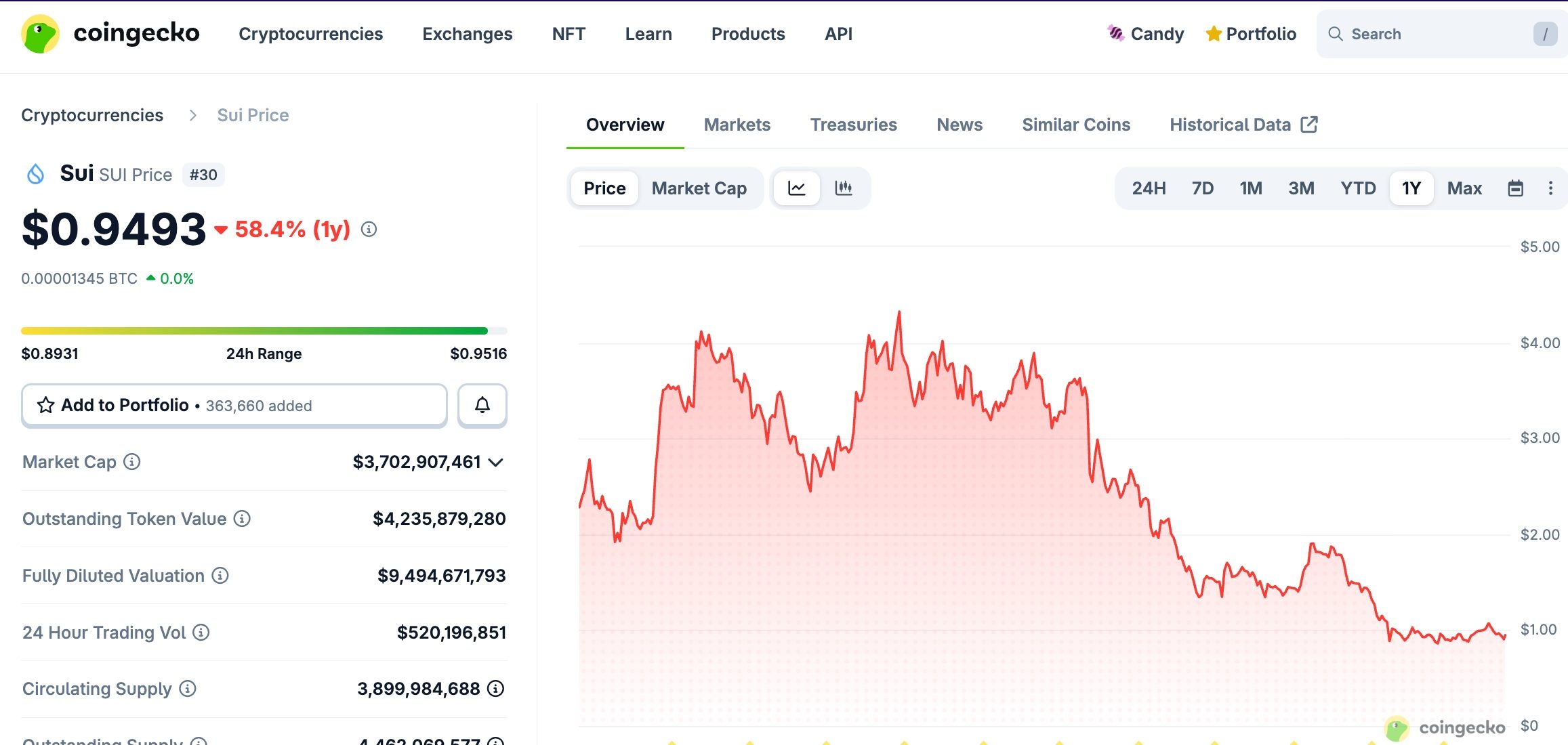
Source: Coingecko
The headline numbers shift daily, but the broader picture is no longer theoretical. As of March 2026, Coingecko shows Sui price is $0.9493. DefiLlama shows Sui with roughly $580 million in DeFi TVL, roughly $499 million in stablecoins, and an active protocol set that includes NAVI, Bluefin, Suilend, Cetus, Scallop, and Walrus-related activity. So while exact chain rankings fluctuate, the SUI ecosystem has clearly moved from “interesting tech” into the upper tier of live DeFi networks with real liquidity, trading, and cross-chain capital.
The Move Programming Language
Why Sui Move is Different from Aptos Move
Move on Sui is not just “Move with another logo.” Sui’s documentation spells out the differences clearly: Sui uses object-centric global storage, repurposes addresses as 32-byte identifiers for both accounts and objects, and makes object ownership a first-class primitive rather than something developers simulate with contract mappings. Aptos also uses Move, but its architecture and account model are different, which is why SUI chain developers talk about “Sui Move” as a distinct programming environment, not merely a deployment target.
Programmable Transaction Blocks: Executing 100+ Actions in One Go
PTBs are one of the most underrated reasons Sui feels different in practice. Sui docs describe them as the default form of user transaction: a programmable block can call multiple Move functions, manage objects, and manage coins inside one atomic transaction. Sui’s Solana comparison page adds that PTBs can include up to 1,024 commands. In plain language, that means a swap, liquidity add, collateral move, and follow-up action can all happen in one signed block instead of several disconnected clicks.
This is where the gas-efficiency argument becomes practical. Sui does not publish a universal “PTBs save exactly X%” claim, and it would be misleading to pretend otherwise. But because PTBs collapse multi-step flows into one atomic transaction, apps can often cut the number of separate fee-paying interactions by roughly 50% to 80% in workflows that would otherwise take two to five transactions on more traditional chains. That is an inference from the PTB design itself, not a guaranteed network-wide discount, but it explains why Sui builders keep treating PTBs as a UX and cost breakthrough rather than just a developer convenience.
How Sui Ensures Smart Contract Safety
Security is another place where Sui’s design is more than marketing. Sui Foundation material states that Move prevents reentrancy and that Move on Sui blocks the dynamic-dispatch style behavior that makes classic reentrancy exploits possible. That does not mean Sui apps are magically audit-proof, but it does remove an entire class of famous EVM-era bugs from the design space.
Technical Breakthroughs
Parallel Execution: Processing Independent Transactions Simultaneously
Because owned objects can be processed independently, Sui can execute many transactions without pushing them all through the same contention bottleneck. Official docs and comparison pages repeatedly emphasize this distinction: not every transaction needs global ordering, so independent activity can clear faster and with less network drag. That is the architectural reason SUI crypto discussions keep returning to objects instead of only talking about TPS.
Pilotfish Technology: The 2026 Upgrade for Elastic Validator Scaling
Pilotfish is best understood as Sui’s horizontal-scaling blueprint. Mysten Labs’ research describes it as the first multi-machine smart-contract execution engine, allowing validators to use multiple machines and autoscale execution as demand rises. In testing, Mysten reported up to an 8x throughput increase when using eight servers, with near-linear scaling on compute-bound loads. Even though the research surfaced earlier, it remains central to the 2026 scalability conversation because it targets the validator side of the bottleneck, not just the transaction format.
Mysticeti Consensus: Reducing Latency to Sub-400ms Finality
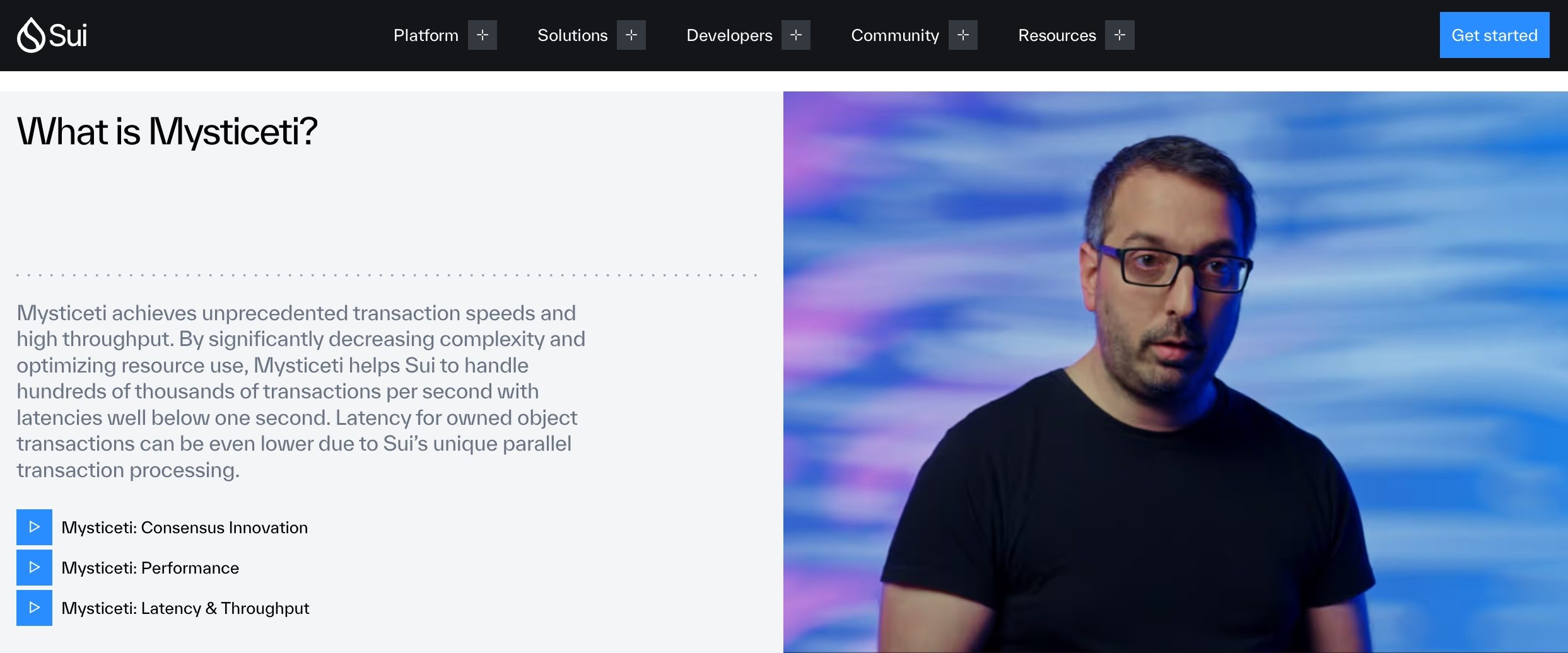
Source: Sui
Mysticeti is the consensus story behind Sui’s speed claims. Sui’s own Mysticeti page advertises 300ms consensus latency and says the network can handle hundreds of thousands of transactions per second with latencies well below one second, while the Sui-vs-Solana comparison page states that shared-object transactions settle around 390ms and independent ones can be even faster. That is why Sui’s low-latency claim is not just about short block times; it is about reducing end-to-end waiting time for the kinds of apps users actually touch.
The SUI Token: Utility, Governance, and Economics
Gas Fees and the Storage Fund
The SUI token is used for gas, staking, and economic security, but Sui’s tokenomics are more interesting than a normal “pay fees and vote” model. Official docs explain that Sui separates storage economics from short-term execution and routes past storage payments into a storage fund. That fund pays only the returns on its capital, not the principal, and users can receive partial refunds when they delete data. The point is to avoid dumping long-term storage costs onto future validators and future users.
This mechanism also gives SUI coin a structural scarcity angle. Sui’s supply is capped at 10 billion, and the network’s storage-fund design can permanently remove or lock tokens as usage grows. A September 2025 Sui Foundation update said the storage fund held about 1.95 million SUI, with nearly 700,000 effectively gone forever and another 1.2 million frozen. Walrus adds to this dynamic because every Walrus blob creates metadata objects on Sui that also feed the storage-fund effect.
Staking and Delegated Proof-of-Stake (dPoS)
Sui uses delegated proof-of-stake, with epochs lasting about 24 hours on mainnet and testnet. Validators receive rewards from gas fees and stake subsidies, and delegators share in those rewards through validator pools whose exchange rates rise over time. In practice, that means staking on Sui is less like “locking into a mystery APY” and more like delegating to a validator with transparent commission, uptime, and pool economics visible in wallets and explorers.
Tokenomics Update
For anyone researching what is SUI coin from an investment angle, token releases still matter. Sui’s official token schedule says total supply is fixed at 10 billion, but not all tokens circulate immediately, and future tranches continue to unlock tokens over time according to the network’s broader ecosystem and reserve plans. That does not make Sui unique, but it does mean any token thesis should watch circulating supply growth as closely as protocol adoption.
The Sui Ecosystem: DeFi, Gaming, and Beyond
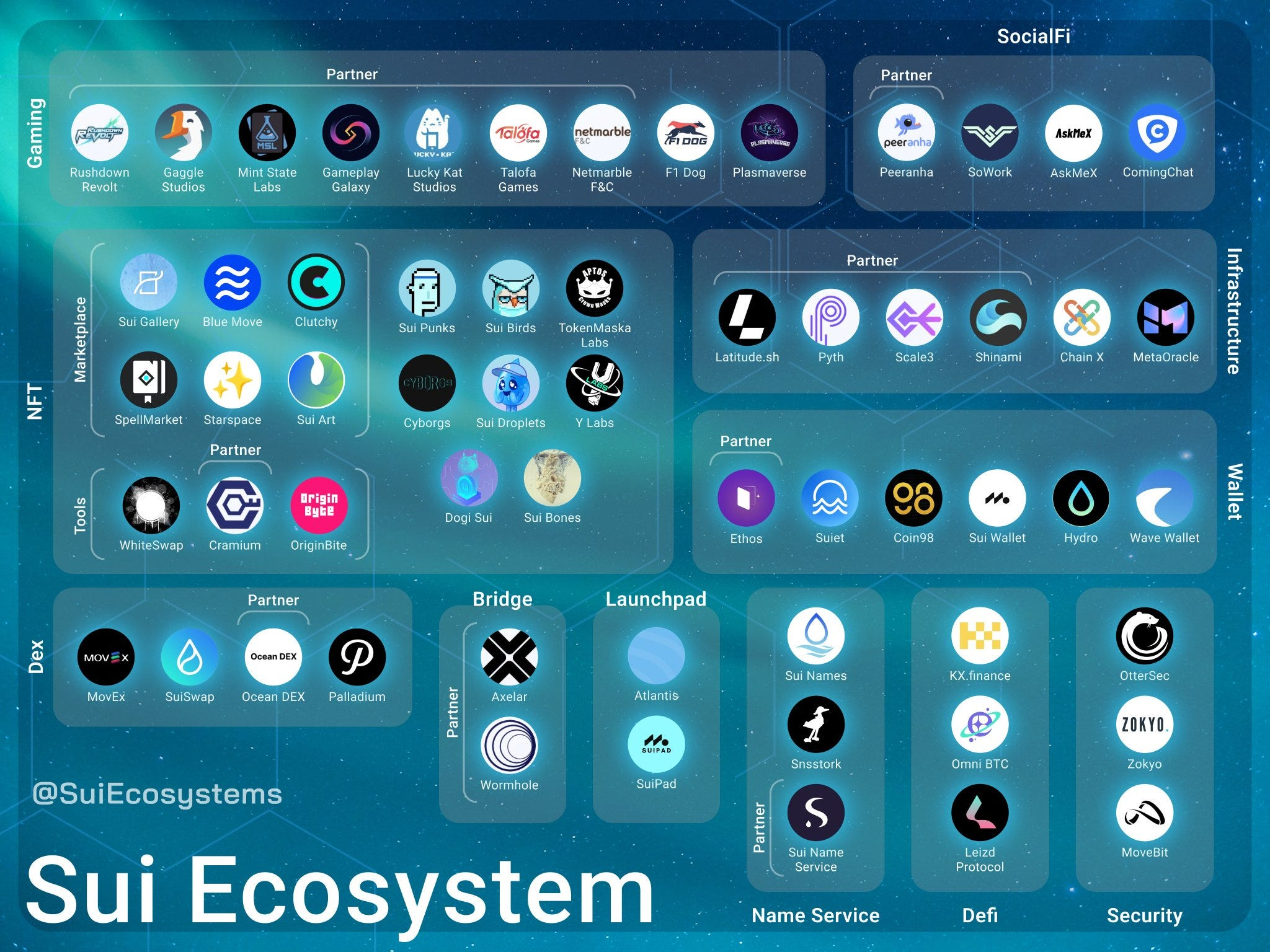
Source: Cryptorank
DeepBook V3: The Central Limit Order Book Powering Sui’s Liquidity
DeepBook is Sui’s native onchain liquidity layer, and version 3 was the milestone that made it feel like foundational infrastructure rather than an experiment. The official launch notes say DeepBook V3 reduced transaction costs and added dynamic fees, flash loans, shared liquidity across pools, and DEEP-driven governance. By early 2026, the ecosystem had already moved beyond that into DeepBook Margin, which turned the order book into a programmable financial layer for builders.
Walrus Protocol: The Rise of Decentralized Storage on Sui
Walrus is where Sui’s freshness edge really shows. Mysten first introduced Walrus as a decentralized storage and data-availability system using erasure coding, able to reconstruct blobs even if up to two-thirds of slivers are missing, while keeping replication closer to 4x–5x instead of the 100x-style replication burden that full validator storage can imply. Then, in 2025, Walrus went live on mainnet as part of the broader Sui Stack alongside Seal and Nautilus.
In 2026, Walrus is no longer just a side project people forgot to update in their articles. Walrus describes itself as a verifiable data platform for AI and onchain finance, with about 356TB of active data stored, 200+ ecosystem partners, and ~800ms downloads for files under 1MB. That matters because it turns the SUI blockchain story into a full-stack story: execution on Sui, durable data on Walrus, programmable access through Seal, and hybrid data flows through Nautilus.
Web3 Gaming on Sui: Why Low Latency Makes It the “Gamer’s Chain”
Gaming is one of the easiest places to see the design logic of the SUI network. Sui docs highlight zkLogin for easy player onboarding, sponsored transactions so games can pay gas for users, and object-based assets for representing items, currency, and character state. That combination is a better fit for game-like interactions than the older “install wallet, buy gas, sign everything manually” model that turned many Web3 games into chores.
Onboarding the Next Billion: Sui’s Revolutionary UX
zkLogin: Accessing Web3 Using Google, Twitch, and Apple IDs
zkLogin is one of Sui’s most important product advantages. Official docs describe it as a primitive that lets users send transactions from a Sui address using OAuth credentials without publicly linking the two, while preserving self-custody through a salt and zero-knowledge proofs. Mainnet-capable providers include Google, Twitch, Apple, Facebook, and others. This is a major reason people asking for a SUI wallet today often experience Sui more like a mainstream app than a seed-phrase-first chain.
Sponsored Transactions: How Apps Pay Gas Fees for Their Users
Sui also supports sponsored transactions, meaning an app or other sponsor can pay gas on behalf of a user. Official docs are explicit that this is meant to reduce onboarding friction for people who do not own SUI yet. Combined with zkLogin, this gives Sui one of the strongest “first session” experiences in crypto.
Sui Kiosk: A New Standard for Digital Commerce and Creator Royalties
Kiosk is Sui’s native commerce framework. The docs describe it as a decentralized system of shared objects that store assets, list them for sale, and enforce creator-defined trading rules such as royalties. That is a bigger deal than it sounds because royalties and marketplace logic are not bolted on by offchain platforms; they are part of the chain’s native commerce architecture.
Competitive Landscape: Sui vs. The Industry Titans
Sui vs. Solana: Parallelization, Uptime, and Developer Experience
For realized throughput, Solana still wins in many live snapshots. Chainspect currently shows Solana around 5,289 max TPS over 100 blocks versus Sui around 926.5. But Sui’s case is not “we beat Solana on every raw metric.” It is that objects, PTBs, zkLogin, and storage design make app composition and onboarding unusually clean. Sui’s own comparison page also argues that Solana still depends more heavily on account-based state handling and had around 12–13 seconds of economic finality before Alpenglow, versus about 390ms for Sui shared-object transactions.
Sui vs. Aptos: The Battle for Move Supremacy in 2026
Aptos remains the closest architectural cousin. In raw Chainspect snapshots, Aptos currently posts a higher realized max TPS than Sui, around 12,933 versus 926.5, and Aptos now has its own Keyless onboarding system using Google and Apple-style identity flows. So the 2026 battle is not “modern UX versus old seed phrases.” It is increasingly a battle between two Move-based ecosystems with different state models: Aptos still leans more account-centric, while Sui leans harder into objects and PTB-style composability.
Sui vs. Ethereum L2s
Against Ethereum L2s, Sui’s pitch is simpler state, lower friction, and fewer mental hops between wallet, bridge, gas asset, and execution environment. Ethereum still has the deepest liquidity and most mature tooling, but Sui’s object model, PTBs, and native primitives like Kiosk let builders do more without stacking multiple frameworks and assumptions. That is an architectural advantage, not a guaranteed market victory, but it explains why SUI foundation messaging now emphasizes full-stack infrastructure rather than just speed.
The table below uses current Chainspect snapshots for realized max TPS, official documentation for onboarding methods, and official network materials for finality descriptions. Treat the numbers as live indicators, not permanent ceilings.
| Chain | Latency / Finality | Max TPS (Realized) | Onboarding Tech |
| Sui | ~390ms for shared-object txs; sub-second for independent txs | 926.5 | zkLogin + seed phrases |
| Solana | ~12.8s economic finality snapshot | 5,289 | Seed phrases / smart-wallet UX |
| Aptos | Sub-second finality | 12,933 | Keyless + seed phrases |
How to Get Started with Sui?
Choosing a Sui Wallet: Sui Wallet vs. Ethos vs. Surf Wallet
In practical terms, most new users should start with the Mysten-led wallet experience now centered around Slush, while power users may also look at Ethos or Surf depending on mobile preference and app integrations. Sui’s own wallet guides show Slush in current documentation, while earlier ecosystem roundups highlighted Sui Wallet, Ethos, and Surf as leading user choices, with zkLogin support already central to the experience.
Bridging Assets: Moving Liquidity from Ethereum and Solana to Sui
For Ethereum, the official route is Sui Bridge, which the docs describe as Sui’s native bridge for moving assets such as ETH between Ethereum and Sui. For Solana-linked liquidity, the more practical path is usually native USDC via Circle’s CCTP ecosystem, since Sui Bridge integrated CCTP and Circle supports both Solana and Sui in its cross-chain USDC universe.
Exploring the Ecosystem: Top DApps to Watch in 2026
If you want to understand what is SUI in practice rather than in theory, watch the apps that reveal the stack: DeepBook and DeepBook Margin for market structure, NAVI and Scallop for lending, Cetus and Bluefin for trading, Walrus for verifiable storage, and Slush for smoother wallet-native DeFi access. Those are the places where the object model, PTBs, zkLogin, and storage design stop being whitepaper material and start becoming product behavior.
Is Sui the Future of the Decentralized Web?
The strongest case for Sui in 2026 is not a single benchmark. It is the way the pieces fit together. The SUI token secures the chain, pays fees, and participates in staking. The SUI foundation and ecosystem programs keep funding builders. The SUI wallet experience is smoother than most L1s because of zkLogin and sponsored transactions. And the broader stack now includes DeepBook, Walrus, Seal, and Nautilus, which makes SUI chain feel less like “another fast L1” and more like a coordinated application platform.
So, what is SUI in one sentence? It is a high-performance, object-centric Layer 1 whose design choices make parallel execution, low-friction onboarding, and full-stack Web3 infrastructure feel native instead of patched together. That does not guarantee it wins every category. But it does explain why developers, DeFi teams, gaming studios, and infrastructure builders keep treating SUI as more than just another token ticker.
FAQ: Critical Questions About the Sui Network
Is Sui really faster than Solana?
For some kinds of transactions, yes. Sui’s official docs say shared-object transactions can finalize around 390ms and independent ones can be faster, while current Chainspect snapshots still show Solana higher on realized max TPS. So the honest answer is that Sui often feels faster per interaction, while Solana still leads many live throughput snapshots.
What is an “Object” in Sui terminology?
An object is Sui’s fundamental unit of onchain storage. Official docs define every asset, resource, or data record on Sui as an object with its own ID, owner, version, and metadata. That object-centric design is the backbone of parallel execution and ownership-aware programming on the SUI blockchain.
How do I use zkLogin to access my Sui assets?
Use a wallet or app that supports zkLogin, choose an approved OpenID provider such as Google, Twitch, Apple, or Facebook, authenticate, and then approve transactions through that flow. zkLogin keeps the experience self-custodial because signing still depends on both the OAuth session and a separate salt, not the provider alone.
What are the rewards for staking SUI in 2026?
Staking rewards on Sui come from gas fees and stake subsidies and are distributed at epoch boundaries through validator pools. The exact APY varies by validator commission and performance, which is why Sui docs recommend checking wallet or explorer validator pages rather than assuming one fixed network rate.
Disclaimer: The material in this article is not financial or investment advice. Everything stated here reflects the author's personal view and should not be treated as a recommendation to trade or invest. We make no warranties regarding the accuracy, reliability or completeness of the information presented. Cryptocurrency markets are highly volatile and can move unpredictably. Before committing any funds, every investor, trader or crypto user should study several independent sources and check the regulations that apply in their own jurisdiction.