
If you’ve ever mined for a few hours, watched your hashrate climb… and still wondered why your wallet isn’t getting paid, you’re not alone. Most new miners eventually type what is Nanopool because they want two things: a simple pool that “just works,” and a clear explanation of the Nanopool payout system (especially PPLNS).
Nanopool is a long-running, multi-coin mining pool where you mine “anonymously” using just a wallet address: no account signup; and get paid automatically once you hit your payout threshold. Nanopool’s big identity has shifted over the years: it was once famous as a major Ethereum pool, but after Ethereum moved to Proof of Stake, the original ETH pool closed and the platform continued as a multi-coin hub (ETC, XMR, RVN, and others).
Below is a practical, miner-first breakdown: how Nano pool works, why PPLNS feels “slow,” how to set payout thresholds, what coins you can mine today, and how Nanopool compares with big competitors like Ethermine and 2Miners.
The Evolution of Nanopool in the Crypto Landscape
From Ethereum Giant to Multi-Coin Hub: A Brief History
For years, miners associated Nanopool with Ethereum. Then September 2022 changed everything: Ethereum switched to Proof of Stake, and Nanopool’s ETH pool was closed. Nanopool’s help center notes the ETH pool closure and the shift to mining PoW forks like ETHW at the time.
In 2026, Nanopool’s front page positions it as a multi-coin pool with a small list of PoW assets: most prominently Ethereum Classic, Zcash, Ravencoin, Conflux, and Monero.
That’s why you still see searches like Nanopool ETH (legacy interest) alongside modern intent searches like Nanopool XMR and Nanopool Monero.
Why Miners Choose Nanopool: Stability, Simplicity, and Speed
The “Nanopool appeal” is boring in a good way:
- No registration: you mine to your wallet address and your “account” appears automatically after your miner submits shares.
- Global endpoints: pool pages list multiple regions (EU/US/Asia/etc.) so miners can choose low-latency servers.
- Predictable fee model: most assets run a 1% pool fee with PPLNS payouts.
If you’re a small miner who doesn’t want dashboards, logins, and API keys, that “wallet-only” workflow is a feature, not a limitation.
Nanopool vs. The Competition: What Sets It Apart in 2026?
Here’s the practical “at a glance” view miners usually want:
| Pool | Typical pool fee | Payout system | Registration required? |
| Nanopool | 1% | PPLNS (window varies by coin) | No (wallet-based) |
| Ethermine | ~1% (varies by coin/pool) | PPLNS | Typically no for basic mining (wallet-based) |
| 2Miners | 1% PPLNS; 1.5% SOLO | PPLNS or SOLO | No (wallet-based) |
Note: pool policies can change; always verify on the pool’s own docs before switching.
In 2026, the differentiators are mostly “user friction” and payout philosophy:
- Nanopool keeps things minimal: wallet address = identity; optional email = alerts/settings.
- It sticks to PPLNS across assets (with different window lengths depending on the coin).
- It’s typically 1% fee – competitive, but not always the absolute lowest.
How Nanopool Works
Understanding PPLNS (Pay Per Last N Shares) vs. PPS
- PPLNS (Pay Per Last N Shares) means you’re paid based on how many valid shares you contributed within a rolling window of the pool’s last N shares (or last N time, some pools define N as time). Nanopool explicitly defines PPLNS windows in time for many coins, for example:
- Monero: PPLNS window 2 hours
- Ethereum Classic: 60 minutes
- Ravencoin: 6 hours
- Zcash: 3 hours
So if you mine for 10 minutes on a coin where the PPLNS window is 6 hours, you’re only “in the window” briefly. If the pool finds blocks after you disconnect, you may earn less (or nothing) for that round.
- PPS (Pay Per Share) is different: you’re paid a fixed value for every accepted share: more predictable, usually with higher fees because the pool operator takes on the variance risk.
A simple mental model:
- PPLNS: “I get paid when the pool finds blocks, based on my share of the last window.”
- PPS: “I get paid per share no matter the pool’s luck.”
Why PPLNS Rewards Loyal Miners During High-Volume Periods
PPLNS is designed to discourage “pool hopping.” If miners could jump into a pool only when it’s “lucky” and leave when it’s “unlucky,” loyal miners would get diluted. PPLNS makes hopping less effective because your payout depends on being present in the window when blocks are found.
In practice:
- If you mine consistently, PPLNS can work in your favor over time (you stay inside the rolling window).
- If you mine intermittently, only when your PC is idle: PPLNS can feel frustrating because there’s a ramp-up effect.
That’s why so many first-time users think Nanopool “doesn’t pay immediately.” It does pay, you’re just seeing variance plus a time-window model.
Pool Fees: Analyzing Nanopool’s 1% Standard Across Assets
Nanopool’s help center lists a 1% fee for major supported pools like XMR, ZEC, ETC, ERG, RVN, and CFX.
It also lists coin-specific payout commissions (network payout cost handling), such as:
- XMR payout commission up to 0.0001 XMR
- ERG payout commission 0.001 ERG
- RVN payout commission 0.0005 RVN
- ZEC/ETC/CFX often show no payout commission in pool info articles
So, the pool fee and the payout transaction fee aren’t always the same thing. The pool fee is the “service tax.” The payout commission is about the cost of pushing payouts on-chain.
Supported Coins: What Can You Mine on Nanopool Today?
Nanopool’s homepage lists Ethereum Classic, Zcash, Ravencoin, Conflux, and Monero as core options.
In practice, Nanopool also has Ergo pool infrastructure (and detailed help center pages for it).
Ethereum Classic (ETC): The Post-Merge Favorite
After Ethereum’s PoS transition, ETC became a natural destination for former ETH miners because it kept an Ethash-family PoW model (Etchash). Nanopool’s ETC pool info lists:
- 1% fee
- PPLNS (60 minutes)
- default payout 1 ETC, adjustable 0.1–100 ETC
If you’re migrating rigs, ETC is usually the first coin miners test on Nanopool: simple configs, lots of community knowledge.
Ravencoin (RVN) and Ergo (ERG): High-Performance Altcoin Mining
Instead of Bitcoin mining, for RVN, Nanopool’s help center lists:
- 1% fee
- PPLNS (6 hours)
- default payout 100 RVN, adjustable 50–50000 RVN
For ERG, Nanopool lists:
- 1% fee
- PPLNS (60 minutes)
- default payout 5 ERG, adjustable 1–1000 ERG
If you’re specifically searching for a Ravencoin pool, Nanopool is one recognizable option, especially for miners who want a no-registration workflow.
Monero (XMR): CPU Mining and the RandomX Advantage
Monero is still the king of CPU mining because its RandomX algorithm is designed to be ASIC-resistant and CPU-friendly. Nanopool’s Monero pool page lists global endpoints and features like email notifications and adjustable payout limits.
Nanopool’s XMR pool info includes:
- 1% fee
- PPLNS (2 hours)
- default payout 1 XMR, adjustable 0.11–10 XMR
So if your goal is Monero mining pools research, Nanopool XMR is a straightforward baseline to compare against other XMR pools, especially if you want simplicity and don’t mind PPLNS variance.
Zcash (ZEC) and Pascal (PASC): Specialized Asset Support
Nanopool continues to support Zcash. The pool info shows:
- 1% fee
- PPLNS (3 hours)
- default payout 0.01 ZEC, up to 10 ZEC
For Pascal (PASC): Nanopool historically supported PascalCoin (and there are still official Nanopool GitHub configs referencing pasc-eu1.Nanopool.org endpoints).
Because Nanopool’s front page doesn’t highlight PASC in 2026, treat it as “specialized/legacy support” and verify current endpoints before committing rigs.
Setting Up Nanopool: A Step-by-Step Beginner’s Guide
Choosing Your Hardware: GPU vs. ASIC vs. CPU
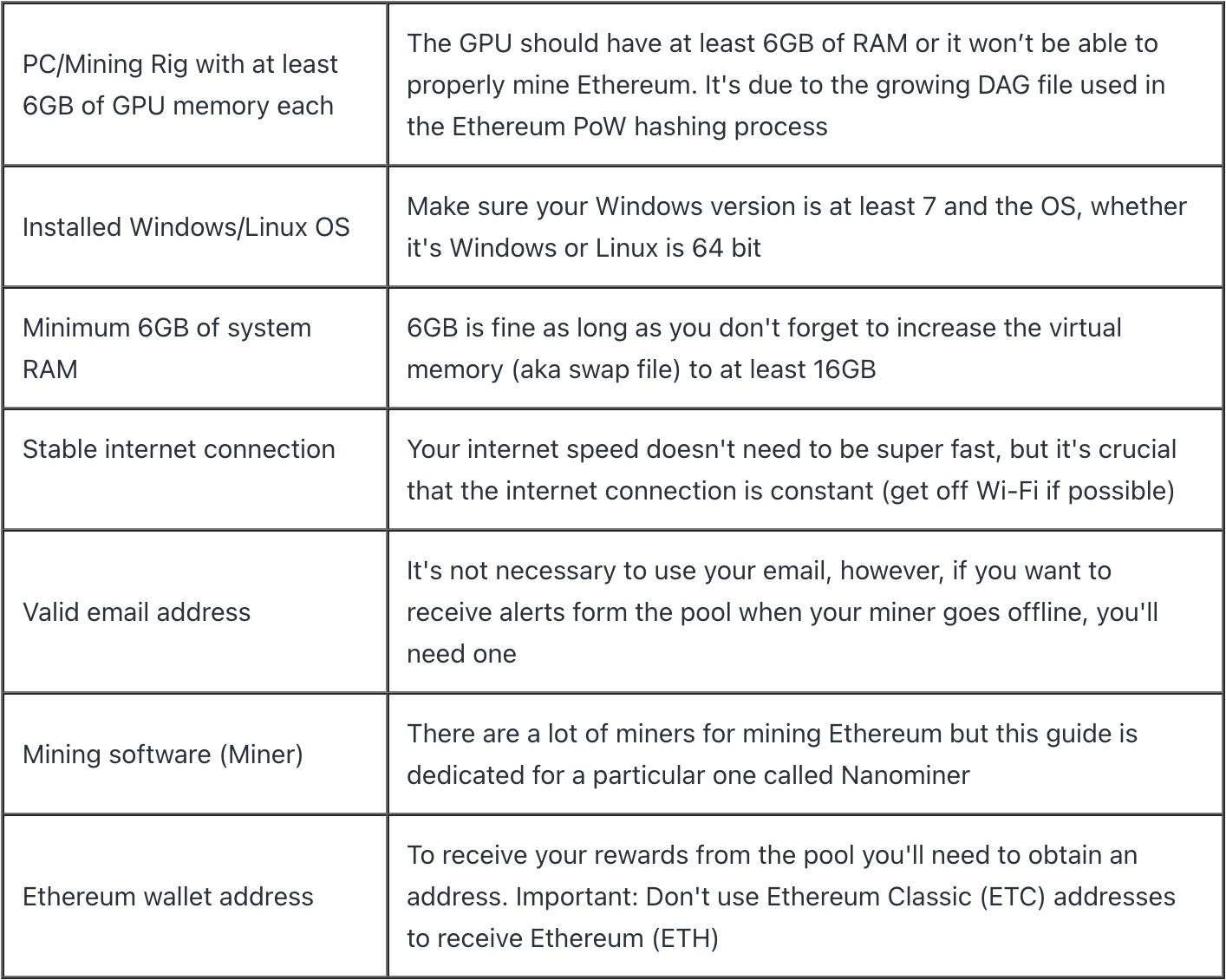
Source: Nanopool Docs
- GPU rigs: best for ETC, RVN, ERG, CFX.
- ASICs: common for Equihash coins like ZEC (depending on hardware availability and market). Nanopool’s ZEC guide references ASIC-friendly stratum formats.
- CPU: the main “CPU coin” on Nanopool is XMR (RandomX). Nanopool provides guides for using XMRig.
Configuring Your Miner: Step-by-Step for Windows and Linux
Nanopool’s help center publishes step-by-step guides for major coins (XMR, ERG, CFX, ETC, RVN).
The universal idea is always the same:
- Install drivers (for GPU mining).
- Download a miner.
- Point it at the closest Nanopool stratum server.
- Use WALLET.WORKER/EMAIL as your worker string (format varies by miner/coin).
Connecting Your Wallet: Security Best Practices
The most common beginner mistake is mining to an exchange deposit address without understanding memo/payment ID requirements (coin-dependent). Safer approach:
- Use a self-custody wallet when possible.
- If you mine to an exchange, triple-check deposit rules (tag/memo requirements, supported networks).
- Don’t reuse “random” wallet strings copied from old configs.
Monitoring and Analytics
Real-Time Hashrate Monitoring
Nanopool typically shows at least three hashrate ideas:
- Reported hashrate: what your miner software claims locally.
- Calculated/Effective hashrate: what the pool estimates from shares submitted over time.
- Average hashrate: smoothed performance.
Because calculated hashrate is share-based, it naturally lags and can look “lower” during short sessions. That’s normal, especially under PPLNS.
Setting Up Email Alerts for Worker Down-Time
Nanopool explains that to receive offline notifications, you must use a valid email in your miner config. If you don’t want emails, you can use a passphrase instead.
The Nanopool Mobile App: Monitoring Your Rigs on the Go
Nanopool pool pages explicitly mention “3rd party apps: iOS/Android” rather than an official Nanopool-branded app.
So the 2026 reality is: monitoring is possible on mobile, but it’s generally through third-party tools using Nanopool APIs.
Managing Your Earnings
How to Change Your Minimum Payout Limit
Nanopool allows adjustable payout thresholds in account settings. Pool info pages show defaults and ranges per coin:
- XMR: default 1 XMR, adjustable 0.11–10 XMR
- ETC: default 1 ETC, adjustable 0.1–100 ETC
- RVN: default 100 RVN, adjustable 50–50000 RVN
- ERG: default 5 ERG, adjustable 1–1000 ERG
- ZEC: default 0.01 ZEC, up to 10 ZEC
- CFX: default 5 CFX, adjustable 1–100 CFX
Lower thresholds usually mean more frequent payouts, but sometimes higher payout commissions depending on the coin.
Payment Frequency: When Do Your Coins Hit Your Wallet?
Nanopool repeatedly states “payouts several times a day” in pool info pages.
But you’ll only be paid when:
- your balance exceeds the threshold and
- the pool runs payout cycles and
- coins mature/confirm (block validation time differs by coin)
Transaction Fees: Keeping Your Profits High
Watch two things:
- pool fee (usually 1%)
- payout commission (coin-dependent)
If you’re a small miner, choosing an unnecessarily high payout frequency can quietly eat profits. Sometimes it’s smarter to raise the threshold slightly so you pay fewer payout tx fees.
The Pros and Cons of Mining with Nanopool
The Advantages: No Registration Required and High Reliability
- No registration required: Nanopool’s help center explicitly says there’s no signup; your account appears after your first valid share.
- Simple setup: Nanopool publishes “quick start” configs for common miners.
- Consistent fee structure: 1% across many assets.
The Disadvantages: Higher Minimum Payouts for Small-Scale Miners
- Nanopool’s defaults can feel high for hobby miners (example: default 1 XMR is not “small”).
- Yes, you can lower thresholds, but a low-hashrate miner on PPLNS may still wait longer than expected, especially on coins with longer PPLNS windows (like RVN’s multi-hour window).
Nanopool and the Future of Proof-of-Work
Will Nanopool Support Kaspa or Iron Fish?
As of March 2026, Nanopool’s main public lineup focuses on ETC, ZEC, RVN, CFX, XMR (and ERG).
Kaspa and Iron Fish are frequently requested by miners, but there’s no official confirmation from Nanopool in the sources above that they’re adding them. Treat any “coming soon” claims you see elsewhere as speculation unless Nanopool publishes it.
The Impact of Institutional Mining on Public Pools
Large-scale mining has two effects on public pools:
- More stable block discovery for big pools
- Tougher profitability for small miners (because network hashrate rises)
For hobby miners, the pool choice becomes less about “who is biggest” and more about payout method and thresholds. PPLNS pools can be great if you mine consistently; PPS/PPS+ pools can feel better if you mine intermittently at the cost of higher fees.
FAQ: Everything You Need to Know About Nanopool
Do I need an account to mine on Nanopool?
No. Nanopool states there is no registration: you start mining with your wallet address and your account appears automatically (often within ~30 minutes after your first valid share).
Can I mine Bitcoin on Nanopool?
Not on Nanopool’s mainstream 2026 lineup. Nanopool’s primary public pools focus on coins like ETC, ZEC, RVN, CFX, XMR (plus ERG).
What happens if my miner goes offline?
Your hashrate drops to zero and you stop submitting shares, which can reduce your payout under PPLNS if you fall out of the window. Nanopool supports offline email alerts if you include a valid email in your miner configuration.
Why is my reported hashrate different from my calculated hashrate?
Reported hashrate comes from your miner software; calculated hashrate is estimated from shares accepted over time. Short sessions, stale shares, network latency, and luck can all make calculated hashrate look lower or “laggy,” especially under PPLNS.