
Liquidity in crypto means how easily an asset can be bought or sold without moving its price much. High liquidity comes from deep order books or well-funded liquidity pools, low liquidity leads to slippage and easier price manipulation. Bitcoin and Ethereum are highly liquid, most small-cap tokens are not, and low liquidity is a key warning sign of rug pulls.
What Does Liquidity Mean in Crypto?
Liquidity is basically how easily you can turn an asset into cash, or into another crypto, without wrecking the price in the process. Think about it like a farmers market. If there are ten stalls selling tomatoes and dozens of buyers walking through, you can sell your tomatoes fast, at a fair price, no drama. But if you’re the only stall in an empty parking lot, you might have to slash your price just to get someone to bite. That second scenario is basically what low liquidity looks like in a market.
In practice, liquidity shows up in two related places. There’s market liquidity, the overall depth and activity of a given asset across all the places it trades, and there’s liquidity within a specific pool or order book on one exchange. An asset can technically be liquid overall while still being thin on a particular platform, which matters more than people realize when they’re comparing prices across different exchanges. A token might show plenty of volume on its biggest listing while being nearly untradeable on a smaller one, and checking only the headline number can leave you with a misleading picture.
Bitcoin and Ethereum sit at the deep end of the pool, billions of dollars in daily trading volume spread across hundreds of venues, meaning even large trades barely move the price. Most small-cap altcoins and brand-new tokens sit at the other end entirely, where a single moderately sized buy or sell order can send the price swinging 20% or more in minutes. That gap is the whole reason liquidity gets talked about so much in crypto specifically, it’s a much bigger factor here than it is in, say, large-cap stocks, where deep institutional participation keeps most household-name tickers reasonably liquid by default.
It’s worth separating liquidity from two things people often confuse it with: market cap and trading volume. Market cap just multiplies price by circulating supply, it says nothing about how easily that price could actually be defended if someone tried to sell a meaningful chunk. Trading volume is closer, but it’s a snapshot over time rather than a measure of depth at any given moment, a token could show decent 24-hour volume while still having a thin order book right now, this instant, when you actually want to trade. Liquidity is the more honest, moment-to-moment answer to the question that actually matters: if I wanted to sell right now, could I, at something close to the price I’m seeing?
How Does Liquidity Work in Crypto Markets?
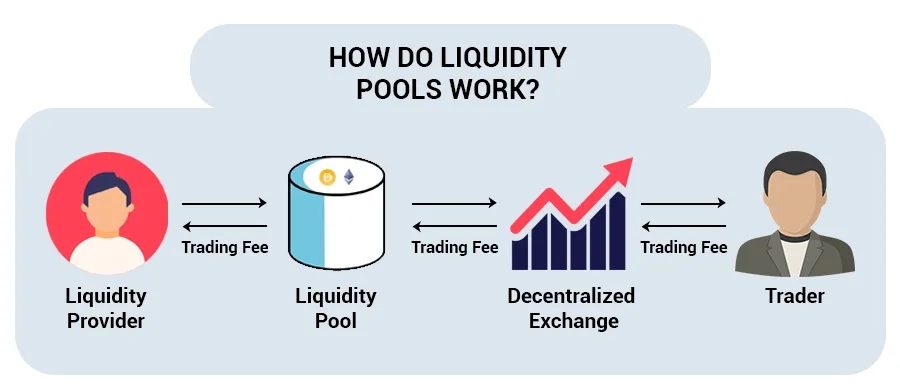
Source: Webisoft
Two different systems create liquidity in crypto, and understanding the difference actually matters. Centralized exchanges use an order book, a running list of buy orders and sell orders at different prices, matched automatically when a buyer’s price meets a seller’s. This is the same basic model stock exchanges have used for decades, and it works well when there are enough active traders on both sides constantly placing orders.
Decentralized exchanges took a different route entirely, mostly because early DEXs struggled badly with order books, not enough traders showing up meant orders sat unfilled for ages. The fix was the automated market maker, or AMM, which replaced human buyers and sellers with a liquidity pool and a pricing formula. Instead of matching two people, you’re trading directly against a pot of tokens locked in a smart contract, and an algorithm decides the price based on the ratio of tokens sitting in that pot.
The most common version of that algorithm is the constant product formula, written as x times y equals k, where x and y are the amounts of each token in the pool and k has to stay the same no matter what. Say you’re trading ETH for USDT in a pool. Buy some ETH, and the ETH side of the pool shrinks while the USDC side grows, which automatically nudges the ETH price up for the next person. It sounds abstract until you watch it happen: a big trade visibly moves the price in real time, which is exactly the slippage effect that traders learn to watch out for.
What Are the Different Types of Liquidity in Crypto?
- Liquidity in crypto isn’t one single thing, it shows up in a few distinct forms depending on where and how an asset trades, and knowing the difference actually helps you read a token’s real risk profile rather than just glancing at one number.
- On-chain liquidity refers to funds sitting directly in a smart contract, most commonly a liquidity pool on a decentralized exchange like Uniswap or Curve. It’s fully transparent and verifiable, anyone can look up exactly how much of each token is locked in a pool at any moment using a block explorer, which is part of why on-chain liquidity has become the default reference point for checking a token’s health. The tradeoff is that on-chain liquidity is only ever as deep as whatever LPs have actually deposited, there’s no market maker stepping in to smooth things out during a rush of selling.
- Off-chain liquidity, by contrast, lives in the order books of centralized exchanges like Coinbase, Binance, or Kraken. These platforms often employ professional market makers who continuously post buy and sell orders to keep spreads tight, which can make off-chain liquidity considerably deeper than what’s visible on-chain for the same asset. The catch is verifiability: you’re trusting the exchange’s own reported numbers rather than checking a smart contract yourself, and that data isn’t always as transparent or auditable as an on-chain pool.
- Protocol liquidity describes a newer model where a DeFi protocol owns and controls its own liquidity outright, rather than depending entirely on outside liquidity providers who might withdraw their funds at any time. Some projects now hold protocol-owned liquidity specifically to avoid the classic problem of LPs pulling out en masse the moment a reward program ends, leaving a pool suddenly, dangerously thin. There’s also market liquidity, the aggregate picture across every venue an asset trades on combined, which is the broadest, most zoomed-out version of the concept and the one most price aggregators are actually reporting when they show a single liquidity figure for a token.
None of these types are mutually exclusive, a single token can have deep off-chain liquidity on major exchanges while having a nearly empty on-chain pool, or vice versa. Checking only one type of liquidity and assuming it tells the whole story is a common mistake, especially for tokens that trade in more than one venue type at once.
Liquidity vs. Trading Volume vs. Market Cap
These three numbers get thrown around almost interchangeably in crypto discussion, but they measure genuinely different things, and mixing them up leads to some pretty bad trading decisions. Market cap is the simplest and also the most misleading on its own: multiply the current price by circulating supply, and you get a number that says nothing about how many people actually want to buy or sell at that price, or whether the price itself is being propped up by a handful of trades on a thin order book.
Trading volume, usually reported over a rolling 24-hour window, measures how much of an asset actually changed hands in that period. It’s a genuinely useful signal of current interest and momentum, but it’s backward-looking by nature, a token could have posted strong volume yesterday while having almost no depth in its order book right now, this exact moment, when you actually want to place a trade. Volume is also the easiest of the three to fake: wash trading, where an entity trades with itself across multiple accounts to inflate apparent activity, has been a persistent problem on smaller and less-regulated exchanges, and it can make a token look far more actively traded than it really is.
Liquidity is the one that most directly answers the question a trader actually cares about: if I want to buy or sell a meaningful amount right now, can I do it near the price I’m seeing? It’s harder to fake convincingly than volume, since it requires genuinely committing real capital to an order book or a pool rather than just cycling trades back and forth, though it’s not impossible to manipulate temporarily either. The table below breaks down how these three concepts actually differ in practice.
| Metric | Liquidity | Trading Volume | Market Cap |
| What it measures | How easily an asset trades without moving its price | Total value traded over a period (e.g. 24 hours) | Price multiplied by circulating supply |
| Time frame | Real-time, this instant | Historical snapshot (usually 24h) | Real-time, but based on last traded price |
| Can be faked or misleading? | Harder to fake, tied to real order book or pool depth | Yes, wash trading can inflate volume artificially | Yes, thinly traded tokens can have inflated paper valuations |
| What low readings signal | High slippage risk, price manipulation risk | Low current trading interest | Small total valuation, not necessarily risky alone |
| Best used for | Judging if you can actually exit a position at a fair price | Gauging recent trading interest and momentum | Comparing overall project size |
The practical takeaway: a healthy, trustworthy token generally shows reasonable alignment across all three. Enormous market cap paired with thin liquidity and volume that spikes suspiciously is a classic setup for a token whose price exists mostly on paper. Checking all three together, rather than leaning on whichever number happens to look most impressive, gives a far more honest read on whether an asset is actually as tradeable as its headline valuation suggests.
What Is a Crypto Liquidity Pool and How Do You Join One?
A crypto liquidity pool is a smart contract holding reserves of two or more tokens that traders swap against, and it’s the engine behind pretty much every major decentralized exchange, Uniswap, Curve, Balancer, and PancakeSwap all run on some flavor of this model. Anyone can become a liquidity provider by depositing an equal value of both tokens in a pair, ETH and USDC, for example, and in return they get LP tokens representing their slice of the pool.
Here’s the actual mechanics of joining one, using Uniswap as a typical example. Connect a wallet, pick a pool, say ETH/USDT, deposit a matching dollar value of both tokens (roughly 50/50), and the protocol hands back LP tokens on the spot. From there, every trade that goes through that pool kicks off a small fee, usually somewhere between 0.01% and 1% depending on the platform and pool type, split proportionally among everyone who’s supplied liquidity. Redeem the LP tokens whenever you want your original deposit back, plus whatever fees have piled up.
It’s not free money, though. The single biggest risk liquidity providers run into is impermanent loss, what happens when the price ratio between your two deposited tokens shifts a lot while your funds sit in the pool. If ETH rockets up 50% relative to USDT during that window, the pool’s rebalancing math means you’d have ended up with more money just holding both assets separately than you did providing liquidity, even after collecting fees. It’s called “impermanent” because the loss only actually locks in if you withdraw while the prices are still skewed, but plenty of LPs who withdrew at the wrong moment can tell you it feels pretty permanent in the moment.
Why Does Liquidity Matter When Trading Crypto?
Liquidity determines how much a trade actually costs you beyond the sticker price, how fast you can get in or out of a position, and honestly, how trustworthy a token even is in the first place. Deep liquidity means tight spreads (the gap between what buyers are offering and sellers are asking) and minimal slippage, so the price you see is close to the price you actually get.
Thin liquidity flips all of that around. A trade that looks small on paper can eat through a shallow pool or order book fast enough that your average execution price ends up nowhere near the quote you started with, that’s slippage in action. It also means whales, big holders with outsized positions, can move a low-liquidity token’s price dramatically with orders that wouldn’t even register on a deeper market. That kind of manipulation is a lot harder to pull off on something like Bitcoin, where you’d need genuinely enormous capital to move the needle.
There’s also a straightforward practical angle: liquidity affects how confidently you can exit a position when you actually need to. A token that looked great on the way up can trap you on the way down if there simply aren’t enough buyers left to absorb your sell order at anything close to a reasonable price. That’s not a hypothetical, it’s the exact mechanism behind a huge chunk of the worst outcomes in crypto trading.
What Is Liquidity Mining and How Is It Different From Staking?
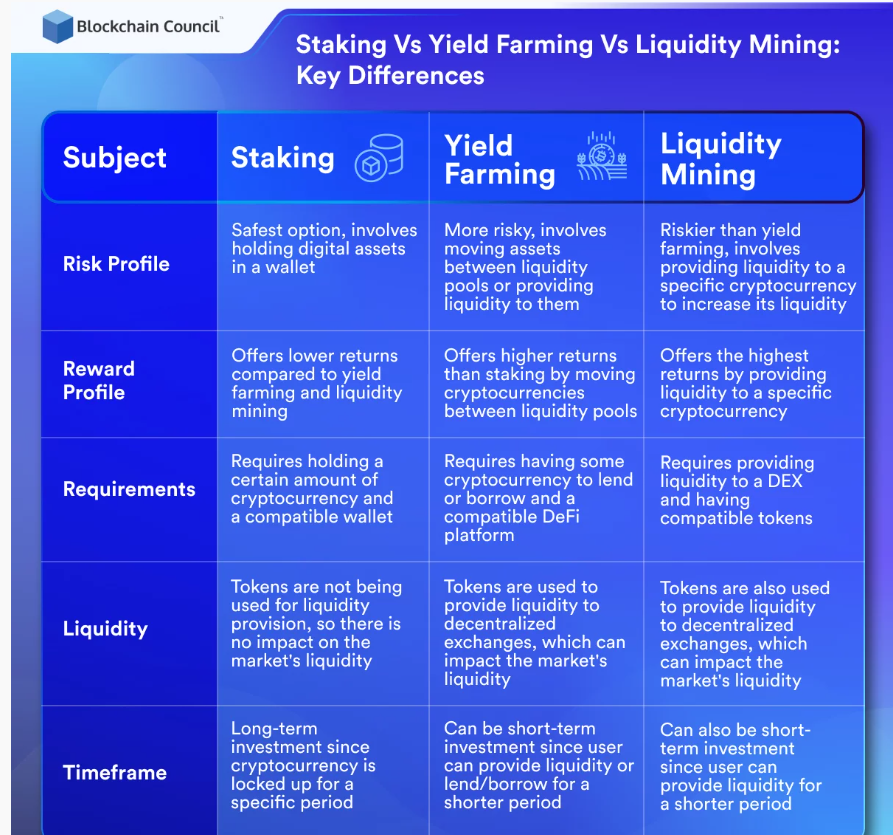
Source: Publish0x
Liquidity mining is what happens when a protocol pays you extra rewards, usually its own token, on top of regular trading fees, specifically to attract liquidity providers during a launch or growth phase. It’s a recruitment tool as much as anything else: a new DEX or a new pool needs deep liquidity fast to actually be usable, and dangling bonus token rewards is the quickest way to get people to show up with capital.
The mechanics build directly on what LPs already do. Deposit your token pair into a pool like normal, but instead of only earning a cut of swap fees, you also start accumulating the protocol’s governance or reward token, often at a rate that can look extremely generous early on, before it gets diluted by more liquidity flowing in. That’s the appeal, and also the catch, those advertised yields tend to compress quickly as a pool fills up with more capital chasing the same reward pot.
People mix this up with staking constantly, and it’s an easy mix-up to make since both involve locking crypto to earn rewards. But staking generally means putting a single asset behind securing a proof-of-stake blockchain, no impermanent loss risk, since there’s only one asset involved, and the main risk is just the asset’s own price movement, plus slashing risk on networks that enforce it. Liquidity mining always involves at least two assets in a pool, carries impermanent loss risk on top of whatever price risk exists, and the yield is fundamentally about compensating for that structural complexity, not just for locking something up.
What Is Exit Liquidity and How Does It Relate to Rug Pulls?
Exit liquidity is the buy-side demand that lets an earlier holder sell their position and cash out, and in crypto the term has picked up a pretty specific, cynical meaning: it often refers to retail buyers who show up late and effectively fund the exit for insiders or early holders who bought in cheap. If you buy a token near its peak and the people who got in early are the ones selling into your buy order, you’ve become their exit liquidity, whether you realize it in the moment or not.
This concept sits right at the center of how a rug pull actually works. In a hard rug pull, developers who control a liquidity pool simply drain it, pulling out the paired asset (ETH, BNB, whatever it’s matched with) and leaving remaining holders with a token that can’t be sold for anything real. A soft rug pull is slower and messier, insiders quietly dump a huge pre-mined allocation into the market over time, draining real value out of the pool without a single dramatic withdrawal moment.
Low liquidity is what makes both versions possible in the first place. A brand-new token paired with a small amount of ETH in its pool doesn’t need much buying pressure at all to look like it’s mooning, and it doesn’t take much selling pressure either to wipe the price out entirely. That’s exactly why liquidity depth, and specifically whether that liquidity is locked, has become one of the very first things experienced traders check before touching a new token.
How Do You Check a Token’s Liquidity Before Trading?
Start with the liquidity-to-market-cap ratio, a rough gut check on whether a token’s price is actually backed by real trading depth. A widely used rule of thumb among experienced traders is looking for at least 10% to 15% liquidity relative to market cap, so a token sitting at a $1 million market cap with only $50,000 in its pool is a pretty clear yellow flag, that price could be resting on almost nothing.
Next, check whether the liquidity is actually locked. Legitimate projects typically lock their LP tokens in a time-locked contract for months or years, specifically so the team can’t just walk away with the pool whenever they feel like it. Block explorers like Etherscan let you look up a token’s contract directly, check the top holders, and see whether the liquidity pool’s LP tokens are sitting in a locking contract or just parked in a regular wallet that could empty it at any moment.
Also worth a quick look: how concentrated the token supply is. If a handful of wallets control a huge chunk of total supply, that’s a coordinated dump risk even with locked liquidity, since holders can crater the price without ever touching the pool itself. Tools built for exactly this kind of check, DEXTools and similar platforms, will show pool depth, holder concentration, and contract details side by side before you commit any real money.
Where Can You Buy or Exchange Crypto?
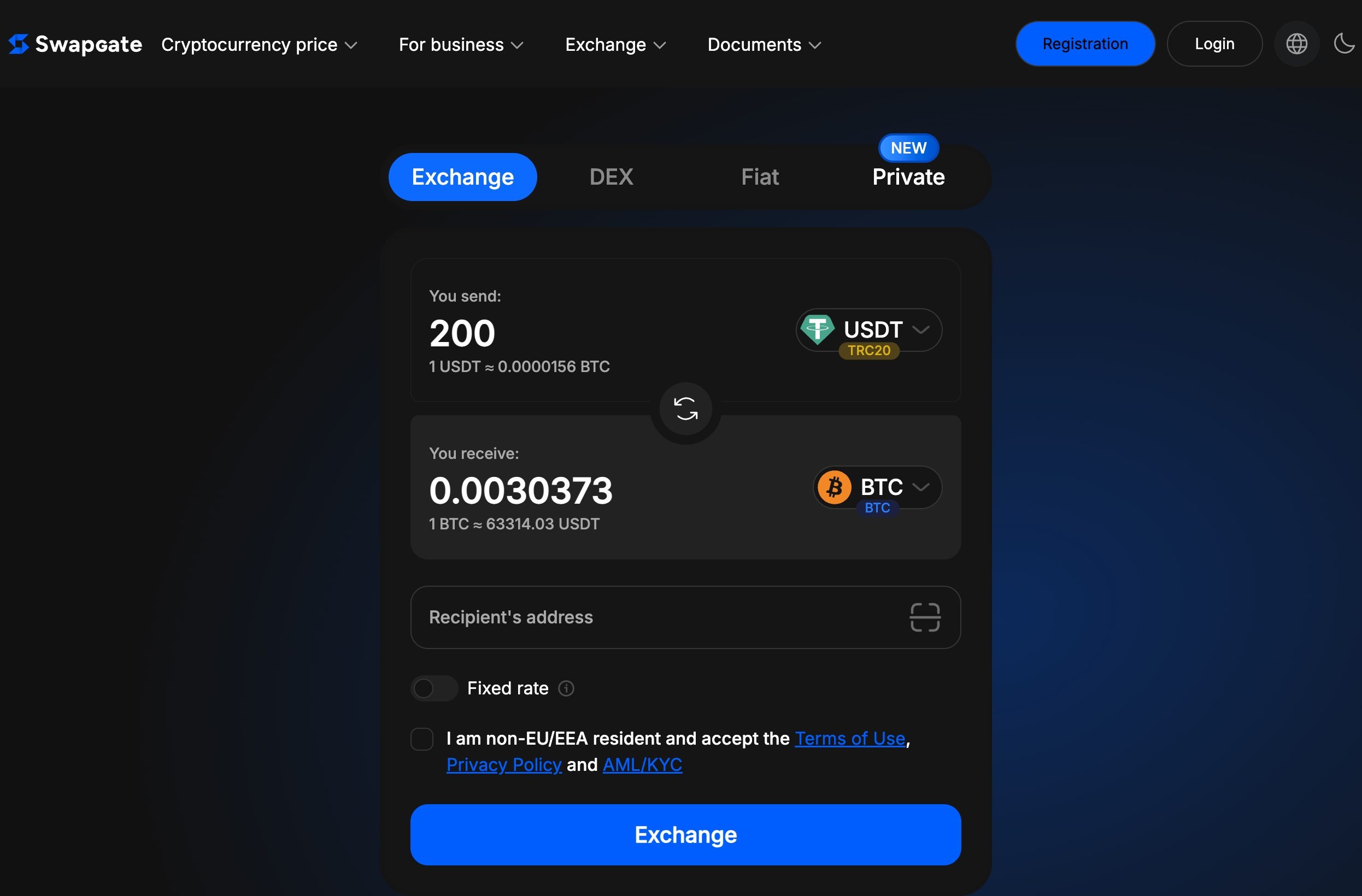
Two broad paths here: centralized exchanges that require identity verification, or no-KYC swap services that convert one crypto directly into another without an account. Which one fits depends mostly on whether you’re buying with fiat for the first time or already hold crypto and just want to move between assets.
Swapgate is a decent example of that second category, an instant swap platform that’s been running since 2022, covering more than 50 cryptocurrencies including Bitcoin, Ethereum, and a long list of altcoins. No account is required to swap.
Once you’re holding something, a no-KYC swap becomes a genuinely quick way to move between assets like BTC, ETH, or USDT without re-verifying your identity every single time.
Whichever route you take, and this loops right back to the liquidity theme, pay attention to the liquidity behind whatever pair you’re trading, whether that’s on a centralized exchange, a swap service, or a DEX pool directly. Thin liquidity on the receiving end of a swap means a worse effective rate even if the quoted number looked fine, and it’s worth checking before you commit rather than after.
Frequently Asked Questions
Is Bitcoin a liquid asset?
Yes, Bitcoin is one of the most liquid assets in crypto, trading billions of dollars daily across hundreds of exchanges.
That deep liquidity means even large trades typically cause only minor price impact compared to smaller altcoins. Bitcoin’s liquidity has also grown alongside institutional adoption, spot ETFs, and integration into traditional brokerage platforms, which has only deepened the pool of buyers and sellers available at any given time.
What is a liquidity provider in crypto?
A liquidity provider, or LP, is someone who deposits crypto into a liquidity pool so others can trade against it, earning a share of trading fees in return.
LPs typically deposit an equal value of two tokens into a pool on a platform like Uniswap or Curve and receive LP tokens representing their share. The main risk they take on is impermanent loss, where a large price shift between the two deposited assets can leave them worse off than if they’d simply held the tokens instead.
What is exit liquidity in crypto?
Exit liquidity is the buy-side demand that lets an existing holder sell their position, often used to describe late buyers who unknowingly fund an early holder’s profitable exit.
The term shows up most often around pump-and-dump schemes and rug pulls, where insiders sell into demand created by retail buyers who bought in near the top. Low liquidity makes this dynamic worse, since it takes less capital for early holders or developers to both pump a price up and then drain value out of a thin market.
How do you know if a crypto token has low liquidity?
Compare the token’s liquidity pool size to its market cap; a ratio below roughly 10% is generally considered a warning sign.
Block explorer and analytics tools can show you a token’s pool depth, whether the liquidity is locked, and how concentrated the holder base is, all in one place. A token with an unusually small pool relative to its market cap, unlocked liquidity, or a handful of wallets holding most of the supply carries meaningfully higher risk of a rug pull or extreme volatility.
What causes low liquidity in crypto markets?
Low liquidity usually comes from limited trading interest, a small or new token with few holders, or thin liquidity pools that haven’t attracted much capital yet.
Newly launched tokens are especially prone to this, since they haven’t built up the trading history or holder base that deeper, more established assets have. Market-wide events can also temporarily thin out liquidity even for established assets, as market makers pull back and widen spreads during periods of high volatility or uncertainty.
Can liquidity pools be hacked?
Yes, liquidity pools can be exploited through smart contract vulnerabilities, and this remains one of the biggest risks in DeFi.
Attackers have used flash loans, price oracle manipulation, and code bugs to drain pools worth millions of dollars, with DeFi exploits collectively costing hundreds of millions of dollars in 2026 alone. Sticking to pools on well-established, audited protocols with a long track record meaningfully reduces this risk, though it never eliminates it completely.
Disclaimer: The material in this article is not financial or investment advice. Everything stated here reflects the author's personal view and should not be treated as a recommendation to trade or invest. We make no warranties regarding the accuracy, reliability or completeness of the information presented. Cryptocurrency markets are highly volatile and can move unpredictably. Before committing any funds, every investor, trader or crypto user should study several independent sources and check the regulations that apply in their own jurisdiction.