
If you are asking what is Kishu coin, the short answer is this: Kishu Inu is an Ethereum-based meme token launched in April 2021 with a built-in 2% holder redistribution system that sends “instant rewards” to eligible wallets whenever on-chain transactions happen. The project’s original pitch was to go beyond a joke coin by adding NFTs, a swap interface, portfolio tracking, and later a gaming/metaverse layer. In 2026, that original vision still defines the brand, but the market now treats Kishu Inu crypto as a micro-cap community token with legacy ecosystem ambitions rather than a top-tier meme asset.
The Origins of Kishu Inu
Launched in the “Meme Summer” of 2021: A Brief History
Kishu Inu launched on Ethereum on April 17, 2021, right in the middle of the meme-coin explosion that pushed dog-themed tokens into mainstream crypto culture. Its whitepaper says the project was created to be a decentralized meme token “with true purpose,” and the current official site still describes KISHU as a community-focused ERC-20 token with active-user rewards.
The Vision: Bringing Modern Utility to the Meme Coin Space
From day one, the team tried to frame Kishu coin as more than a mascot token. The whitepaper and current site both highlight the same utility stack: participation rewards, NFTs, a DEX layer, and wallet tracking. That is what made early supporters talk about Kishu Inu coin and Kishu token as a “meme-plus-utility” play rather than just a viral punt.
Kishu vs. Shiba Inu vs. Dogecoin: Identifying the Core Differences
The big structural difference is simple. Dogecoin runs on its own proof-of-work blockchain and does not use token-burn or reflection marketing mechanics. Shiba Inu is an ERC-20 token on Ethereum with a large ecosystem, but it does not have KISHU’s built-in 2% holder redistribution tax. KISHU is also an ERC-20 token, but it adds that static-reflection layer directly into its tokenomics and leans much harder on “instant rewards” as its core identity.
| Token | Blockchain | Redistribution | NFT Ecosystem | Transaction Fee |
| Kishu Inu | Ethereum (ERC-20) | Yes, 2% holder redistribution | Yes | Ethereum gas + token tax/slippage |
| Dogecoin | Native Dogecoin chain | No | No native NFT ecosystem focus | Native network fee only |
| Shiba Inu | Ethereum / Shibarium ecosystem | No built-in static reflection on SHIB | Yes | Ethereum or Shibarium network fee |
Market Performance and Price Analysis: 2026 Outlook
Historical Price Action
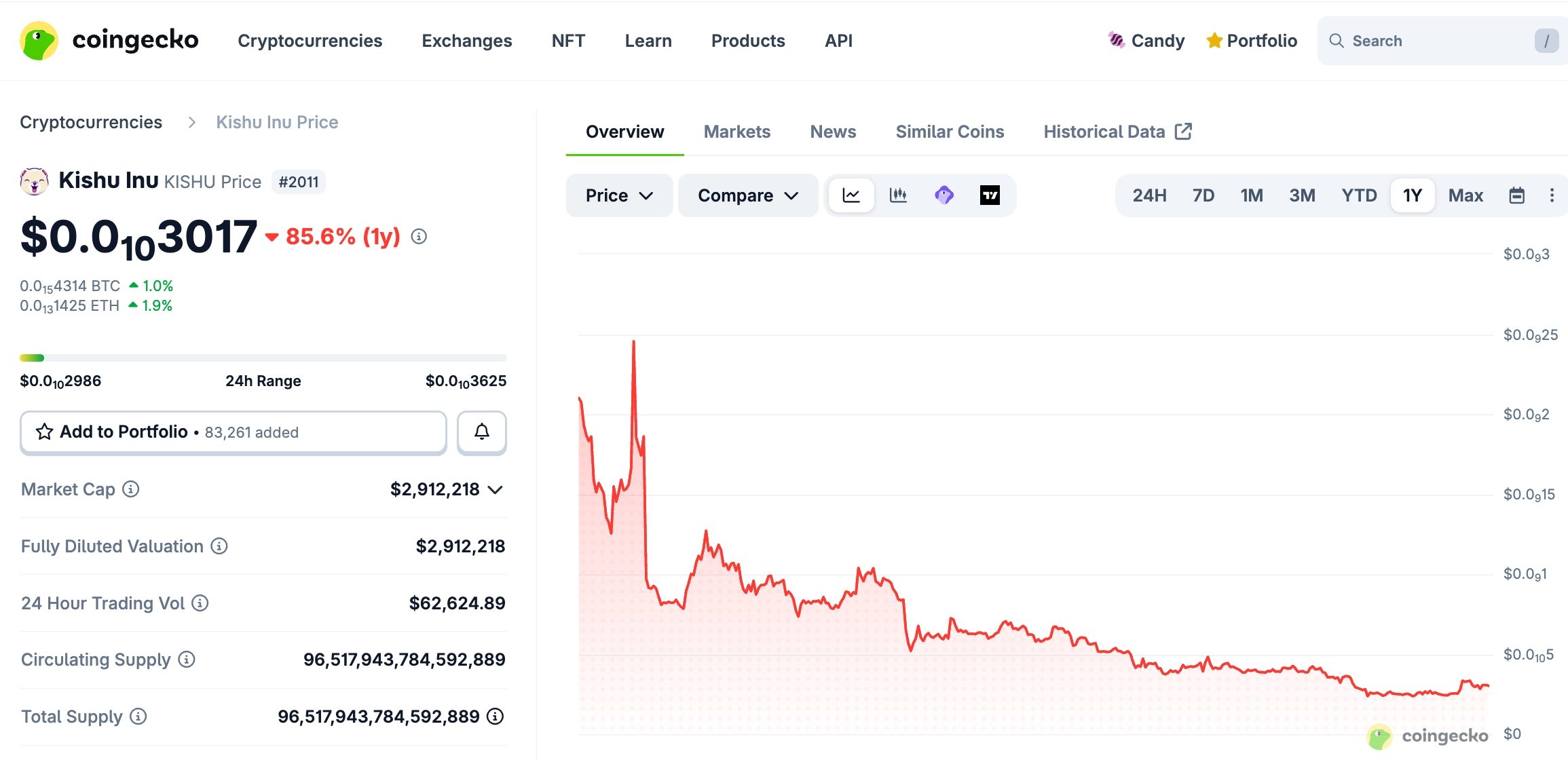
Source: Coingecko
The market history tells a blunt story. CoinGecko shows the all-time high at about $0.00000001755, while today’s Kishu Inu price sits around $0.000000000030, leaving the token roughly 99.8% below peak. Kraken’s historical table also shows that even the 2024 rebound period remained tiny compared with the 2021 mania, which tells you how hard it has been for Kishu Inu coin to reclaim relevance outside meme-season bursts.
Can KISHU Reach $0.00001? The Math of Market Cap and Supply
This is where supply matters. With about 93.13 quadrillion KISHU circulating, a price of $0.00001 would imply a market cap of roughly $931 billion. On a full 100 quadrillion supply basis, it would be about $1 trillion. That does not make it mathematically impossible, but it makes it wildly demanding for a token currently valued around $2.8 million to $2.9 million. Any serious analysis of Kishu Inu price has to acknowledge that the path to $0.00001 is not just “go viral again”; it would require a transformation in scale that is many orders of magnitude above where the market values KISHU today.
The Impact of “Meme Seasons” on KISHU Volatility
Because KISHU is now a micro-cap, volatility can be violent in both directions. CoinGecko shows 24-hour volume around $62,760, while CoinMarketCap shows roughly $145,510, which is enough to keep the token liquid but nowhere near the depth of major meme coins. That is why Kishu Inu crypto still moves hardest during meme seasons, when small inflows can create outsized percentage swings.
The Tokenomics of KISHU Token
The 2% Redistribution Rule: How Holders Earn Passive Income
This is the most important thing to understand about what is Kishu coin. KISHU’s whitepaper and official site both state that for every active user transaction, a 2% Kishu Inu token reward is redistributed to holders’ decentralized wallets. In plain English, part of each transfer is carved out and spread across eligible holders automatically. That is why many users ask, “Why is my KISHU balance increasing?” The answer is that the token contract is designed to reflect a slice of each transaction back to holders without requiring manual claiming.
Technically, this works like a static-reflection model. The more of the supply your wallet represents, the bigger your share of that 2% stream. If daily trading activity rises, the reward pool rises too; if activity falls, the passive income falls with it. Kishu’s current site is also very clear that these rewards are automatic for DEX wallets, while CEX support depends on each exchange’s own implementation. That distinction matters because people holding on an exchange may not always receive reflections the same way as self-custody wallets.
Burning the Supply: Analyzing the Long-Term Deflationary Strategy
Kishu’s supply story is not a classic “auto-burn on every transaction” design. The project’s site says the burn wallet was made one of the biggest holders through buybacks and manual burns of founder tokens. Because the reward system distributes more tokens to larger holders, that burn wallet also receives reflections over time. In effect, part of the 2% mechanism can end up intensifying long-term token removal because reflections sent to the burn address are no longer liquid.
The whitepaper lists a max supply of 100 quadrillion tokens, while CoinMarketCap currently shows about 93.13 quadrillion in circulating supply out of that 100 quadrillion maximum. So KISHU is still an ultra-high-supply asset even after burns, which is why any serious discussion of future price targets has to start with market-cap math, not just community hype.
Transaction Fees and Liquidity
In practice, trading Kishu crypto means dealing with both Ethereum gas and KISHU’s own fee behavior. The official site tells users to expect around 4% to 7% slippage, and the whitepaper describes the token as an ERC-20 with a 2% reward mechanism. The official homepage also says LP tokens were burned, and the project points to audits from TechRate and CertiK; CertiK’s live project page still shows one audit on file from August 2021.
The Kishu Ecosystem: Beyond the Meme
Kishu Swap: The Decentralized Exchange (DEX) for Meme Assets
Kishu’s whitepaper describes Kishu Swap as a Uniswap-powered DEX where users can swap ERC-20 tokens, and CoinMarketCap still summarizes it the same way today. That is important because Kishu did not try to build an entirely separate exchange engine from scratch; it used Uniswap infrastructure as the underlying trust layer. In ecosystem terms, Kishu Swap was meant to be the hub that connected the token to everything else.
Kishu Crate: The Kishu NFT Marketplace
Kishu Crate was pitched as the project’s NFT marketplace, where users could stake KISHU to access NFT affiliate programs, rewards and community-created collectibles. The whitepaper frames it as a community contest and reward system, and Kishu’s Medium updates later described Crate as officially launched. That matters because Kishu Inu was one of the early meme projects that tried to turn token holding into NFT participation rather than stopping at stickers and profile photos.
Kishu Paw Print: The Wallet Tracker
Paw Print was designed as a portfolio tracker for rewards, balances, USD value, and token stats over time. In the original whitepaper, it is presented as the visibility layer for the reflection model, which makes sense: when a token promises passive holder rewards, users want proof their wallet balance is rising. That product idea helped Kishu explain its redistribution mechanic better than many other 2021-era reflection coins.
The Kishuverse: Entering the Metaverse
Kishu Kingdom: The Play-to-Earn (P2E) Strategy and Rewards
The most ambitious part of the brand was always the gaming layer. Kishu’s Medium posts described Kishu Kingdom as a play-to-earn trading-card game tied to NFT utility, beta tournaments, and community events. The concept was that Kishuverse NFTs and Kishu Kingdom avatars would move beyond art into game assets and P2E rewards. That is a much more ambitious claim than “we have NFTs,” because it aims for a loop where token, game, and collectibles reinforce each other.
In 2026, though, the honest view is more cautious. The official site now warns that community-led ecosystem projects may change, lose developer support, or be discontinued. So the right way to read Kishu Kingdom today is as part of Kishu’s long-running metaverse and gaming thesis, not as proof of a mature live gaming economy.
Virtual Real Estate: Owning a Piece of the Kishuverse
Most crypto metaverses talk loudly about Metaverse land, but Kishu’s clearest on-chain footprint is actually its NFT collection. OpenSea still lists the official Kishuverse collection as 8,888 NFTs created in November 2021, which suggests the ecosystem’s visible metaverse layer is still more NFT-first than land-first. So when people imagine “owning a piece of the Kishuverse,” the strongest evidence today is collectible NFT ownership and associated community utility, not a large, active virtual real-estate market.
Interactive Community Events
Kishu has always been more community-governed in culture than formally governed on-chain. The whitepaper describes it as ownerless and community-driven, and the current site repeatedly attributes ecosystem projects to community volunteers. That means governance in practice has been social coordination: Telegram, X, Discord, AMAs, streams, contests, and community launches rather than a hardcoded DAO voting machine.
Where to Buy and Exchange Kishu Inu (KISHU) Safely
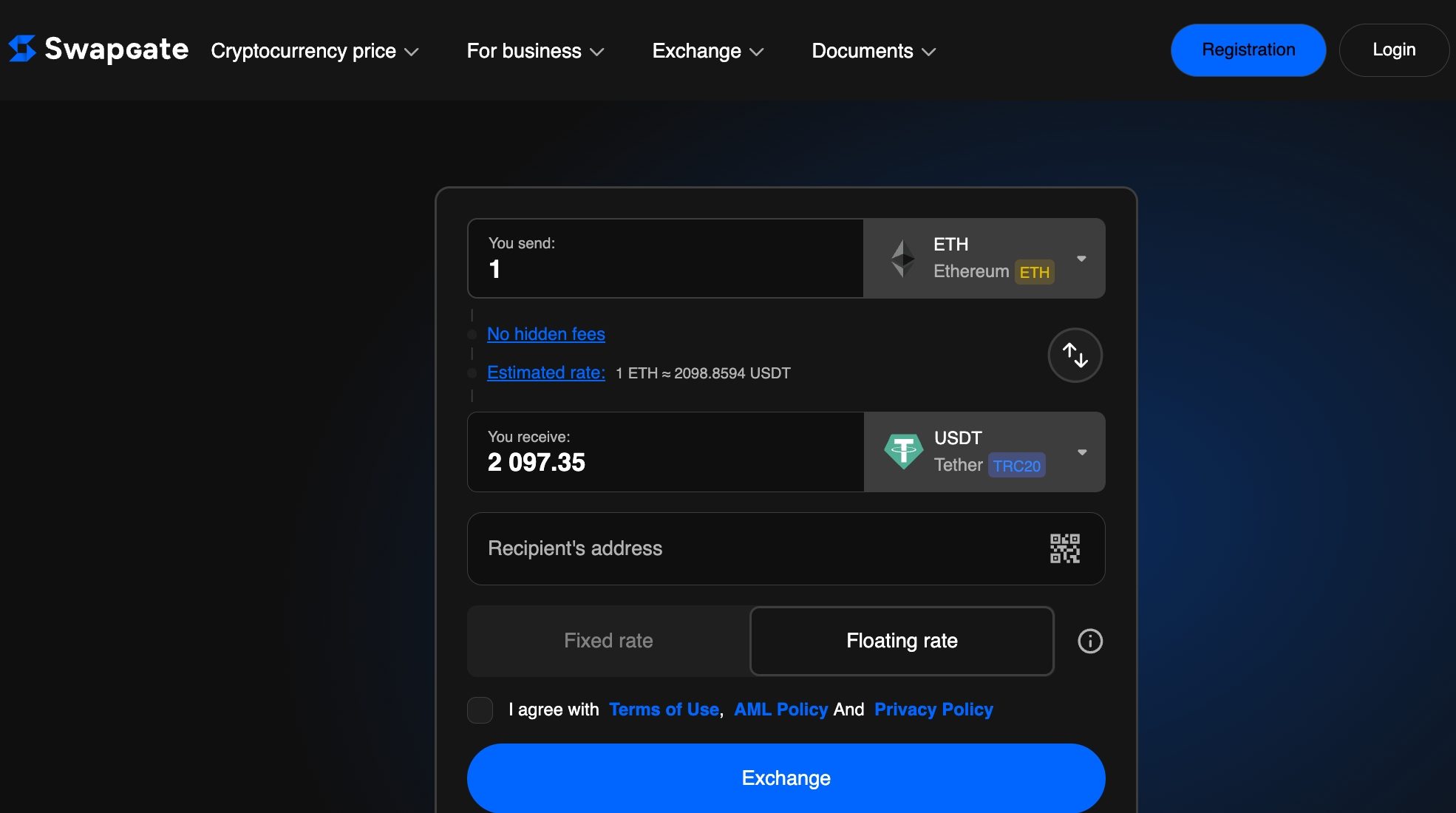
If you want to use an exchange service like Swapgate to exchange ETH to USDT, treat it like any other instant service: first verify that KISHU is currently supported, confirm you are using the Ethereum network, and double-check the official KISHU contract address before sending funds.
The Power of the “Kishu Army”
From Times Square to Dubai Billboards
Kishu’s rise was never just organic chart action. The project became known for aggressive, community-fueled marketing, including Times Square promotion and later Dubai publicity tied to Ronaldinho and the Burj Khalifa fountain show. Those campaigns helped turn Kishu Inu into a recognizable name during the 2021 meme boom, even if that visibility did not translate into lasting large-cap status.
Social Media Dominance: Tracking Growth
Even in 2026, Kishu is not invisible. CertiK’s live page shows roughly 511,000 X followers, while CoinMarketCap still lists about 273,580 holders. The project’s X account also remained active in early 2026, which suggests the community layer is still alive even if the token’s market cap has shrunk dramatically from its peak era.
Influencer Collaborations: How KISHU Maintains Viral Momentum
One reason Kishu crypto held attention longer than many copycat meme tokens is that it kept leaning into visibility plays. The Ronaldinho-linked Dubai campaign is the clearest example: it blended celebrity recognition, meme branding, and spectacle marketing. That does not guarantee long-term value, but it does explain why the Kishu Inu token still has name recognition disproportionate to its current market cap.
FAQ: Questions About Kishu Inu Coin
What is Kishu Inu?
Kishu Inu is an Ethereum-based meme token launched in 2021 that uses a 2% static-reflection model to reward holders automatically. Its brand grew around “instant rewards,” NFTs, swap tools, and community-led ecosystem ideas such as Kishuverse, making it more than a pure joke token.
Is Kishu Inu a “Dead Coin” in 2026?
No, not literally. KISHU still trades on live markets, still has daily volume, still shows hundreds of thousands of holders, and its official channels are still active. But it is no longer a frontline meme giant; it is a speculative micro-cap with an aging brand, a loyal community, and ecosystem promises that investors should treat carefully.
What is the 2% redistribution and how do I receive it?
It is the token’s built-in reflection mechanic. Each eligible on-chain transaction routes 2% of the value back to holders, and the official site says DEX wallets receive those rewards automatically with no claim step required. Some centralized exchanges may support rewards differently, so self-custody is the clearest way to participate.
Does Kishu Inu have a maximum supply?
Yes. Kishu’s whitepaper sets the maximum supply at 100 quadrillion tokens, and CoinMarketCap continues to list that same max-supply figure today. Current circulating supply is far below the maximum on paper, but still enormous in absolute terms, which is why price targets must be judged against market-cap math.
How does Kishuverse differ from other crypto metaverses?
Kishuverse has always been more NFT-first and community-first than land-first. The clearest live evidence is the official 8,888-NFT collection and the old Kishu Kingdom gaming vision, not a giant operating virtual world with deep land-economy mechanics. In other words, it is smaller, more brand-driven, and more experimental than the big metaverse narratives of the last cycle.