
Swapgate has expanded its exchange options by integrating HoudiniSwap’s private swap functionality. This addition gives users access to a privacy-focused routing method alongside standard and DEX routes.
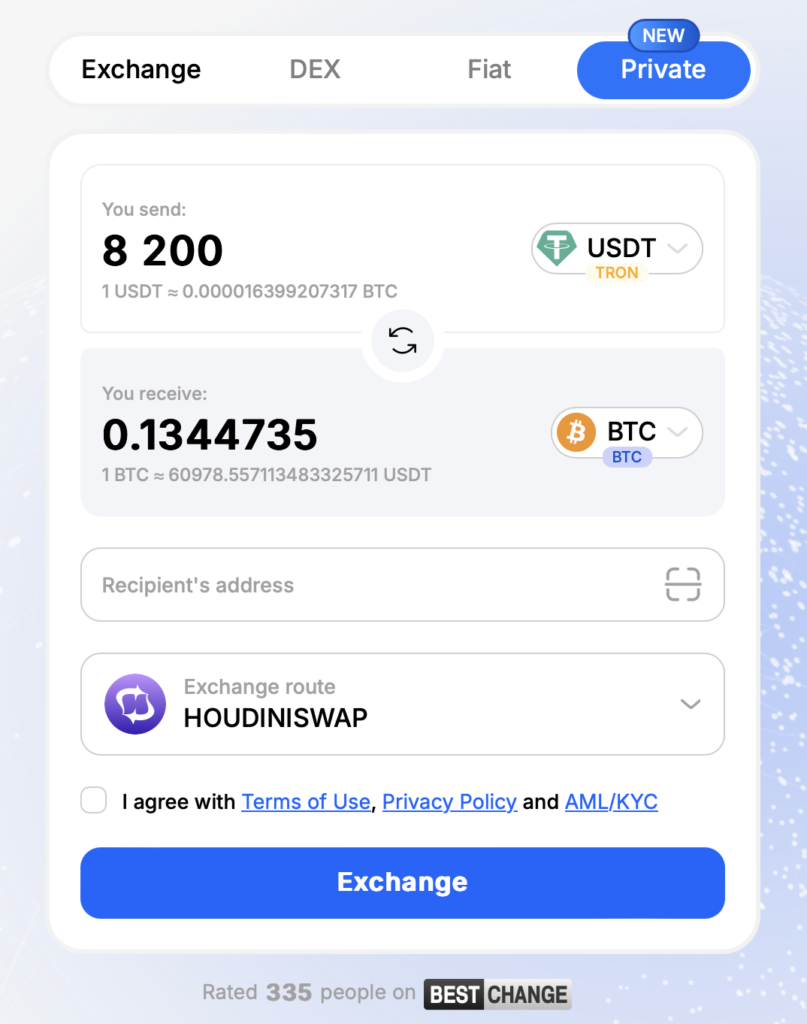
The new Private tab appears directly in the interface, allowing seamless selection of private routing for supported pairs.
What Private Swaps Deliver
A private swap breaks the direct on-chain connection between the sending wallet and the final recipient address. Instead of a single visible path, the transaction routes through two independent non-custodial exchanges with a temporary intermediary token acting as a buffer. This structure ensures the original sender and ultimate receiver do not appear linked in any single transaction or traceable sequence.
HoudiniSwap operates as a non-custodial aggregator. It never takes custody of user funds and relies on vetted exchange partners for execution. Users interact only by sending assets to a one-time deposit address and specifying the recipient wallet — no wallet connection, signatures, or account creation required on the Swapgate side.
How to Use Private Swaps on Swapgate
The process follows the familiar Swapgate flow but selects the private route:
- Open Swapgate and navigate to the Private tab.
- Enter the amount and select the asset you send, for example, USDT on TRON.
- Choose the asset you want to receive, for example, BTC.
- Paste the recipient’s address in the dedicated field.
- Review the displayed rate, which comes from HoudiniSwap’s routing across available liquidity.
- Confirm the exchange route shows HOUDINISWAP.
- Agree to the terms and click Exchange.
- Send the exact amount from your wallet to the provided deposit address.
The transaction completes in the background through the two-leg process. Users can track status in real time on the platform.
Advantages of Private Swaps for Users
Private swaps offer several practical benefits compared with standard on-chain or single-hop routes:
- Stronger privacy protection — The dual-exchange structure with intermediary token removes the simple sender-receiver link that on-chain analysis tools often exploit.
- No wallet connection required — Users avoid exposing balances or signing messages beyond the initial deposit transaction.
- Non-custodial execution — Funds move directly between exchanges and the recipient; neither Swapgate nor HoudiniSwap holds assets at any point.
- Compliant privacy design — Partner exchanges apply risk-based checks while the overall flow remains non-custodial and does not require user KYC or accounts.
- Access to broad liquidity — HoudiniSwap aggregates routes across 100+ chains, helping maintain competitive rates even in the private mode.
- Suitable for sensitive transfers — Useful for treasury movements, business payments, or any situation where users prefer to limit on-chain visibility of their holdings.
Private swaps work for both same-chain and cross-chain pairs, making them versatile within Swapgate’s supported assets.
Private Swaps Compared with Other Routes on Swapgate
Standard Exchange and DEX routes typically create a more direct or visible path between sender and receiver.
A private swap adds the extra layer of separation at the cost of slightly longer processing time, usually 5–50 minutes depending on network conditions and liquidity checks.
It is not intended for high-frequency trading or very small amounts where the privacy benefit may not justify the extra steps. For most users seeking better confidentiality without extra complexity, the private option sits cleanly alongside the existing tabs.
HoudiniSwap’s approach has been tested with significant volume and maintains an emphasis on automated best-route selection while preserving the privacy properties described above.
FAQ
How much slower are private swaps than regular ones?
Private swaps involve two separate exchange legs and an intermediary step, so they generally take longer than single-hop routes. Most complete within 5–50 minutes, though exact timing depends on network congestion and liquidity at the moment of execution.
Do private swaps cost more in fees?
Rates remain competitive because HoudiniSwap routes across multiple sources. Any difference comes mainly from the extra steps rather than hidden markups. Users see the final amount before confirming, with no additional platform fees from Swapgate for choosing the private route.
Can someone still trace the transaction if they try hard enough?
The design intentionally creates an infinite anonymity set by routing through unrelated exchanges and a temporary buffer token across many chains. Each leg appears as an ordinary transaction. While no system offers absolute guarantees against determined analysis, the structure significantly increases the difficulty compared with direct sender-receiver paths.
What happens if the transaction fails or gets stuck?
Swapgate and HoudiniSwap provide transaction tracking. In case of issues, users can contact support through the platform. Because the service remains non-custodial, funds stay under user control until the final delivery step completes.
Which pairs support private swaps right now?
Availability depends on current liquidity through HoudiniSwap’s partners. Popular pairs such as USDT on various networks to BTC and many cross-chain combinations are already live, with more added as routing expands.
Disclaimer: The material in this article is not financial or investment advice. Everything stated here reflects the author's personal view and should not be treated as a recommendation to trade or invest. We make no warranties regarding the accuracy, reliability or completeness of the information presented. Cryptocurrency markets are highly volatile and can move unpredictably. Before committing any funds, every investor, trader or crypto user should study several independent sources and check the regulations that apply in their own jurisdiction.